After presenting his second Economic Survey, Chief Economic Advisor Krishnamurthy Subramanian spoke with Dilasha Seth and Arup Roychoudhury about the projections in the Budget, the need for enhancing credit in the system, and how the time had come to choose between fiscal prudence and growth. Edited excerpts:
In the Economic Survey, you have pitched for relaxation of the fiscal deficit target for FY20 to revive growth. What should be the magnitude? Is there an upper limit?
There is always a balancing act between fiscal prudence and spurring growth. In times like these, it is better to lean on growth. And that’s the directional sense that we have given. I’ll leave it at that. The actual magnitude, of course, depends on a lot of different factors. There is no getting away from the fact that you don't have a benign choice; everything you know you have to make trade-offs and in the trade-off between fiscal prudence and spurring growth in times like these, it is important to actually focus on growth because when your growth increases, your revenues also increase and then, as a result, the fiscal situation also comes under control. But if you actually end up at this point in time just focusing on fiscal discipline without necessarily worrying about growth, then you may neither get growth nor will you get fiscal prudence in subsequent years.
You have proposed the China model to achieve growth by integrating assembling in India with Make in India. Do you think India will be able to compete with China in that?
While the Chinese have specialised in the labour-intensive sectors, we have basically been as good as China in terms of diversifying across product categories. So in other words, pick a few sectors and just invest intensively in those and develop specialisation, instead of carpet-bombing across many different product categories which is diversification. So it’s clear that the difference in the Chinese performance vis-à-vis India's is primarily because of specialisation or the lack of it. Besides, trade tensions have been happening between the US and China, as well.
While there is some traction on the deal, it remains that whatever tariffs have been imposed, those will continue. But a larger point is that many countries like Japan, South Korea, Singapore, and Indonesia are now on a declining trend in terms of the benefits that they can derive from exports. In contrast, India is actually now in a situation where we can still increase and that is why there is an opportunity clearly for us to be able to utilise the window.
But what is really crucial is that we should be focused on saying these are the six network sectors where overall trade worldwide stands at close to $8 trillion. And by getting a share of that, not only India achieves the $5-trillion economy goal but also creates 40 million well-paying jobs by 2025 and 80 million by 2030. This is primarily by assembling in India, where we enable import of components, assemble them here using the labour force and export them, and that's a clear-headed strategy that we've actually provided.
How confident are you of achieving 6-6.5 per cent growth?
There have been a number of steps taken by the government. There are some encouraging signs. Also, if you look at a business cycle with its peaks and troughs, I think we have reached a trough, and there should be an uptick in growth. That is what we are budgeting. Notice that we have not said 7 per cent-plus, we are keeping it at 6-6.5.
You spoke about bank credit being subscale given the scale of the economy. How big a concern is that and how do we boost credit, without having another NPA issue?
That’s why we’ve actually talked about the use of technology. Artificial intelligence and machine learning is an area that I genuinely believe in, and that is why we suggest it to the public sector banking network, so that it has the ability to generate all the data, and actually use that to generate insights. If you take for instance some of the corporate defaults, there were many indicators, whether it’s financial statement quality or the nature of transactions. All these can actually be flagged by using data analytics. Trust me, this is something with a significant potential to be able to enter even for something as simple as geotagging of collateral. The opportunity to extract patterns actually is enormous.

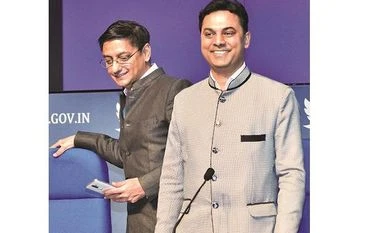 "In times like these, it is better to lean on growth: CEA K V Subramanian")












 Connect with us on WhatsApp