India is back on the diplomatic table pushing oil producing countries to raise production in a bid to cool down runaway oil prices. Brent crude oil prices traded above $90 a barrel, on Thursday, for the first time since 2014. Brent is the most popular marker for crude oil trade. It is used as a benchmark for two-thirds of the world's internationally traded crude oil.
The high prices mean pressure on oil marketing companies to raise domestic auto fuel prices, a move that has been kept in abeyance in light of looming assembly elections in five states.
Earlier this week, Petroleum Minister Hardeep Puri had a telecall with the Sultan Al Jaber, the Managing Director and Group Chief Executive Officer (CEO) of the Abu Dhabi National Oil Company (ADNOC), the national oil company of oil rich United Arab Emirates (UAE). In a tweet, Puri said that that the two deliberated on various issues relating to the bilateral energy partnership. He also condemned the terror attack on the UAE in which two Indian’s had lost their lives.
Officials in the know said these calls are among the measures that India is taking to nudge crude oil producing countries to raise output and lower prices. The 25th OPEC and non-OPEC Ministerial meeting of the Organisation of Petroleum Exporting Countries (OPEC) is scheduled for Wednesday next week (February 2, 2022). It is expected that this meeting will result in a decision on whether oil producing countries will hike output or not. Since OPEC operates as an international cartel, the oil producers mutually decided to lower global output, resulting in higher prices to their benefit.
These developments push up the Indian Basket of Crude oil, an estimate of the average price at which domestic refiners buy crude oil, to $ 88.23 a barrel on Wednesday.
But prices of petrol and diesel sold by IndianOil (IOCL), Hindustan Petroleum Corporation (HPCL), and Bharat Petroleum Corporation (BPCL), the three public sector undertaking (PSU) oil companies, have remained unchanged from November 4, 2021. The Indian Basket of Crude oil had averaged at $ 80.64 a barrel during November 2021.
“We are currently making losses on product sales,” an official at one of the three PSU OMC’s told Business Standard. “The impact of $ 90 a barrel crude oil will be more pronounced in 15 days,” he added.
But this period will coincide with ongoing assembly elections and the companies are expected to continue bearing losses on fuel sales with the centre dissuading them from politically unpopular moves such as hiking petrol and diesel prices.
Higher crude oil price also means more expensive Liquefied Petroleum Gas (LPG) or cooking gas. Price of domestic LPG cylinders have also remained unchanged since October 6, 2021.
“The OMCs did not cut petrol and diesel prices when crude oil prices had fallen in December 2021 (Indian Basket averaged at $ 73.30 a barrel during the month). The understanding was that any losses that OMCs made on domestic LPG will be made good by higher margins on petrol and diesel. But with crude oil prices rising and elections around the corner, loses are bound to widen,” the official said.
This sentiment is being echoed in the share market as well. Shares of the PSU OMCs are down from a week ago levels (January 20, 2022). The IOCL scrip is down 2.35 per cent to Rs 122.60 a share, HPCL is down 5.17 per cent to Rs 309.10 a share, and BPCL is down 3.51 per cent to Rs 382.40 a share on the BSE.

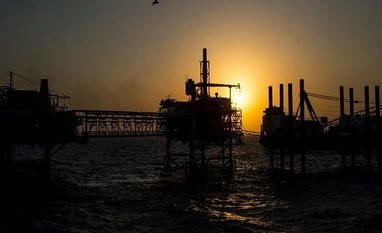 "India dials oil producers to raise output as Brent tops $90 a barrel")












