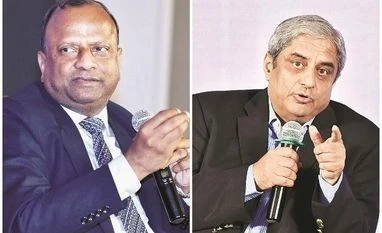
There is no cause for despair about the Indian economy though it is going through a phase of slowdown, said two top-most bankers of the country in a fireside chat at the Business Standard Annual Banking Forum last Friday.
Companies have started enquiring about fresh loans, and there are signs that economic recovery is taking shape, according to Rajnish Kumar, chairman of country’s largest, public-sector bank, State Bank of India (SBI), and Aditya Puri, managing director of the largest private-sector bank, HDFC Bank. “Demand slowdown is a reality. But the fact is also that in October and November, everybody says that we are better off than in August. Based on our conversations with businessmen, industrialists, and manufacturers — where we get the first insights — it seems that we are on a recovery path,” said Kumar.
“In the last 10 days, we were having conversation on many other projects and these conversations were missing in the past three-four months. Nobody was coming to us for loans at that time... they have started coming now,” said Kumar.
But the growth won’t be a lift-off. It will be uneven and gradual.
“The September numbers may not be that good, but is there scope for optimism? I think ‘yes’. But do not have unbounded optimism. There will be a recovery. Our own estimate is that from the first quarter of the calendar, we will see a gradual pick-up,” said Puri.
Credit demand is firming up and coming from roads, solar power projects, and the oil and gas sector, particularly city gas projects in the case of SBI. Demand is evident in rural and semi-urban areas, while payments system-related demand from merchants, as well as for working capital requirements of smaller and larger companies, has been strong.
“But remember, when an elephant sits down, to make it stand up again it takes a little bit time,” said Puri. In the case of non-performing assets, “the worst is probably over,” according to Puri. An important aspect here is the recent ruling of the Supreme Court (SC) on the Essar Steel case, in which the rights of financial creditors and operations creditors have been settled for good.
“I hope and I am presuming that they (the SC) have settled the debate around the entire Insolvency and Bankruptcy Code,” said Kumar. “With clarity coming on all issues, the resolution process would be faster,” said Kumar.
As far as the systemic risk caused by the failure of non-banking financial companies (NBFCs) is concerned, that is unlikely to happen.
“I believe there is no systemic risk in the Indian banking system,” said Puri.
“Is the Indian banking system safe, secure and fine? I think so. Everyone, including the Reserve Bank of India, has said banks have not been allowed to fail. Either they will get capital or they will be merged,” said Puri.
NBFCs did cause losses to banks, but Kumar defended the lending, saying the banks lent to them, seeing their ‘AAA’ ratings, and the financial numbers also matched the risk appetite and modelling of the banks.
According to Kumar, being the largest bank in the system and being owned by the government, SBI cannot shy away from giving loans. But not everyone would be creditworthy.
“Whoever deserves credit, credit is available,” the SBI chairman said.
Even as SBI has burnt its fingers in project finance, it cannot afford not to give such loans.
“All the institutions that were doing long-term lending are closed now. We have burnt our fingers in project finance, but in return this country has got something,” Kumar said.
For example, between 2008 and 2016, a power capacity of 100,000 megawatt was added, which is about 35 per cent of the addition in the country in the past 65 years. The same goes for airports, roads, and highways.
“We are more advanced than Europe in this respect (Unified Payments Interface, or UPI) ... They tried to implement open banking in Europe, but we have in a way already implemented through UPI,” said Kumar.
Bank branches are here to stay, and so will the human touch, according to the bankers. “You started with brick and click. Brick is here, click is here, Amazon is also here. And Amazon is also going to brick,” said Puri.
SBI is in the process of opening 600 branches in the next seven to eight months.
Puri said his bank had as large a presence in rural and semi-urban areas as SBI did.
The SBI chief defended his bank’s stance in lowering the savings rate to 3 per cent.
“Savings bank looks like a cheap product, but it’s actually the most expensive product from the bank’s perspective. It is a transaction account. It should not be seen from a returns perspective. All my branch network, all my automated teller machine network, 250,000 people, payment system, cybersecurity… it is a huge cost associated with managing the savings account. If you come and keep a fixed deposit at 6.5 per cent, and you keep a savings bank deposit at 3 per cent, to me in terms of cost, they are the same.”

 "Indian economy is firming up, banking system safe: SBI, HDFC Bank chiefs")












