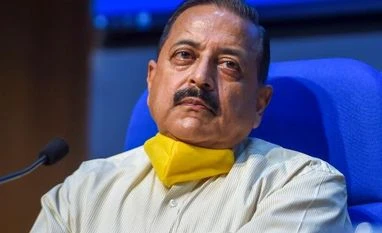
Mapping groundwater sources to aid in using it for drinking: Jitendra Singh
Union Science and Technology Minister Jitendra Singh said on Monday CSIR is using the latest technology to map sources of groundwater in arid regions that will help use it for drinking
Press Trust of India New Delhi Union Science and Technology Minister Jitendra Singh said on Monday the Council of Scientific and Industrial Research (CSIR) is using the latest technology to map sources of groundwater in arid regions that will help use it for drinking.
This, in turn, will supplement the Jal Jeevan Mission, an ambitious programme of the Narendra Modi government aimed at providing piped potable water to all rural households, he said.
Singh said the CSIR, along with National Geophysical Research Institute (NGRI), have undertaken high-resolution aquifer mapping and management in arid regions of northwestern India to augment groundwater resources.
The Heli-borne geophysical mapping technique of CSIR-NGRI provides a high-resolution 3D image of the subsurface up to a depth of 500 metres below the ground.
At a meeting of the CSIR attended by K VijayRaghavan, the principal scientific advisor, Shekhar Mande the Director General of CSIR and other chief scientists, Singh said the Ministry of Jal Shakti has entrusted CSIR-NGRI with the responsibility of mapping groundwater sources in arid regions.
"The latest state-of-the-art technology is being employed by the CSIR for mapping groundwater sources in arid regions and which would help in using groundwater for drinking to supplement Prime Minister Narendra Modi's ambitious 'Har Ghar Nal Se Jal' scheme," Singh said.
The minister said arid areas in north-western India spread over parts of Rajasthan, Gujarat, Haryana and Punjab cover nearly 12 per cent of the total geographical area of the country and is home to more than 8 crore people.
With annual rainfall in the range of less than 100 to 400 mm, this area faces an acute shortage of water throughout the year.
High-resolution aquifer mapping and management is cost-effective, precise and is useful to map large areas (districts/states) within a short period of time. The entire work will be completed by 2025 covering over 1.5 lakh square kilometres of an area with an estimated cost of Rs 141 crore.
He said the aim of this project is to map the potential sites for groundwater withdrawal and conservation and results will be used to meet the broader objectives of aquifer mapping, rejuvenation and management of groundwater resources in the arid areas.
(Only the headline and picture of this report may have been reworked by the Business Standard staff; the rest of the content is auto-generated from a syndicated feed.)

 "Mapping groundwater sources to aid in using it for drinking: Jitendra Singh")


 Connect with us on WhatsApp