Abe secures big win in Japan snap polls amid low turnout
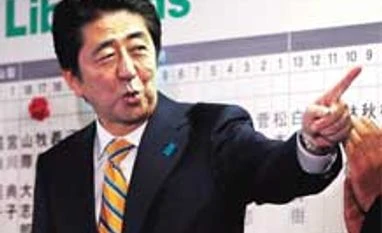
Reuters Tokyo Japanese Prime Minister Shinzo Abe's ruling coalition has secured a big election win on Sunday, but feeble turnout could weaken his claim of a mandate for policies including reflationary steps to revive the economy.
Most media exit polls showed Abe's Liberal Democratic Party and its junior partner, the Komeito party, winning more than 317 seats in the 475-member lower house, enough to maintain its "super-majority" that smoothes parliamentary business.
But many voters, doubtful both of the premier's "Abenomics" strategy to end deflation and generate growth and the opposition's ability to come up with a better plan, stayed at home, putting turnout on track for a record low, interim figures showed. Turnout had already hit a post-war record low of 59.3 per cent in the 2012 poll that returned Abe to power for a rare second term on pledges to reboot an economy plagued by deflation and an ageing, shrinking population.
Hopes for Abe's "Three Arrows" of hyper-easy monetary policy, government spending and reforms such as deregulation were tarnished after the economy slipped into recession in the third quarter following an April sales tax rise. Recent data suggest any rebound is fragile.
Abe decided last month to put off a second tax hike to 10 per cent until April 2017, raising concerns about how Japan will curb its huge public debt, the worst among advanced nations.
"I worry that Japan's public finances will get even worse," said 38-year-old Tokyo voter Akihiro Fujihara.
"I wish there was a party out there that would come up with actual proposals to make Japan a better place to live."
The main opposition Democratic Party of Japan (DPJ) was unable to gain much traction, largely due to voters' memories of a 2009-2012 rule plagued by policy flip-flops, infighting and three premiers in three years.
Exit polls showed the DPJ gaining from the 62 seats it held before the vote, but falling well short of the 100 seats it had unofficially targeted.
Abe called the election in a bid to strengthen his grip on power before tackling unpopular policies such as restarting nuclear reactors taken off-line after the 2011 Fukushima disaster and a security policy shift away from post-war pacifism.
The LDP-led coalition victory could make it easier for Abe to be re-elected in a party leadership race next September, boosting the chance he stays in power through 2018 and becomes one of Japan's rare long-term leaders.
Aside from local elections in April, his coalition will probably not need to face voters until a 2016 election for the upper house, where the LDP and the Komeito party now hold a majority.
Doubts, however, persist over whether Abe will knuckle down on his "third arrow" of reforms in politically sensitive areas such as labour market deregulation that would make it easier to shift workers to growth areas but also to lay off employees, and reform of the highly protected farm sector.
Critics say progress has been limited, partly due to opposition from members of Abe's own party.
"My personal assessment is that we are likely to see more of what we've seen - piecemeal reforms moving more or less in the right direction, but at a fairly slow clip and no bold breakthroughs because of this election," Columbia University professor Gerry Curtis said before the results were in.
Some experts say Abe could also turn attention away from the economy to his conservative agenda that includes laying the groundwork to revise the post-war, pacifist constitution and recasting Japan's wartime past with a less apologetic tone.
That agenda raises hackles in China and South Korea, where bitter memories of Japan's past militarism run deep.
The LDP had 295 seats and Komeito 31 in the 480-member lower house when it was dissolved for the election. Five seats were cut through electoral reform.

 "Abe secures big win in Japan snap polls amid low turnout")


 Connect with us on WhatsApp