Parliament unanimously votes to grant Xi a new term as China's president

Lawmakers name ex-anti-graft chief Wang Qishan vice president
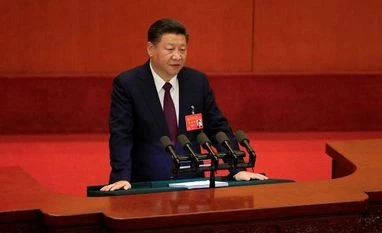
Xi Jinping
Chinese President Xi Jinping speaks during the opening of the 19th National Congress of the Communist Party of China at the Great Hall of the People in Beijing, China. Photo: Reuters.
Peter Martin, Jessica Sui & Dandan Li | Bloomberg
Last Updated : Mar 18 2018 | 12:29 AM IST
China’s parliament unanimously reappointed Xi Jinping as president while installing one of his most trusted allies as vice president, highlighting how little public opposition remains to his rule.

The rubber-stamp National People’s Congress voted 2,970-to-0 to give Xi a second five-year term Saturday, days after repealing a constitutional provision that would’ve barred him from a third. Although legislative dissent is rare -- only four lawmakers withheld support for Xi’s first term in 2013 -- no president has received a unanimous vote in at least a quarter-century.

The legislature also confirmed Wang Qishan -- a well-known economic reformer who oversaw Xi’s signature anti-corruption campaign -- as vice president. Wang’s appointment was opposed by one lawmaker, who wasn’t identified.
 
The votes cap months of Communist Party conclaves and pageantry that confirmed Xi’s status as arguably the world’s most powerful leader. Xi, 64, got his name written into the constitution and party charter -- putting him on a status equal to Mao Zedong -- and laid the groundwork for breaking the precedent of handing over power after two complete terms.

Moments after the vote, the party’s People’s Daily newspaper proclaimed Xi as China’s “great helmsman” in an alert to mobile phones. The history-laden honorific had previously been reserved for Mao, although some official media and party members have used variations of the term in recent months in reference to Xi.

“Xi will be chairman of everything,” said Ether Yin, a partner at advisory firm Trivium China in Beijing. “He has effectively put himself at the center of the whole country.”
 
While most of Xi’s power flows from his roles as party chief and supreme military commander, being president -- or “chairman” in Chinese -- gives him legal standing as head of state. The largely ceremonial role of vice president is second in succession and can carry out duties delegated by the chief executive.

Wang’s appointment to the vice presidency allows Xi to retain a trusted surrogate with connections to the U.S. diplomatic and financial communities. He helped set up China’s first investment bank with Morgan Stanley in the 1990s and also established enduring ties with prominent Wall Street figures such as Hank Paulson.
 
Wang, 69, and Xi have known each other since their days as “sent down youths” in China’s countryside during Mao’s Cultural Revolution. After Xi came to power in 2012, Wang was charged with overseeing Xi’s campaign against corruption, disciplining more than 1.5 million party cadres, including the country’s retired security chief and another official once seen as a presidential contender.

Yanmei Xie, a China policy analyst for Gavekal Dragonomics in Beijing, said appointing Wang could extend decision-making beyond the seven-member Politburo Standing Committee, the party’s top body and a key component of the collective leadership system set up after Mao’s tumultuous rule.

“Basically, it’s him minimizing collective leadership without abolishing the institution altogether,” Xie said. “Xi will be relying on a collection of personal advisers to run the country and make decisions.”

Chinese lawmakers were expected to confirm new terms for more top officials -- including Premier Li Keqiang and top military and law enforcement officials -- in votes Sunday. Several minister-level appointments were scheduled for Monday, including a replacement for retiring central bank chief Zhou Xiaochuan and the head of a new agency to regulate the country’s $43 trillion finance-and-insurance sector.
 
Beside appointing Xi, the legislature also passed a plan Saturday to create, eliminate or consolidate dozens of state agencies under a sweeping government overhaul aimed at solidifying party control. Lawmakers were also expected to confirm the leader of a powerful new law enforcement and ethics commission to police millions of public servants, party officials, academics, journalists and state company managers.

The changes leave Xi with sole responsibility for China’s $12 trillion economy, mounting debt pile, more aspirational middle class and growing overseas interests. He’s attempting to build a developed economy without loosening political control, staking the party’s legitimacy on its ability to make China rich and strong.

Xi’s new power might provide reassurance to investors who believe that bureaucratic resistance has slowed his reform agenda. Still, centralized control by one man could become a problem should his health fail or subordinates fail to question bad decisions from the top.

“Xi’s dominance has been achieved through top-down measures, such as tightened discipline and the anti-graft drive, as well as skillful politics, rather than the winning of hearts and minds,” said Tom Rafferty, the Economist Intelligence Unit’s regional manager for China “That points to a potential fragility, but we do not expect any challenge to his position to emerge in the coming years.”

One subscription. Two world-class reads.

Already subscribed? Log in

Subscribe to read the full story →
*Subscribe to Business Standard digital and get complimentary access to The New York Times

Smart Quarterly

₹900

3 Months

₹300/Month

SAVE 25%

Smart Essential

₹2,700

1 Year

₹225/Month

SAVE 46%
*Complimentary New York Times access for the 2nd year will be given after 12 months

Super Saver

₹3,900

2 Years

₹162/Month

Subscribe

Renews automatically, cancel anytime

Here’s what’s included in our digital subscription plans

Exclusive premium stories online

  • Over 30 premium stories daily, handpicked by our editors

Complimentary Access to The New York Times

  • News, Games, Cooking, Audio, Wirecutter & The Athletic

Business Standard Epaper

  • Digital replica of our daily newspaper — with options to read, save, and share

Curated Newsletters

  • Insights on markets, finance, politics, tech, and more delivered to your inbox

Market Analysis & Investment Insights

  • In-depth market analysis & insights with access to The Smart Investor

Archives

  • Repository of articles and publications dating back to 1997

Ad-free Reading

  • Uninterrupted reading experience with no advertisements

Seamless Access Across All Devices

  • Access Business Standard across devices — mobile, tablet, or PC, via web or app

Next Story



