US rescinds plan to strip visas from foreign students in online classes

Forced by Harvard, MIT lawsuits, Trump administration drops plans to deport foreign students whose courses have fully moved online
harvard university, students, abroad, US universities, foreign, students
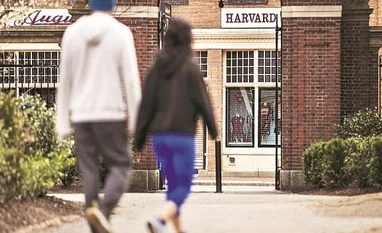
The loss of international students could have cost universities millions of dollars in tuition and jeopardised the ability of US companies to hire the highly skilled workers who often start their careers with an American education. PHOTO: BLOOMBERG
Miriam Jordan & Anemona Hartocollis | NYT
5 min read Last Updated : Jul 15 2020 | 11:44 PM IST
In a rare and swift immigration policy reversal, the Trump administration on Tuesday bowed to snowballing opposition from universities, Silicon Valley and 20 states and abandoned a plan to strip international college students of their visas if they did not attend at least some classes in person.

The policy, which would have subjected foreign students to deportation if they did not show up for class on campus, had thrown the higher education world into turmoil at a time when universities are grappling with whether to reopen campuses during the coronavirus pandemic.

The loss of international students could have cost universities millions of dollars in tuition and jeopardised the ability of US companies to hire the highly skilled workers who often start their careers with an American education.

Two days after the policy was announced on July 6, Harvard and the Massachusetts Institute of Technology (MIT) filed the first of a litany of lawsuits seeking to block it. On Tuesday, minutes before a federal judge in Boston was to hear arguments on their challenge, the judge, Allison D Burroughs, announced that the administration had agreed to rescind the policy and allow international students to remain in the country even if they are taking all their classes online.

The government has argued that the requirement that students take at least one in-person class was actually more lenient than the rule that had been in effect for close to 20 years which required foreign students to take most of their classes in person.

But that rule was temporarily suspended on March 13, when Trump declared a national emergency and campuses across the country began shutting down, with classes moving online. 

On July 6, the government made its announcement that foreign students could not remain in the US if their studies were entirely online.

“If they’re not going to be a student or they’re going to be 100 per cent online, then they don’t have a basis to be here,” Kenneth T Cuccinelli II, the acting deputy secretary of the Department of Homeland Security, said in an interview on CNN after the policy was announced. “They should go home, and then they can return when the school opens.”

Each year, about 1 million international students enroll in American universities. They contribute $41 billion to the economy annually and support more than 458,000 jobs. In addition to Harvard and MIT, the attorneys general of 20 states, including Massachusetts and California, also sued, charging that the policy was reckless, cruel and senseless. Scores of universities threw their support behind the litigation, along with organisations representing international students.

The pressure grew on Monday, when more than a dozen technology companies, including Google, Facebook, and Twitter, also came out in support of the lawsuit, arguing that the policy would harm their businesses.

Then on Tuesday, 15 Republican members of Congress signed a letter urging the Trump administration to restore its previous policy on international students. Representative Rodney Davis, an Illinois Republican who had organised the letter, applauded the Trump regime’s “right decision” to cancel its plan.

“These hardworking students are the best and brightest from their countries, and they help our communities grow both culturally and economically,” he said.
The policy about foreign students was one of a number of measures President Trump has taken to advance his agenda on immigration, using the coronavirus pandemic and the need to protect the country from health threats as justification.

The administration has also stopped processing green cards for applicants abroad; closed the southwestern border to nonessential travel, allowing only Americans and legal permanent residents to enter while barring asylum seekers; and banned the entry of thousands of foreigners on work visas.

The universities said in their court challenge to the latest policy that “by all appearances,” the government’s attempt to force international students to study on campus had also been a political move, calculated to advance the Trump administration’s agenda to force universities to reopen their gates with in-person classes.

They said forcing students to return to their home countries would in many cases separate them from families in the United States, returning them to places where they no longer had a home. In some cases, they would be living under the thumb of repressive regimes, which policed or restricted internet access. Many international students from Asian countries would have to contend with a time difference that would mean taking classes between 2 am and 7 am, if they had internet access.

Foreign students attending elementary, middle and high schools on visas would have also had to depart the country if their classes went 100 percent online.

In court filings, universities said that some arriving students already had been barred from entering the country by immigration officials at airports who told them that their institutions were going online.

After the announcement on Tuesday that the policy had been rescinded, university officials praised the decision and warned that they would be prepared to go back to court should the administration make any further moves to restrict the ability of international students to study online when necessary.

“This is a significant victory,” Harvard’s president, Lawrence S Bacow, said in a statement. “The directive had disrupted all of American higher education. I have heard from countless international students who said that the July 6 directive had put them at serious risk. These students — our students — can now rest easier and focus on their education, which is all they ever wanted to do.”

©2020 The New York Times News Service

One subscription. Two world-class reads.

Already subscribed? Log in

Subscribe to read the full story →
*Subscribe to Business Standard digital and get complimentary access to The New York Times

Smart Quarterly

₹900

3 Months

₹300/Month

SAVE 25%

Smart Essential

₹2,700

1 Year

₹225/Month

SAVE 46%
*Complimentary New York Times access for the 2nd year will be given after 12 months

Super Saver

₹3,900

2 Years

₹162/Month

Subscribe

Renews automatically, cancel anytime

Here’s what’s included in our digital subscription plans

Exclusive premium stories online

  • Over 30 premium stories daily, handpicked by our editors

Complimentary Access to The New York Times

  • News, Games, Cooking, Audio, Wirecutter & The Athletic

Business Standard Epaper

  • Digital replica of our daily newspaper — with options to read, save, and share

Curated Newsletters

  • Insights on markets, finance, politics, tech, and more delivered to your inbox

Market Analysis & Investment Insights

  • In-depth market analysis & insights with access to The Smart Investor

Archives

  • Repository of articles and publications dating back to 1997

Ad-free Reading

  • Uninterrupted reading experience with no advertisements

Seamless Access Across All Devices

  • Access Business Standard across devices — mobile, tablet, or PC, via web or app

Topics :GoogleDonald TrumpUnited StatesUS universitiesHarvard UniversityFacebookSilicon ValleyIndians in USIndian students in USUS immigrationOnline education

Next Story



