4 min read Last Updated : Sep 21 2021 | 4:03 PM IST
Despite the picture of an economic contraction painted by most forecasters, the India consumption story seems to be still going strong. The Nifty Consumption index, a gauge of consumption-driven stocks on the National Stock Exchange (NSE) has rallied 42 per cent since March 23 when the market hit their recent low as compared to 51 per cent rise in the Nifty 50. Though the margin of underperformance compared to the benchmark index may not be much, what is important to note is that all stocks that comprise the Nifty Consumption index have given a positive return since then.
Among the lot, Mahindra & Mahindra (M&M), Hero MotoCorp, Tata Power, Britannia Industries, Maruti Suzuki, Jubilant FoodWorks and Godrej Consumer have been among the top gainers, rallying 57 per cent to 105 per cent since March 23 low, ACE Equity data show.
For the coming few months, analysts expect the Indian consumers to forego big ticket retail purchases and opt for reasonably priced indulgences, or what is called a ‘Lipstick Effect’. According to this theory, consumers would still be willing to spend money on small indulgences even during a recession, economic contraction and even during times when they have little personal disposable income. Then there is pent-up demand due to the lockdown, the expectation of which analysts say, could have been the driving these stocks.
“There are three types of demand trends working in tandem right now – normal demand, pent-up demand and inventory build-up. In automobiles, we saw a case of pent-up demand. In April and May 2020, nobody bought anything due to the lockdown. That said, personal mobility is a big thing now. One must also realise that India is an economy built on the consumption of ‘essentials’ and not ‘discretionary’ items. Once the demand is back fully, the market and economic recovery will be fantastic,” argues Raamdeo Agrawal, co-founder and joint managing director, Motilal Oswal Financial Services.
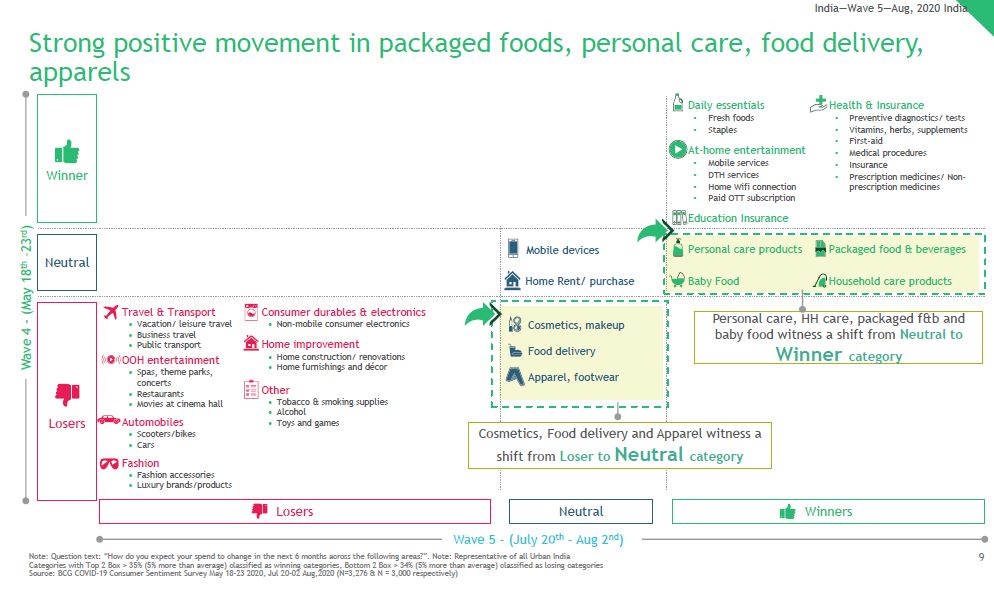
An August 2020 report by the Boston Consulting Group (BCG) said while essentials, health, in home entertainment continue to see an increase in consumption levels, there is an uptick in sentiment across many semi-essentials like personal care, packaged food as well as discretionary items like apparel, cosmetics, automobiles and consumer electronics. “Revival stronger among lower income segments and lower tier cities,” the BCG report said. CLICK HERE FOR THE GRAPHIC
“We cannot paint the entire sector and the consumption pattern with the same brush. People will avoid lumpy / big ticket investment and will focus on smaller items even if they are a bit indulgent – a classic ‘lipstick effect.’ Fast moving consumer goods (FMCG) stocks will continue to do well as the demand is more or less intact. Investors should look for demand continuity, valuation of consumption stocks and balance-sheet strength of the companies before investing in consumption-driven stocks now,” suggests G Chokkalingam, founder and chief investment officer at Equinomics Research.
A word of caution
Though the consumption-driven stocks have done well over the past few months, some analysts do remain cautious about this segment as they feel the recovery to a large extent in the FMCG segment has been led by an increase in disposable income in rural India.
“While rural may be better off than urban in the first quarter of fiscal 2021 (Q1FY21) and perhaps such a trend may even continue for another few months, we would still shy away from calling out strong growth in rural areas. Q2FY21 can actually post good growth, as pipelines have not yet normalised, but it is quite possible that post this, growth would taper, as second/third-round impacts of the economic damage caused by the virus filter through,” wrote Percy Panthaki, Avi Mehta and Sameer Gupta of IIFL in an August 19 note.