OMCs, RIL better placed; oil producers stare at losses as crude plunges

Reliance Industries' higher cost efficiencies and diversified business model will prove helpful
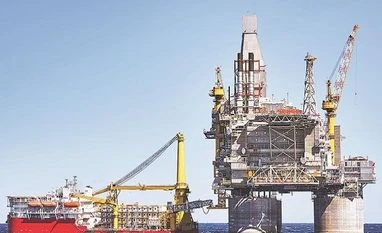
Oil, OMCs, Oil rig, Fuel, Indian Oil, Hindustan OIL, Bharat Petroleum, Petrol, Gas, LPG, Oil drilling, block, basin
Globally, while there continues to be a demand-supply mismatch, with oil supplies exceeding demand, it has led to storage issues for crude
Ujjval Jauhari
4 min read Last Updated : Apr 22 2020 | 1:18 AM IST
The sharp fall of 25 per cent in the Brent crude oil price to below $19 a barrel over two days is not a good news for domestic oil producers, such as ONGC, Oil India and even Vedanta, whose subsidiary Cairn India is involved in oil production and exploration, as well as Reliance Industries (RIL). Oil marketing companies (OMCs), too, will be hit in the short run, but they stand to gain if oil prices sustain at lower levels.  Globally, the demand-supply mismatch, with oil supplies exceeding demand, has led to storage issues. This was the key reason for WTI crude oil May futures tumbling into negative territory, and Brent crude prices slipping to $25 levels on Monday, even as major oil-producing countries have announced deep output cuts. On Tuesday (11.28 pm IST), Brent prices fell another 27 per cent.

“As storage becomes saturated, price volatility will remain exceptionally high in coming weeks,” observed analysts at Goldman Sachs who added that production would soon need to fall sizeably to bring the market into balance.

With the International Energy Agency already expecting demand for crude oil to drop by 23 million barrels per day, Ravindra Rao, vice president-head Commodity Research, Kotak Securities, feels that "the selling might continue until the supply glut remains and demand doesn’t pick up.”


Stocks of oil producers, such as ONGC and Oil India, were down by 5-7 per cent on the bourses. OMCs, too, corrected between 3.5 per cent and 5.3 per cent. RIL, which had fallen over 6 per cent in intraday trade, recovered to close with a decline of 0.67 per cent. ONGC and Oil India will likely feel the maximum pinch of the decline in crude prices as this will hit their net realisations significantly. The cost of oil production for ONGC, including capex for maintaining output from oil fields, is close to $31 a barrel, while for Oil India, it is $25-26 a barrel, according to analysts. Because of the tumbling crude oil prices, these companies now stare at losses at the operating level, if the weakness persists. 

For refiners like RIL, which is already witnessing pressure on its refining segment's profitability because of demand woes, the fall in oil prices also means that it may face inventory losses, thereby pulling down its refining margins further, say analysts.  Though RIL clocks relatively higher gross refining margins or GRMs (compared to OMCs) due to its crude sourcing ability and complex refinery, its GRM is estimated to have declined to $7.5 in the March quarter, from $9.2 in Q3FY20. However, analysts say that RIL's diversified business model places it ahead of peers.

State-run OMCs (Hindustan Petroleum, Bharat Petroleum and Indian Oil), too, will feel the heat on refining margins and likely report inventory losses. But, they would also benefit from the ongoing positive trend in marketing margins.

Further, cheaper oil benefits OMCs as they need to pay less for imports, and hence, it lowers their working capital requirements.  For the refining industry, GRMs have been under pressure in the last couple of months because of weak demand. The benchmark Singapore GRM had averaged at $1.2 a barrel during the March quarter, lower than $1.6 in the previous quarter and less than half of $3.2 a barrel in the year-ago period.
Meanwhile, post the inventory write-downs, OMCs will remain in a sweet spot in a low oil price environment. Currently, OMCs are earning net marketing margin of Rs 13/litre, each on petrol and diesel. This will likely improve given the fall in oil prices. Analysts estimate that a $1 fall in prices leads to Rs 0.45/litre improvement in net marketing margins on petrol and diesel. Yogesh Patil at Reliance Securities says marketing margin will remain at all-time highs, subject to no increase in excise duty after the normalisation of petroleum product sales.  Among OMCs, Bharat Petroleum remains his top pick. 

For these gains to accrue, it is also crucial that the economy bounces back fast, otherwise lower volumes will limit benefits for OMCs.

One subscription. Two world-class reads.

Already subscribed? Log in

Subscribe to read the full story →
*Subscribe to Business Standard digital and get complimentary access to The New York Times

Smart Quarterly

₹900

3 Months

₹300/Month

SAVE 25%

Smart Essential

₹2,700

1 Year

₹225/Month

SAVE 46%
*Complimentary New York Times access for the 2nd year will be given after 12 months

Super Saver

₹3,900

2 Years

₹162/Month

Subscribe

Renews automatically, cancel anytime

Here’s what’s included in our digital subscription plans

Exclusive premium stories online

  • Over 30 premium stories daily, handpicked by our editors

Complimentary Access to The New York Times

  • News, Games, Cooking, Audio, Wirecutter & The Athletic

Business Standard Epaper

  • Digital replica of our daily newspaper — with options to read, save, and share

Curated Newsletters

  • Insights on markets, finance, politics, tech, and more delivered to your inbox

Market Analysis & Investment Insights

  • In-depth market analysis & insights with access to The Smart Investor

Archives

  • Repository of articles and publications dating back to 1997

Ad-free Reading

  • Uninterrupted reading experience with no advertisements

Seamless Access Across All Devices

  • Access Business Standard across devices — mobile, tablet, or PC, via web or app

Topics :OMCsRILCrude Oiloil stocks

Next Story



