Tata Mutual Fund (MF), which manages assets worth Rs 450 billion, is grappling with employee churn. The fund house, backed by the Tata group, has seen exits of two fund managers in three months and lay-offs in the sales team.
In May, chief investment officer Gopal Agarwal had put in his papers. Senior fund manager Pradeep Gokhale is also on his way out, say two people in the know. Gokhale has worked at Tata MF for 14 years and at one point was managing Rs 40 billion of assets.
According to the people cited above, at least 10 people in Tata MF’s sales team have been asked to look for jobs elsewhere. The re-shuffling has come close on the heels of Prathit Bhobe taking charge (in May) as chief executive officer (CEO) and managing director (MD).
Tata MF didn't respond to a questionnaire on the issue of employee movement and long-term strategy.
Before appointment of Bhobe, who has a credible record of heading the wealth management, retail liabilities and private banking business at ICICI Bank, Tata MF operated without a CEO for almost a year. Bhobe is the fourth CEO the fund house has seen in seven and a half years.
Lack of a stable leadership has made it difficult for Tata MF to gain sizable market share. The fund house currently ranks 13th in terms of assets managed.
Despite being in the industry for more than two decades, Tata MF’s assets under management (AUM) as of March 2018 stood at Rs 450 billion, only two per cent of industry's overall AUM.
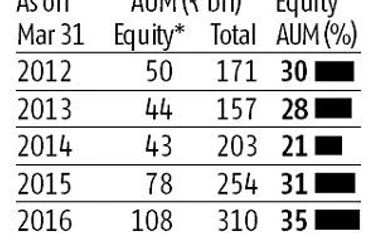
In terms of equity assets, which typically have higher contribution to profits, Tata MF's actively managed equity funds (including equity-oriented hybrid funds) also have a two per cent share in the industry's equity assets, data from Value Research shows.
“In a people's business like fund management, you need a strong and stable leadership. Without that, it is difficult for people to perform, whether it is the fund managers or sales staff,” said Dhirendra Kumar, CEO of Value Research.
Between 2003 and 2010, Tata MF had a good run when it had a stable leadership in Ved Prakash Chaturvedi. When he took over in 2003, the fund house managed assets of only Rs 10 billion. When Chaturvedi left in 2010, the AUM had surged 17-fold, compounding at 50 per cent annually. According to reports, Tata MF had a decent equity-debt mix of 40:60 at that time, when industry average was 30:70. However, since 2010, Tata MF’s AUM has grown at 12 per cent CAGR, with profits compounding at three per cent annually.
However, Tata MF continues to maintain a decent mix of equity-oriented schemes. Data from Value Research shows as of end-March, 36 per cent of Tata MF's AUM came from actively-managed equity-oriented schemes (including equity-oriented hybrid schemes).
Industry observers find it difficult to fathom Tata group's relatively lacklustre performance in the MF industry. “It is strange. A brand that has a lot of trust associated with it has not managed to gain a sizable foothold in a business where trust is the most important factor,” adds Kumar.