TCS may surge 15% from here, tech charts suggest. Investors should stay put

At a fundamental level, analysts hold a bullish view on the stock, though they are concerned about the valuation

Tata Consultancy Services, TCS
Avdhut Bagkar Mumbai
2 min read Last Updated : Jul 09 2021 | 10:52 AM IST
Shares of Tata Consultancy Services swung between gains and losses in Friday's session following its June quarter results that were lower than expectations.

The net profit of the company for Q1FY22 stood at Rs 9,008 crore, up 28.5 per cent year-on-year (YoY) but was down 2.5 per cent sequentially. Revenue for the quarter grew 18.5 per cent YoY at Rs 45,411. According to a Bloomberg poll, analysts were estimating revenue of Rs 45,767.5 crore and net profit of Rs 9,391.9 crore for the quarter gone by. READ HERE

Following this, the scrip declined over 1 per cent in early trade to Rs 3,211.85 on the BSE, however, it recouped losses to trade marginally in the green at Rs 3,271.05 around 10.40 am. READ HERE

Analysts largely hold bullish views on the stock although they are concerned about the valuations. Most expect TCS to bounce back following a blip in the Q1 earnings show. 

Here's a look at what technical charts are signalling for the stock in the days ahead.

Tata Consultancy Services (TCS)
Likely target: Rs 3,700 and Rs 3,900
Upside potential: 8% and 15%

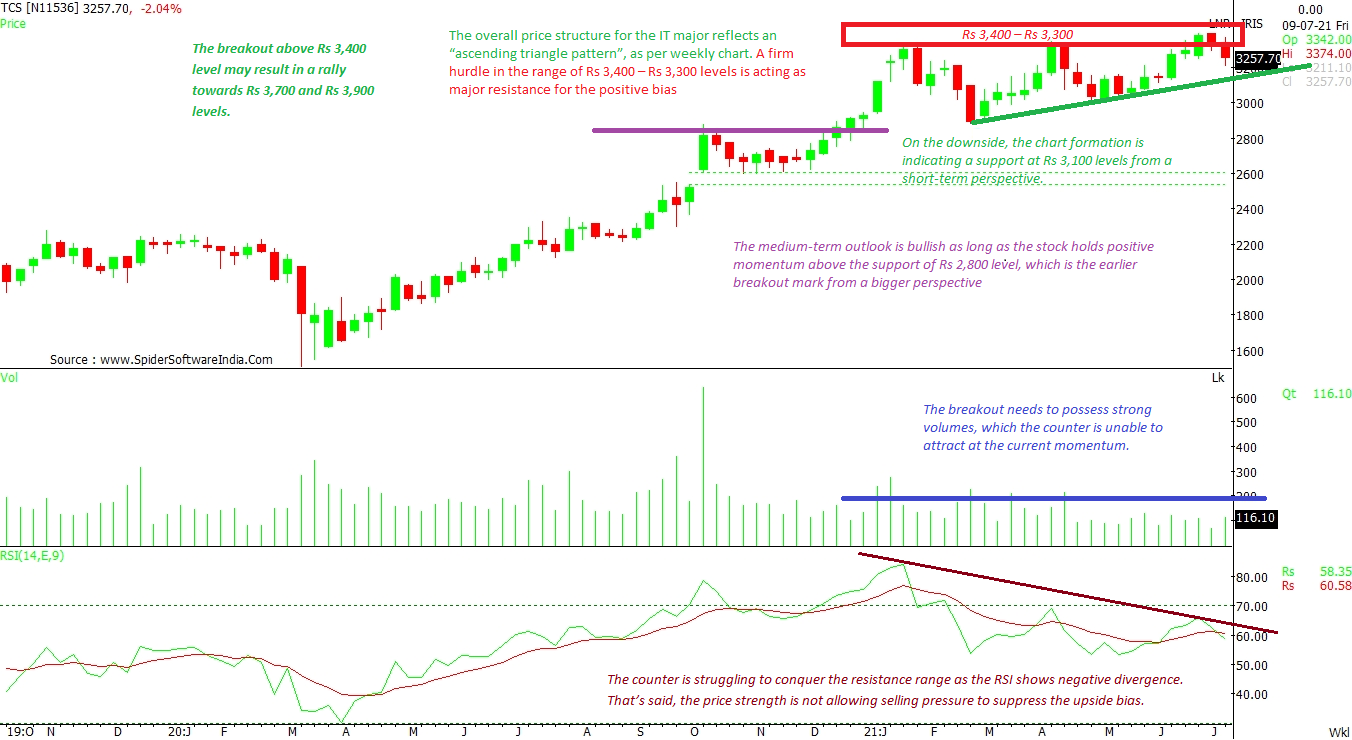
The overall price structure reflects an “ascending triangle pattern” for IT major TCS. The stock faces stiff resistance in the range of Rs 3,400 – Rs 3,300 per share, show daily charts. That said, a breakout above this level may result in a rally towards Rs 3,700 and then Rs 3,900 levels. The said breakout must possess strong volumes, which the stock is unable to attract currently. 

On the downside, the chart formation is indicating support at Rs 3,100 levels from a short-term perspective. The medium-term outlook remains bullish as long as the stock holds positive momentum above the earlier breakout mark of Rs 2,800 level.

The counter is struggling to conquer the resistance range as the Relative Strength Index (RSI) shows negative divergence. That said, the price strength is not allowing selling pressure to suppress the upside bias. CLICK HERE FOR THE CHART 

One subscription. Two world-class reads.

Already subscribed? Log in

Subscribe to read the full story →
*Subscribe to Business Standard digital and get complimentary access to The New York Times

Smart Quarterly

₹900

3 Months

₹300/Month

SAVE 25%

Smart Essential

₹2,700

1 Year

₹225/Month

SAVE 46%
*Complimentary New York Times access for the 2nd year will be given after 12 months

Super Saver

₹3,900

2 Years

₹162/Month

Subscribe

Renews automatically, cancel anytime

Here’s what’s included in our digital subscription plans

Exclusive premium stories online

  • Over 30 premium stories daily, handpicked by our editors

Complimentary Access to The New York Times

  • News, Games, Cooking, Audio, Wirecutter & The Athletic

Business Standard Epaper

  • Digital replica of our daily newspaper — with options to read, save, and share

Curated Newsletters

  • Insights on markets, finance, politics, tech, and more delivered to your inbox

Market Analysis & Investment Insights

  • In-depth market analysis & insights with access to The Smart Investor

Archives

  • Repository of articles and publications dating back to 1997

Ad-free Reading

  • Uninterrupted reading experience with no advertisements

Seamless Access Across All Devices

  • Access Business Standard across devices — mobile, tablet, or PC, via web or app

Topics :TCSQ1 resultsstocksMarkets

Next Story