A scary new world?

International economic and political order, led by the US, is under threat from Trump administration
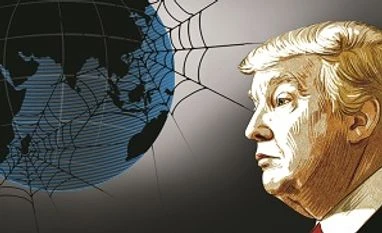
Illustration by Ajay Mohanty
Shankar Acharya
Last Updated : Jun 18 2017 | 10:43 PM IST
Have the first five months of the Trump presidency taken us into a scarier new world of global economics and politics? I believe so. 

In broad terms, the 70 years since the Second World War (WW2) saw the rise of a liberal international economic order (LIEO) for trade, capital flows and, to a limited extent, skilled labour. It also witnessed the economic development of emerging nations, many of which had been under colonial rule. The LIEO was buttressed by a set of international institutions, created under US leadership after WW2, notably the International Monetary Fund, the World Bank and the General Agreement on Tariffs and Trade (GATT) and its successor the World Trade Organization (WTO). GATT/WTO oversaw successive Rounds of multilaterally negotiated trade agreements, which gave a strong and sustained impetus to the post WW2 expansion of world trade, the principal driver of post war globalisation and a major propellant of unprecedented world economic growth.

The international political order that underpinned the LIEO was, mainly, the “Western Alliance” led by the United States (the strongest victor of WW2) and including Western Europe nations and Japan. Many have characterised these seven decades as “Pax Americana”, since American economic, political and military leadership was clearly dominant, especially after the fragmentation of the Soviet Union in 1991. Pax Americana was not all about peace and prosperity. In pursuit of her interests, America fought long and ruthless wars in Indo-China, Iraq and Afghanistan and intervened both overtly and covertly in several countries of Latin America and West Asia. But it has to be acknowledged that Pax Americana and the LIEO helped foster an unprecedented surge of international trade and economic prosperity across most of the developed and developing world. Amongst the principal gainers were nations of Europe and East Asia, with one of them, China, experiencing sustained hyper growth to become, in recent years, the second largest national economy and a challenger to American hegemony.

Pax Americana and the LIEO were already under stress from various factors and forces since the last decade. These included: growing cross-border Islamic-jihadist terrorism, including the “9/11” airliner attack in the US in 2001; the long wars in Afghanistan (the “war of necessity”) and Iraq (the “war of choice”), the Global Financial Crisis and the associated Great Recession of 2007-9 and their prolonged negative consequences on growth of output and trade in major countries; the increasing economic inequality and associated political polarisation within the US and several major European nations; the surge in refugees from West Asia and North Africa as their home countries were devastated by civil strife and/or Western armed intervention; the extraordinary rise of China as a new great power as well as its recent economic slowdown; and all the ramifications of Brexit.

Illustration by Ajay Mohanty
Despite all these major stresses and strains, the global economy and world trade had begun to pick up steam over the past year. The Paris Agreement on policies to combat Climate Change, weak though it was, did get concluded in late 2015 and entered into force in November 2016. The Trans-Pacific Partnership (TPP) agreement (a “super” regional trade pact) was concluded in February 2016. 

All this changed with the inauguration of Trump as President on January 20. Consider some of the policy actions and announcements of the Trump administration in the last five months.

Global Trade: America withdrew from the TPP within 3 days of the inauguration, vastly diminishing her potential role in Asian economic affairs and leaving the field for dominance by China. The threat of renegotiating the North American Free Trade Agreement continues. There has been a spate of anti-trade pronouncements by Trump and his cabinet officers, all of which demonstrate a clear preference of bilateralism over multilateralism. Although the initial threat of a US-China trade war appears to have receded, it might be revived at any time. There has been little by way of support for the WTO and its principles of non-discriminatory, multilateral trade; or for international calls against trade protectionism.

Peace and Security: Perhaps the biggest blow to the Western Alliance, the key platform supporting Pax Americana, was delivered during the NATO summit meeting in Brussels in late May, when Trump failed to give the customary endorsement of the treaty’s article 5, which binds all NATO allies to come to the aid of any member under attack. This was followed by his equivocation on the Paris climate accord at a lacklustre G-7 summit two days later. German Chancellor Angela Merkel subsequently mused that Europe could no longer depend on America. A few days earlier Trump had decisively sided with his Saudi Arabian hosts in their long-running rivalry with Iran, portraying Saudi Arabia as a bulwark against jihadi terrorism, despite the kingdom’s long record in exporting Wahabi fundamentalism across the globe for 40 years. By aligning so closely with one side of the long-running Sunni-Shia schism, Trump may have stirred up more future terrorism challenges for the US and the world. Trump’s endorsement of the Saudis and their close allies may have also helped precipitate the ongoing crisis over Qatar (which hosts a major American military base), on which US policy statements (and presidential tweets) have been confusing, to put it mildly.

Global Public Goods: In the past, America has typically played a leadership role in organising actions and funding for global public goods. On June 1 Trump announced withdrawal of the US from the Paris climate accord, thus majorly weakening the fight against global warming and climate change. His administration had already issued a series of executive orders liberalising regulations for coal mining, pipeline building and so forth, in effect reversing anti-carbon actions taken by the Obama administration. The prospects for American leadership on other public goods such as protection of the oceans and the battles against communicable diseases look bleak.

Little wonder that John Ikenberry (Professor of International affairs at Princeton) writes “the world’s most powerful state has begun to sabotage the order it created. A hostile revisionist power has indeed arrived on the scene, but it sits in the Oval Office, the beating heart of the free world.” (Foreign Affairs, May-June 2017).
 
The writer is former Honorary Professor at ICRIER and former Chief Economic Advisor to the Government of India. Views are personal

One subscription. Two world-class reads.

Already subscribed? Log in

Subscribe to read the full story →
*Subscribe to Business Standard digital and get complimentary access to The New York Times

Smart Quarterly

₹900

3 Months

₹300/Month

SAVE 25%

Smart Essential

₹2,700

1 Year

₹225/Month

SAVE 46%
*Complimentary New York Times access for the 2nd year will be given after 12 months

Super Saver

₹3,900

2 Years

₹162/Month

Subscribe

Renews automatically, cancel anytime

Here’s what’s included in our digital subscription plans

Exclusive premium stories online

  • Over 30 premium stories daily, handpicked by our editors

Complimentary Access to The New York Times

  • News, Games, Cooking, Audio, Wirecutter & The Athletic

Business Standard Epaper

  • Digital replica of our daily newspaper — with options to read, save, and share

Curated Newsletters

  • Insights on markets, finance, politics, tech, and more delivered to your inbox

Market Analysis & Investment Insights

  • In-depth market analysis & insights with access to The Smart Investor

Archives

  • Repository of articles and publications dating back to 1997

Ad-free Reading

  • Uninterrupted reading experience with no advertisements

Seamless Access Across All Devices

  • Access Business Standard across devices — mobile, tablet, or PC, via web or app

Next Story



