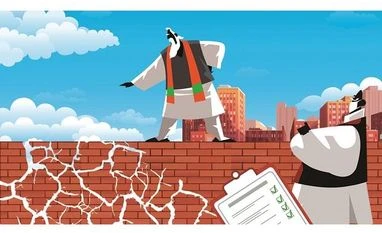
BJP: As safe as a big bank

After West Bengal, Narendra Modi and Amit Shah have recognised the next run on their bank might come in Uttar Pradesh
Assembly elections, narendra modi, politics
Illustration: Binay Sinha
Vir Sanghvi
6 min read Last Updated : Jun 14 2021 | 11:28 PM IST
There is a well-worn analogy in American politics that harks back to the Great Depression. Governments and political parties may look strong and impregnable from the outside. But many of them are like the big banks in 1929. The banks looked powerful and secure. But one day, a depositor asked to pull his money out of one bank and the whole structure came tumbling down.

That’s the thing about politics, the analogy suggests. Just because something looks too big to fail from the outside, does not mean that it is not riven with flaws and weaknesses on the inside.

I thought of that analogy when I saw what was happening in Bengal last week. We all remember the fervour with which the Bharatiya Janata Party (BJP) went up against Mamata Banerjee and the Trinamool Congress (TMC) in the months preceding the Assembly election. The prevailing view at the time (backed by many opinion pollsters) was that the BJP juggernaut was impossible to stop. The party had thousands of crores to spend, the investigative agencies at its beck and call, a superb social media operation and the Prime Minister’s own charisma.

Such was the mood that large chunks of the TMC defected to the BJP thinking they would be on the winning side. “Two hundred seats,” bragged Amit Shah, when asked about the BJP’s likely tally and, whatever they may say now, many people believed him.

As we know, the juggernaut was far from unstoppable. It ground to a shuddering halt and then toppled over. As it collapsed, those who had accompanied it, struggled to escape. Mukul Roy, one of the defectors from the TMC sought shelter with his old party. And now the rush to return to the TMC has become so frantic that the party has had to board up its windows and bolt its doors to prevent too many former members from rushing back inside.

All it took was for a few depositors in Bengal to ask to withdraw their money and the once so solid edifice came tumbling down.

 Narendra Modi and Amit Shah have recognised that the next run on their bank might come in the Uttar Pradesh elections due next year. As of now, the BJP is set to win but there are worrying signs. Yogi Adityanath is unpopular with his own MLAs. There is said to be untapped public anger across the state.

If the BJP loses Uttar Pradesh, then a Great Depression will set in and the party will take years to recover. Hence the parleys last week and the panicky attempts to assess the scale of the damage while keeping Adityanath in check.

It is by no means certain that the BJP will lose Uttar Pradesh. There are still months to go and the party hopes to access some of the Bahujan Samaj Party vote. Plus, it is convinced that unlike Mamata Banerjee who made it her mission to defeat Modi and Shah, Akhilesh Yadav is taking it far too easy, believing that a BJP collapse is inevitable.

Illustration: Binay Sinha

But the disaster in Bengal and the worries about Uttar Pradesh point to a central weakness in the BJP’s strategy. The party has cast its appeal in terms of the There is No Alternative (TINA) factor. Even if it screws up, it believes, it can hold on to power as long as there is no national alternative.

Accordingly, it spends crores in campaigns designed to make Rahul Gandhi look like a fool and to paint the Congress as a party on the skids. Each time it talks about the Congress, it focuses on the Gandhis and on dynasty.

There are two flaws with this approach. The first is that it doesn’t help the BJP win in states—like Bengal and Uttar Pradesh  — where the Congress is not a significant player and voters don’t really care whether Rahul Gandhi is a Pappu or not.

And secondly, even in those states where politics is still a straight fight between the BJP and the Congress (Rajasthan, Madhya Pradesh, Gujarat etc.) the BJP’s strategy is too limited.

It says that while the Gandhis are terrible people, the Congress is full of other wonderful politicians who are welcome to join the BJP. Jyotiraditya Scindia, Jitin Prasada and Sachin Pilot were all targets of BJP acquisition operations (Sachin Pilot did not finally join) and Ghulam Nabi Azad is apparently, such a splendid chap that the Prime Minister grew tearful in Parliament while recalling their old association.

The BJP’s  position is predicated on the assumption that Rahul Gandhi will always be the leader of the Congress. At every general election voters will be asked to choose between Narendra Modi and Rahul Gandhi and naturally, the BJP believes, they will prefer Modi.

But what happens if, at the next general election, the Congress is not led by Rahul? Suppose he declares that he will not be a candidate at the election for Congress president later this year? Suppose he announces that he will continue to work for the party but not as its leader? Rahul has tried saying something like that for many months now but nobody believes him because the Congress is yet to choose a new President.

But, assume for a moment, that Rahul does actually remove himself from the reckoning. What happens then? Well, it effectively destroys the central plank of the BJP’s TINA strategy. It won’t be wise old Modi versus an immature Pappu any longer. It will be Modi versus a whole collection of experienced opposition leaders, including whoever the new Congress president is.

Does that really seem like a TINA situation now that we know that Modi-Shah can be beaten and beaten badly?

There are many “what ifs” in this scenario but it could hold. In fact, even if the BJP does win Uttar Pradesh next year, two more years of Yogi Adityanath might be enough to put the state back in play at the next general election.

 As of now, the government is strong and secure. But always remember, it only takes one customer to make a withdrawal from a seemingly strong bank for everything to crash. 

The writer is a TV presenter and journalist

One subscription. Two world-class reads.

Already subscribed? Log in

Subscribe to read the full story →
*Subscribe to Business Standard digital and get complimentary access to The New York Times

Smart Quarterly

₹900

3 Months

₹300/Month

SAVE 25%

Smart Essential

₹2,700

1 Year

₹225/Month

SAVE 46%
*Complimentary New York Times access for the 2nd year will be given after 12 months

Super Saver

₹3,900

2 Years

₹162/Month

Subscribe

Renews automatically, cancel anytime

Here’s what’s included in our digital subscription plans

Exclusive premium stories online

  • Over 30 premium stories daily, handpicked by our editors

Complimentary Access to The New York Times

  • News, Games, Cooking, Audio, Wirecutter & The Athletic

Business Standard Epaper

  • Digital replica of our daily newspaper — with options to read, save, and share

Curated Newsletters

  • Insights on markets, finance, politics, tech, and more delivered to your inbox

Market Analysis & Investment Insights

  • In-depth market analysis & insights with access to The Smart Investor

Archives

  • Repository of articles and publications dating back to 1997

Ad-free Reading

  • Uninterrupted reading experience with no advertisements

Seamless Access Across All Devices

  • Access Business Standard across devices — mobile, tablet, or PC, via web or app

More From This Section

Disclaimer: These are personal views of the writer. They do not necessarily reflect the opinion of www.business-standard.com or the Business Standard newspaper

Topics :Amit ShahMamata BanerjeeBharatiya Janata PartyNarendra ModiAssembly electionsUttar PradeshUP Assembly ElectionsWest Bengal Assembly pollsKeralaTamil NaduCongressTMCrajasthan

Next Story



