That the Bharatiya Janata Party (BJP) would lose in Madhya Pradesh and Chhattisgarh was a forgone conclusion because it had been in power there for 15 years. Anti-incumbency was bound to take its toll.
That it would lose in Rajasthan was also a forgone conclusion because of the poor management skills displayed by the chief minister, Vasundhara Raje, and the infighting in the ranks of the BJP which the Rashtriya Swayamsevak Sangh (RSS) head, Mohan Bhagwat, had tried his best to quell. Indeed, but for his efforts, the margin of defeat might have been even larger.
One consequence of these defeats is, of course, that the Congress thinks it can get more than 120 seats in the Lok Sabha in 2019 — that is triple its current strength.
Another consequence is that infighting will now begin between the rival factions led by those who want to be the chief minister in each of these states.
A third consequence regardless of who becomes the chief minister will be an increase in corruption as the pressure to generate funds for the general elections grows.
A fourth consequence will be the struggle for control over the police which, in MP and Chhattisgarh at least, has become accustomed to a certain way of functioning. The control of the police will play an important role in the 2019 elections.
A fifth consequence will be the sudden dissonance between these states and the central government. This will have an adverse impact on economic decision making.
A sixth and most important short-term consequence will be a sudden increase in the pressure to build the Ram temple in Ayodhya because that is the only thing that can win Uttar Pradesh for the BJP and prevent a further leakage of its core vote in 2019.
These results also mean that the BJP needs to learn some important lessons, as do Narendra Modi and Amit Shah.
The BJP needs to learn that even in the Hindi heartland the appeal of Hindutva can be overdone. Eighty-five per cent of Indians may be Hindu but that doesn’t mean they approve of extreme methods such as the ones adopted by the BJP since 2014.
As for the non-Hindi states, this approach has always had only marginal appeal. So the BJP has to always bear in mind that while there are only seven Hindi states, there are 22 that are not. The ‘we are all Hindus’ approach will not work.
That leaves Narendra Modi and Amit Shah. While there is nothing they could have done about anti-incumbency, after the debacles of Gujarat and Karnataka last year they could certainly have changed their methods. These defeats suggest that even if they did, it was not by much.
Primarily, this appears to have been the same mistake that the Congress has always made: wrong candidate selection. This had been at its most glaring in the 2015 Bihar election but the massive win in UP in 2017 might have made them think that one defeat didn’t matter. But candidates do matter, especially in state elections.
As for the Congress, which has suddenly been infused with renewed vigour, Dilli door ast. The BJP will still emerge as the single largest party in 2019, even if its majority is reduced very considerably.
The real issue, therefore, for the BJP is whether it will want to continue with the Modi-Shah duo or look for replacements. These two have not yet attained the Vajpayee-Advani stature and may find themselves quite friendless if the BJP drops more than 100 seats in 2019.
Clearly, some very interesting times, politically at least, lie ahead. Unfortunately, interesting politics also spells a bad time for the economy.

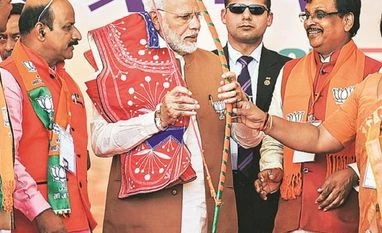 "BJP's Assembly election losses: Six consequences and lessons for Modi, Shah")










 Connect with us on WhatsApp