BJP's poll victories and impact on Sensex: Go long and stay long

Every trend-following system would advocate going long and staying long
top draw
.
Devangshu Datta
Last Updated : Mar 20 2017 | 11:55 AM IST
Assembly elections proved to be a triumph for the Bharatiya Janata Party (BJP) and the results cemented Prime Minister Narendra Modi’s position as the only individual capable of delivering a pan-India mandate. The BJP recorded decisive victories in Uttar Pradesh and Uttarakhand, and it will also form governments in Goa and Manipur, never mind how!

That UP mandate in itself was enough to boost sentiment and the market promptly jumped to a new high. The rupee also strengthened sharply since the market actually rose on substantial foreign institutional investor buying —many domestic institutions sold into the rally. Interestingly the rupee continued to strengthen even after the US Federal Reserve hiked the USD policy rate, as it did for the second time in succession.

The Fed action was expected. Three other central banks, the European (ECB), the Bank of Japan, and the Bank of England continue to maintain status quo on respective policy. The ECB says it will continue normalisation (that is, cease its bond buying programme) only if it sees inflation climbing across the entire Eurozone. Japan also continues to hold a negative policy rate and the Bank of England will wait, one way or another, until Brexit proceeds.

The US continues to see fairly strong growth. American employment data for February was better than consensus. Housing Starts also grew. The major apprehensions are about fiscal policy and protectionism. European stocks also rallied to new 52-week highs as the Eurosceptic right lost out in the Dutch elections. China cut its gross domestic product growth target to a range of six per cent and 6.5 per cent. The People’s Republic of China seems set to focus on reforms, cleaning up high-risk debt and cooling real estate speculation. 

Back in India, the January Index of Industrial Production (IIP) was up 2.7 per cent year-on-year after registering a negative change in December. Mining (5.3 per cent) and capital goods (10.7 per cent) were up while consumer non-durables (-2.9 per cent) and consumer goods (-1 per cent) were down. The capital goods segment is absurdly sensitive to the insulated cable segment, which rose by 283 per cent. If we discount that anomaly, IIP would be down 1.9 per cent in January. The April 2016-January 2017 gain has been just 0.6 per cent.  

February inflation was up across both indices, though this was partly due to base effects. The Consumer Price Index (CPI) was up by 3.65 per cent year-on-year while the Wholesale Price Index (WPI) was up by 6.55 per cent. The WPI rise was the highest in 39 months while the CPI jump was at a four-month high. In both cases, food made a large contribution as the food basket moved from negative to positive in January 2017. 

Fuel also contributed, with crude prices up considerably year-on-year over February 2016. The food basket can be expected to see a further rise in March as the hot season effect kicks in (and demonetisation effects fade out). However, international crude prices have eased again, to four-month lows, so inflation on the fuel front is not really a cause for concern.


Among other macro data, exports continued to revive, with February registering gains. Exports have now grown for six months in succession, though this is partly due to petro-product exports. Anyway, this is an improvement on the preceding long decline when exports declined for two years. The strong rupee could hurt exporters at some stage but the real fears hinge on protectionism, not currency.

The goods and services tax (GST) seems to be proceeding on schedule. Whatever the actual merits and demerits of the new tax system and whatever the short-term pain, the market will rejoice if GST does come into being. That would, of course, mean reviewing every major budgetary revenue assumption. Indeed, a new Budget would make sense if GST does come in. 

Bank credit remains at record lows, suggesting demand is tepid. However, the Purchasing Managers’ Indices indicated that there was some expansion in activity in February across both services and manufacturing. This reverses a four-month period of contraction and indicates that India Inc is cautiously optimistic again. 

Remonetisation has put around 75 per cent of junked currency back into circulation. That is, currency in circulation now equals about 78-79 per cent of currency in circulation on November 8, 2016. The Reserve Bank of India’s inability to state how much junked currency was returned to banks is puzzling, and the opacity regarding the level of cash that will finally be remonetised is irritating.

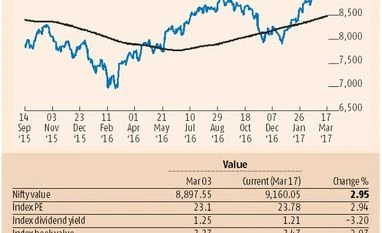
Equity investors have pushed indices into unreal zones. The Nifty has hit new record highs several sessions in succession and smaller stocks have outperformed the giants. Interestingly, as mentioned above, the bulk of buying has come from overseas investors and retail, with domestic institutions selling into the rally. Multiple stocks have hit record highs in the rally. It’s almost self-evident that an index PE of 24 is hard to justify, given the current EPS growth rates or prevailing interest rates. 

However, technical trends can last for long periods even if the market seems overbought or overvalued. Every trend-following system would advocate going long and staying long. As an investment banker once famously remarked, “While the music’s playing, you’ve gotta dance!”

One subscription. Two world-class reads.

Already subscribed? Log in

Subscribe to read the full story →
*Subscribe to Business Standard digital and get complimentary access to The New York Times

Smart Quarterly

₹900

3 Months

₹300/Month

SAVE 25%

Smart Essential

₹2,700

1 Year

₹225/Month

SAVE 46%
*Complimentary New York Times access for the 2nd year will be given after 12 months

Super Saver

₹3,900

2 Years

₹162/Month

Subscribe

Renews automatically, cancel anytime

Here’s what’s included in our digital subscription plans

Exclusive premium stories online

  • Over 30 premium stories daily, handpicked by our editors

Complimentary Access to The New York Times

  • News, Games, Cooking, Audio, Wirecutter & The Athletic

Business Standard Epaper

  • Digital replica of our daily newspaper — with options to read, save, and share

Curated Newsletters

  • Insights on markets, finance, politics, tech, and more delivered to your inbox

Market Analysis & Investment Insights

  • In-depth market analysis & insights with access to The Smart Investor

Archives

  • Repository of articles and publications dating back to 1997

Ad-free Reading

  • Uninterrupted reading experience with no advertisements

Seamless Access Across All Devices

  • Access Business Standard across devices — mobile, tablet, or PC, via web or app

Next Story



