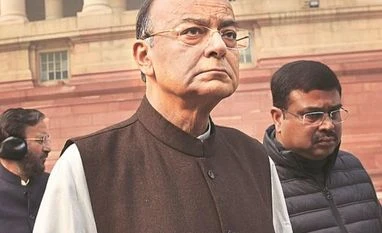
Some speculation about how the government planned to deal with the overheating economy has been set to rest by the government over the past few days. Finance Minister Arun Jaitley has said that the government remains committed to the revised fiscal consolidation path announced in the Budget, which would require it to keep the fiscal deficit at 3.3 per cent of gross domestic product (GDP) for the ongoing financial year. This would be accomplished, said Mr Jaitley, without any squeezing of capital expenditure — he argued that 44 per cent of budgeted capital expenditure had already been spent, and he was confident that the entire amount would be spent eventually. This is also good news, given the need to support growth as costs rise. Clearly, therefore, this puts the onus on revenue mobilisation. Here the government is on shaky ground. While Mr Jaitley is correct that direct tax buoyancy has been good, with more taxpayers also coming into the tax net, the indirect tax situation is less clear. Mr Jaitley said that the goods and services tax (GST) had “settled down” but the truth is that this is not the case. The government’s delays in disbursing the integrated GST pool are one indication that indirect taxes may be difficult to budget around for some time. The finance minister is confident that non-tax revenue will meet targets, but many observers will be less confident about this eventuality.
The government’s expression of confidence in the economy comes at a time when global concerns are hitting all emerging economies, and particularly causing currency depreciation. The rupee is among the worst-performing currencies in Asia over the past year, partly as a consequence of this trend and also as a result of crude oil prices putting pressure on the current account deficit (CAD). It is clear that the external account, while weak, is not in a danger zone yet, but even so the government has also announced a five-part plan to control the CAD. Many aspects of this plan are familiar, as they are similar to methods introduced in 2008 and 2013, when too the CAD was ballooning. Manufacturing companies are permitted now to borrow externally even if the loans have a maturity of a single year instead of the three-year requirement earlier. A hedging requirement for external commercial borrowing for infrastructure has been removed. An unwise limit on foreign investment in corporate bonds has been lifted. While that last measure is particularly welcome, overall the broad thrust of these changes is surprising. They seem to share the notion with earlier such packages that only short-term capital flows can solve the problem India finds itself in. But surely the lesson of earlier episodes is that in fact India needs to encourage stable capital flows, as hot money is naturally volatile and leaves the economy vulnerable to episodes such as it is currently undergoing.
Most worrying is the government’s commitment to curb “non-essential” imports. It is not the government’s place to determine, in a market economy, what is essential and what is not. More importantly, there is little doubt that the reversal in trade liberalisation that the government has undertaken over the past years, and clearly intends to continue, will only be seen as an indication of policy instability by global investors. Rather than making India look attractive, it will cause stable capital flows to dry up. A rethink is needed. Instead of import controls, an exports boost is needed — but on that front the government has done nothing so far.

 "Govt's economic fire-fighting")












 Connect with us on WhatsApp