Ever since the publication of the 2017-18 Q1 national income estimates by the Central Statistics Office (CSO) on August 31, the media has been buzzing with commentary and debate on the decline of growth in Gross Domestic Product (GDP) at market prices to below 6 per cent. Both inter and intra political party debates have heated up on the causes of the slowdown and the need for correctives. The government too seems to have at last woken to the gravity of the situation. It is mystifying as to why this all-round concern and debate was not sparked four months earlier, when the 2016-17 Q4 data were released. After all, as I pointed out in my article “Economic slowdown and revival” (Business Standard, August 10, 2017), the May 31 CSO press note clearly showed that the growth of real Gross Valued Added (GVA) had shown “steady and sizeable decline” from 8.7 per cent in 2015-16 Q4 to 5.6 per cent in 2016-17 Q4. GVA is almost identical to “GDP at factor cost”, the concept most commonly used to track economic growth until 2015 when the new GDP series was started. And the GVA number for 2017-18 Q1 has remained unchanged at 5.6 per cent. Indeed, it is significant that the entire first half of calendar 2017 has recorded only 5.6 per cent growth in GVA. And that too is probably an overestimate, since early national income estimates have the least direct information on the informal/unorganised sector, which was disproportionately hit by the November 2016 demonetisation (henceforth Demon).
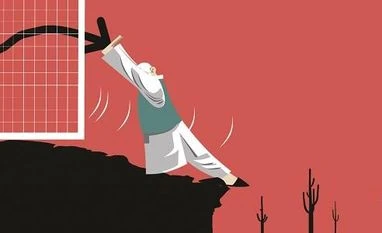
Illustration: Binay Sinha
Against this background, the principal proximate causes of the recent economic slowdown have been:
- The vanishing of the one-time terms of trade windfall from the commodity price tumble.
- The ill-advised, ill-timed and badly implemented Demon shock of November 2016, which slammed production and employment in the cash-intensive unorganised sector, including nearly all small producers of goods and services, and which had deleterious feedback effects on the organised sector. Estimates suggest a negative impact at 1-2 per cent of GVA growth over the three quarters of October 2016 to June 2017.
- The significant overvaluation of the rupee over the past 18 months, which discouraged both exports and import-competing production.
- The increasing, cumulative drag of the unresolved “twin balance sheet problems” of (mainly) public sector banks and borrowing corporates on credit, investment and growth.
- The transitional stresses of the poorly-designed and weakly implemented Goods and Services Tax (GST) initiated from July 2017. These stresses have been especially severe for small businesses (including many exporters), already reeling from the Demon shock.
So, drawing on the above, what can be done to boost economic recovery in the short-run? The challenges are daunting and the prospects highly constrained by the past:

 "Past policies constrain economic recovery")












 Connect with us on WhatsApp