Peering into the recovery: There are reasons to be optimistic

Many indicators are flashing different signals, and we try to peer into the incipient post-pandemic recovery
trade, export, container, import, economy, sea, business, seafarer, merchan navy
Illustration: Ajay Mohanty
Ajay Shah
6 min read Last Updated : Nov 16 2020 | 8:59 AM IST
The Indian economy is in an interesting moment, where output is below the level of a year ago, but the glass is half full with momentum in many areas. We look at a few indicators with data for the July-August-September quarter or monthly data for September or October. We see a wide spectrum of outcomes, from profit after tax growth for non-financial listed companies of over 41 per cent to consumer sentiment of -51 per cent. The parts of the economy, which have started coming into full operations will send demand signals into the rest of the economy, and in coming months, many of the other indicators may be expected to come back to positive values for year-on-year (YoY) growth.

India fared relatively well in the pandemic when it comes to sickness and death and when compared with projections which were made in February and March. It is now increasingly clear that a large swathe of the Indian population has been exposed to the virus, and has developed immunity, with relatively mild experiences of sickness or death. We do not really know why SARS-Cov-2 was relatively kind to people in India and other poor countries. What we now know with increasing confidence is that a large fraction of the Indian population has immunity, and by December, we are likely to have “herd immunity” (with declining numbers of infected people) in many regions.

The table shows 11 revealing indicators with the latest values for year-on-year growth. In the case of monthly data, the values for September and October are shown, and in the case of quarterly data, the value for the July-August-September quarter are shown.

Non-financial listed companies have shown an interesting combination of -9.2 per cent sales growth, but 41 per cent profit growth. Perhaps these firms had sharply pulled back on expenses, perhaps they had expected India’s encounter with Covid-19 to be worse than what actually happened, and this has generated a surprising and highly positive result. This performance on profit will do a lot to bring back a skip in the step for the leadership of large firms. It is, however, bracing to see that the top-line shrank by 9.2 per cent nominal, which is consistent with the 13 per cent decline in government tax collections. Bank credit growth is also negative in real terms, but this may reflect the sustained difficulties of Indian banking in the period after 2012, rather than demand for credit from firms and individuals.

Looking forward, a key question lies in the extent to which some firms are able to distil the experience of the pandemic into permanent productivity gains. Will we really go back to working in offices as before? Will we go back from a shop floor managed through a computer screen, to casual conversations on a shop floor? Once new management techniques have been perfected for the work from home (WFH) environment of 2020, many firms may not return to their old ways. For many firms, production levels of a year ago are now feasible at a structurally lower expenditure profile. The firms that make greater progress on modified processes in 2020, will create intense competitive pressure upon their rivals who do not.

Illustration: Ajay Mohanty
If this high level of profit is maintained for the October-November-December quarter, we may expect firms to start coming back to normalcy on discretionary expenses in early 2021. In this happy scenario, the stock of private projects under implementation (which has the latest value of -5.5 per cent growth for September) could come back to positive values by March 2021.

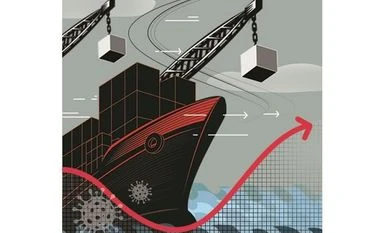
Growth is visible in exports. The world economy is coming back and Indian exporters are getting orders. In contrast, imports growth remains in negative territory. Ordinarily, the import of raw materials in this month would have gone into exports of the next month, so export-linked imports would have fuelled better performance of imports. The negative values for the growth of imports suggest that this aspect is swamped by sluggishness in domestic demand, which is consistent with the picture seen in -9.2 per cent sales growth.

There is a sense of recovery in the change from September to October in electricity generation (which went from 4.77 per cent to 8.88 per cent), the consumption of petroleum products (-4.32 per cent to 2.5 per cent) and imports (-12.17 per cent to -4.59 per cent). If this momentum is maintained, output in October-November-December will work out pretty well.

There are lead/lag relationships between profit, employment and investment. Firms tend to first achieve sustained profits, then add workers to existing production facilities to cope with the first tendrils of sales growth, and only embark on investment, when sustained growth of sales is quite likely and existing production lines are fully utilised. By this reasoning, the recovery of employment comes before the recovery of investment.

The number of employed persons is about two per cent down compared with a year ago. Firms are generally loath to recruit until existing employees are fully utilised (and the observed decline in jobs is biased by workers with high firm-specific capital who were not sacked, who are likely to be under-utilised at 9.2 per cent lower sales). In addition, the productivity gains of 2020 imply that the output of 2019 can be replicated with fewer employees. We need to debate: When sales growth comes back to zero per cent YoY, how many fewer jobs will the economy have? These concerns are probably reflected in consumer sentiments. The value for September was 58 per cent down compared with last year, and there was a small gain to 51 per cent down in October.

It is easy to decry the 41-per-cent growth in profit when juxtaposed against the 51 per cent decline in consumer sentiment, coupled with sluggish growth in the number of employed persons. But we should see the various elements of the market economy are deeply interconnected. The only path to recovery of the economy lies in profit growth that triggers off employment growth, and finally investment. The most important good news from the July-August-September quarter is that non-financial listed companies did well on profit.

The writer is an independent scholar

One subscription. Two world-class reads.

Already subscribed? Log in

Subscribe to read the full story →
*Subscribe to Business Standard digital and get complimentary access to The New York Times

Smart Quarterly

₹900

3 Months

₹300/Month

SAVE 25%

Smart Essential

₹2,700

1 Year

₹225/Month

SAVE 46%
*Complimentary New York Times access for the 2nd year will be given after 12 months

Super Saver

₹3,900

2 Years

₹162/Month

Subscribe

Renews automatically, cancel anytime

Here’s what’s included in our digital subscription plans

Exclusive premium stories online

  • Over 30 premium stories daily, handpicked by our editors

Complimentary Access to The New York Times

  • News, Games, Cooking, Audio, Wirecutter & The Athletic

Business Standard Epaper

  • Digital replica of our daily newspaper — with options to read, save, and share

Curated Newsletters

  • Insights on markets, finance, politics, tech, and more delivered to your inbox

Market Analysis & Investment Insights

  • In-depth market analysis & insights with access to The Smart Investor

Archives

  • Repository of articles and publications dating back to 1997

Ad-free Reading

  • Uninterrupted reading experience with no advertisements

Seamless Access Across All Devices

  • Access Business Standard across devices — mobile, tablet, or PC, via web or app

More From This Section

Disclaimer: These are personal views of the writer. They do not necessarily reflect the opinion of www.business-standard.com or the Business Standard newspaper

Topics :CoronavirusIndian EconomyEconomic recovery

Next Story



