Shyam Ponappa: Pathfinding approach for Digital India

It's not only the installation of the OFC, but of ensuring quality and reliability
Graph
Graph
Shyam Ponappa
Last Updated : Feb 01 2017 | 12:43 AM IST
Most people believe an optical fibre cable (OFC) connection is necessary for broadband. While largely true, this is often financially viable only in urban agglomerations. What is less known is that trading companies use wireless links between New York and Chicago for high-speed electronic trades [1]. For people outside urban clusters, wireless is a less expensive alternative to fibre. They get only a few megabits per second, but realistically, ubiquitous broadband at 2 Mbps would be great.

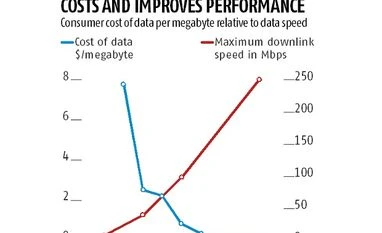
Three factors are driving internet access and usage in India. An overriding factor is the growth of wireless devices and traffic as a global phenomenon. Cisco estimated in June 2016 that in 2015, wired access comprised 52 per cent of IP traffic, but would reduce to one-third by 2020, while wireless access would increase to two-thirds. This trend is reinforced by another factor: Innovation that lowers costs and improves performance in mobile wireless (Chart 1).
 
Metropolitan and urban areas have additional factors, such as intense competition in OFC in localities with high commercial potential. Fibre is preferable provided the installation is feasible at reasonable cost, and is commercially sustainable. There are exceptions, as in the high-speed trading links mentioned above, or where users are geographically dispersed. Even in dense urban areas, it is sometimes impractical to install OFC connections because of congestion and/or rights-of-way costs.

Sources: Cisco Visual Networking Index; International Telecommunication Union; IE Market Research; Motorola, Deutsche Bank; Qualcomm
Note: Data speed indicated the maximum downlink speed, not average observed speeds. The average observed speeds depend on many factors, including infra, subscriber density and device harware and software

The third factor is the combination of the geographic spread of our population, the concentration of broadband penetration (Chart 2), and the limited coverage of OFC networks. While major cities and their connecting links are covered by OFC, less populated and less commercially attractive areas between them are not.  In hilly terrain, there is considerable difficulty in laying OFC, which extends far beyond cost.  In urban areas, cost can be a deterrent because we lack reasonable, uniform charges for rights-of-way. Such procedures and practices are difficult to institute and enforce, but are essential for robust, viable OFC networks.

Source:  http://www.thehindu.com/sci-tech/technology/internet/The-India-wide-web/article14588938.ece

It’s not only the installation of the OFC, but of ensuring quality and reliability. OFC networks in India apparently suffer from 12 to 14 cuts per km per month, whereas the international benchmark is 0.7 km per month. Apart from more frequent repairs, the capital expenditure is nearly three times as high as in Australia or the US. [2]
 
Estimates for installing OFC using standard procedures vary from about Rs 1 lakh to Rs 4 lakh per km. However, there have been attempts at getting costs down by radical changes in approach. For example, Andhra Pradesh considered an OFC installation of 22,500 km estimated Rs 4,700 crore. By stringing fibre overhead along electric cables, however, the estimate was cut to Rs 333 crore, reducing costs from Rs 21 lakh to under Rs 1.5 lakh per km. It remains to be seen how this network will perform in terms of quality and reliability. Also, wireless technology is needed to extend connectivity from the fibre to villages, and cellular network costs rise with less bandwidth. For instance, one estimate is that excluding spectrum costs, a network using 5 MHz costs nearly 70 percent more than using 20 MHz.
 
For all these reasons, we need concerted action to redesign our approach to broadband, covering the fundamentals of infrastructure, spectrum and market design.  The exponential growth in mobile services has reached a plateau, and is complicated by the taint of the 2G spectrum scams. This has resulted in a mindset combining witch-hunting and paranoia in the press, the public, government departments, and the judiciary. This is not conducive for the coordinated, collective strategy and action that is required to extricate ourselves. Several proven wireless technologies are not permitted in India, although the Telecom Regulatory Authority of India has recommended their use. Methods to increase connectivity like those listed below are urgently needed, with requisite environmental safeguards such as the use of renewable energy.
 
  • 60 GHz (V band) wireless gigabit for short-haul; 
  • 70 and 80 GHz (E band) for multi-gigabit backhaul up to 5 km;
  • TV White Space for the middle mile from the fibre to users in villages up to 8-10 km away in a single hop;
Additional steps, e.g.: 

  • Increasing unlicensed spectrum in the 5.8 GHz band from 50 MHz to 80 MHz to enable 866 Mbps per channel, or more for gigabit capacity;
  • Enabling secondary sharing of spectrum bands such as TV White Space, which has the possibility of existing Indian IPR establishing domestic manufacturing and dominating this niche;

It is evident that despite intense efforts by the people involved, our existing approach is simply not getting us to where we need to be. This has been repeated by government and private sector representatives many times. There’s no substitute for developing a sound approach, collectively and participatively, with professional facilitation, cutting across government, industry (operators and equipment providers), users, and the judiciary, to devise whatever solutions will deliver better results.  We have to move away from adversarial deadlock.  

A good way to begin is by accepting facts, and considering the evidence before dismissing points of view. For licensing, we know that government collections from revenue sharing far exceed the auction fees foregone (“Breakthroughs Needed for Digital India”, organising-india.blogspot.in). We have the experience of building other infrastructure such as roads and airports on revenue-sharing principles.  We have to take a similar systematic, phased approach to designing and implementing broadband networks. Policies on infrastructure resource use including spectrum need to be rationalised, and the sector organised through participative path-finding and problem solving.  We have to build national champions in manufacturing to keep costs affordable, for instance, using TV White Space. India could set the standard with its IPR and products where OFC is infeasible or unviable for connectivity to villages and rural clusters. Both the administrative and political leadership need to do this, working with all stakeholders, and not treating any of them as adversaries, or cronies.
 
shyamponappa@gmail.com
1. ‘Information Transmission between Financial Markets in Chicago and New York’,  Gregory Laughlin, Anthony Aguirre, and Joseph Grundfest, Cornell University Library, arXiv.org
2. Conference presentation, Sterlite, http://www.trai.gov.in/sites/default/files/Sterlite-Badri.pdf

One subscription. Two world-class reads.

Already subscribed? Log in

Subscribe to read the full story →
*Subscribe to Business Standard digital and get complimentary access to The New York Times

Smart Quarterly

₹900

3 Months

₹300/Month

SAVE 25%

Smart Essential

₹2,700

1 Year

₹225/Month

SAVE 46%
*Complimentary New York Times access for the 2nd year will be given after 12 months

Super Saver

₹3,900

2 Years

₹162/Month

Subscribe

Renews automatically, cancel anytime

Here’s what’s included in our digital subscription plans

Exclusive premium stories online

  • Over 30 premium stories daily, handpicked by our editors

Complimentary Access to The New York Times

  • News, Games, Cooking, Audio, Wirecutter & The Athletic

Business Standard Epaper

  • Digital replica of our daily newspaper — with options to read, save, and share

Curated Newsletters

  • Insights on markets, finance, politics, tech, and more delivered to your inbox

Market Analysis & Investment Insights

  • In-depth market analysis & insights with access to The Smart Investor

Archives

  • Repository of articles and publications dating back to 1997

Ad-free Reading

  • Uninterrupted reading experience with no advertisements

Seamless Access Across All Devices

  • Access Business Standard across devices — mobile, tablet, or PC, via web or app

More From This Section

Disclaimer: These are personal views of the writer. They do not necessarily reflect the opinion of www.business-standard.com or the Business Standard newspaper
Next Story



