Status revoked

There will always be ever more stringent loyalty tests, and at some point everyone with a soul will fail to clear at least one
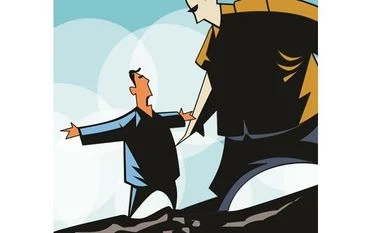
Illustration by Binay Sinha
Mihir S Sharma
5 min read Last Updated : Nov 08 2019 | 8:43 PM IST
Eventually, illiberal governments come even for those who welcomed their ascent. That is one of the great lessons of history, and if India is unlucky a similar story will play out here over the next few years. You cannot ever demonstrate enough loyalty to an illiberal government unless you are already part of whichever in-group it prefers. In India, if you have a “Muslim-sounding” name, have served a past government, are linked to the West through education or commerce or funding, have spoken on social media of “human rights” — all these are, in one way or another, indicators of potential disloyalty. 

The latest incarnation of this effect is what has happened to the writer Aatish Taseer. It appears that his status as an Overseas Citizen of India has been revoked — “revocation of status” is something the government is pretty good at, apparently. The Ministry of Home Affairs said on Twitter that “Mr Aatish Ali Taseer” — a nice touch that, like Barack Hussein Obama — “while submitting his PIO application concealed the fact that his late father was of Pakistani origin”. Now, on the face of it, this appears truly representative of the Indian state’s famed brilliance. Taseer has written columns, essays, and entire books about his complicated relationship with Salman Taseer, the murdered British-Pakistani politician who was his biological father. Only the Indian state could say he was “concealing” it. It also reveals the Indian state’s general inability to deal with modern life, and its realities such as single-parent families. Salman Taseer did not bring up Aatish Taseer, who was in effect the child of a single mother. Surely the PIO application should reflect the fact that single mothers exist? That in such case, the applicant’s biological grandparents and great-grandparents on the “other side” are irrelevant? Or is any link, however distant, to Muslim countries so insidious, like a worm coiled deep in your soul, that even if you spend your life in India re-awakening your Hindu, “Indic” heritage it is still too dangerous to allow you to stay? 

Taseer says, and many believe, though the Union home ministry has officially denied it, that the revocation of Taseer’s status is linked to an article he wrote on the subject of the Prime Minister for Time magazine. I myself have not read it, so cannot let you know whether the article was of earth-shattering novelty, though the chances are it was not. Nevertheless it apparently came to the attention of the Prime Minister, who was quoted by NDTV as saying that the magazine was foreign and the writer from “a Pakistani political family”. The home ministry perhaps felt itself constrained to follow up. 

I do not, as it happens, believe that the Prime Minister himself sought that Taseer’s status be revoked. That would be ridiculous and uncharacteristic of the PM. It is also not how things happen in illiberal states. In such places, lower-level functionaries of every rank and hue seek to ingratiate themselves with the highest authority by going pell-mell after dissenters and outsiders. All you have to do is indicate who the outsiders are — and, fortunately, there are usually relatively easy indicators. Somebody with the middle name “Ali” is never going to be an insider in today’s India, after all. 

The advantage for these aspiring apparatchiks in India is that our rules, laws and procedures are so spiky with arbitrariness and contradictory principles that they can be weaponised almost at will. If citizenship rules don’t get you, tax will; if tax doesn’t, FEMA can; if all those fail, then surely you’ve said something on Twitter that violates colonial-era provisions of the penal code. You might want to give in to schadenfreude at the sight of those who minimised such concerns in the past now being caught up in them. How else should one feel when a former home minister, under whose watch the government went after foreign-funded NGOs, independent-minded researchers and much else, is himself incarcerated because of the oppressive rules that he failed to change and in fact used against dissenters? How should one react when the ruling party comes after a man who was a prominent supporter in the years leading up to 2014, and who said in 2012, when debating whether India should welcome foreign writers, that “a little xenophobia is not such a bad thing” in a country overrun with invisible foreign power? (Taseer meant Sonia Gandhi, of course, who was apparently still a foreigner in 2012.) 

But such schadenfreude would be both unkind and unwise. The fact is that similar things could happen to anyone and probably will. It is impossible to ever be loyal enough. There will always be ever more stringent loyalty tests, and at some point everyone with a soul will fail to clear at least one. And then, well, those very people whose approval you once sought, whose rise you once praised, whose triumph you welcomed — those people will see you as an outsider, and “revoke your status”.

One subscription. Two world-class reads.

Already subscribed? Log in

Subscribe to read the full story →
*Subscribe to Business Standard digital and get complimentary access to The New York Times

Smart Quarterly

₹900

3 Months

₹300/Month

SAVE 25%

Smart Essential

₹2,700

1 Year

₹225/Month

SAVE 46%
*Complimentary New York Times access for the 2nd year will be given after 12 months

Super Saver

₹3,900

2 Years

₹162/Month

Subscribe

Renews automatically, cancel anytime

Here’s what’s included in our digital subscription plans

Exclusive premium stories online

  • Over 30 premium stories daily, handpicked by our editors

Complimentary Access to The New York Times

  • News, Games, Cooking, Audio, Wirecutter & The Athletic

Business Standard Epaper

  • Digital replica of our daily newspaper — with options to read, save, and share

Curated Newsletters

  • Insights on markets, finance, politics, tech, and more delivered to your inbox

Market Analysis & Investment Insights

  • In-depth market analysis & insights with access to The Smart Investor

Archives

  • Repository of articles and publications dating back to 1997

Ad-free Reading

  • Uninterrupted reading experience with no advertisements

Seamless Access Across All Devices

  • Access Business Standard across devices — mobile, tablet, or PC, via web or app

More From This Section

Disclaimer: These are personal views of the writer. They do not necessarily reflect the opinion of www.business-standard.com or the Business Standard newspaper

Topics :IndiaHuman Rights

Next Story



