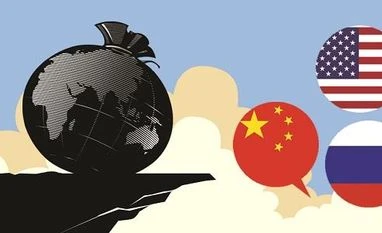
Three big questions now matter for the world economy. In the US, macroeconomic stability is threatened by an inflation crisis, and there are concerns about monetary policy strategy there. In China, a big non-market economy was built up, but it suffers from internal contradictions, and there is a spot of distress. While Russia is a small economy, the combination of war in Ukraine and the suddenness of the economic collapse can generate ripples into the world economy. We should worry about the possibility of tail events in the coming year.
The most important element of the global macro is the US. US macro policy played well in counteracting the pandemic, and India has been one of the beneficiaries of expansionary macro policy in the US and in other developed markets (DMs). But in the din and fury of the battle, US macro policy over-compensated.
The US central bank is organised around a 2 per cent inflation target. But US inflation has gone well beyond 2 per cent. There are signs of a 'wage-price spiral', where wage growth feeds into higher prices and then back into wage growth. In the 'great moderation' of the last 40 years, when all DM central banks moved to inflation targeting, such difficulties had been abolished.
The present stance of the US Fed consists of two things. It is expected that there will be a hike in the policy rate of about 150 basis points in a year, and it is claimed that this will suffice to bring inflation under control. The problem with this position is that even after the short rate has been raised by 150 basis points, it will remain negative in real terms. We run the risk that through calendar 2022, monetary policy is in fact not disinflationary.
The second problem for the world economy is China. While China is a big economy, it does not have good institutions, and in many respects, resources are allocated by officials and not the price system. This results in fragility. For years, officials have goosed up growth through policies that encourage borrowing and high real estate prices. With the failure of Evergrande, and many other real estate companies, the economy is facing distress.
Illustration: Ajay Mohanty
From the late 1970s, global firms felt they could commit to China, trusting in its evolution into a mature market economy located in a liberal democracy. After Xi Jinping took charge, China has turned inwards, into nationalism and authoritarianism. The process of advancement into good institutions has broken down. As a consequence, global asset allocators and non-financial firms have been reducing their prioritisation of China. China's share in US imports has been declining, owing to MNCs shifting production out of China.
As with China, in Russia also, global firms once felt they could commit, trusting in its evolution into a liberal democracy and market economy. Now all external players are holding large losses in Russia. This gives one large economy (China) and one small economy (Russia) where external participants have been disappointed.
The central problem in globalisation is 'home bias', the bias in the minds of DM asset allocators and boards, to stay within DMs to a disproportionate extent. Large losses in China and then Russia will reinforce home bias, raise the bar for the minimum institutional quality that India needs to show the world, and adversely impact the world economy.
These three problems are hitting the world economy at once: Concerns about US inflation and monetary policy, concerns about macro stability in China, and a sudden collapse in a small economy, Russia. Each of them would have been easier to comprehend and absorb if they had come alone. But all three are in motion and will interact nonlinearly.
It is likely that problems will erupt in various elements of the world economy, in response to these stresses. The precise causal chain will surprise us, as we do not understand economics enough to pinpoint the precise ways in which things will go wrong.

 "Three problems for world economy")












 Connect with us on WhatsApp