After the rocky start to his presidency, US President Donald Trump’s approval ratings according to the latest Rasmussen poll is 50 per cent compared with the 45 per cent for former President Barack Obama at the same stage in his presidency. (‘America beginning to love its president’, Daily Telegraph, February 24, 2018). This is due to two factors which have pleased his base: His appointment of a conservative justice to the Supreme Court to replace late Justice Antonin Scalia; and his removal of various Mr Obama’s regulations, particularly environmental ones damaging the US’ energy sector, including coal. This has converted the US into an energy superpower and given a new lease of life to Mr Trump’s supporters in the coal industry. But, in my view Mr Trump’s more favourable ratings are based on December’s Republican tax reform bill.
Illustration by Binay Sinha
I have argued for the classical liberal view in my Reviving the Invisible Hand (Chapter 2, pages 248-249). The ideal tax from this viewpoint is a flat tax which limits the fiscal predation of governments. The ideal base of such a tax is consumption. This can be approximated by replacing multiple marginal tax rates with a single marginal rate and abolishing all the complex systems of allowances and relief which governments use for social engineering or for buying votes. A high personal tax-free allowance allows the poor to be taken out of the tax net and imparts progressivity to the system. If all taxes — corporate, personal income, and commodity (for instance value added tax, or VAT) — are set at the same rate, there would in effect be a consumption tax which abolishes all double taxation of dividends.
The final tax reform passed by the Republican majority in Congress brings the US tax code closer to the classical liberal ideal. The most important aspects are the reduction in the corporate tax rate, and lowering the user cost of capital by allowing depreciation of the full cost of investment at the time it is made. It also provides incentives for multinationals to repatriate the large profits they are holding abroad. These should raise investments, both domestic and foreign, raising gross domestic product (GDP). The bill also reduces marginal tax rates on labour income for most taxpayers, except for those affected by the base-broadening measure of limiting the federal deductibility of state and local income taxes. As most of those affected live in the highly taxed ‘blue’ states, this also makes the relatively lightly locally taxed ‘red’ states more attractive for the movement of the highly skilled.
Looking at the 2017 “Tax Cuts and Jobs Act” and the 2018 “Bipartisan Budget Act” together, it is clear that the Republicans have given up being deficit hawks. The budget removes the previous caps on discretionary spending, particularly on the military, whilst doing nothing to finance increases by any cut in spending on entitlements. It is estimated to add another $2 trillion to the national debt.
Thus the Trump tax and spending bills are a replay of the Ronald Reagan fiscal stance, when tax cuts were combined with increased military spending to take on ‘the evil empire’, and with a relaxed official attitude to the ensuing fiscal deficit. Does this matter? Given that the US dollar is still the world currency and given the depth of the US capital markets, the demand for US public debt is unlikely to disappear. There is — alas for fiscal hawks — a lot of potential fiscal ruin left in the US. But, depending on the size of the supply side boost to US growth from the tax cuts the burden of the US debt will diminish, and be good for the world economy, including India. Whilst in the geopolitical contest with China, Mr Trump is now doing what Reagan did in taking on the latest evil ‘wannabe’ empire by financing a large expansion of the military prowess of the only current superpower. This is clearly in Indian geopolitical interests.

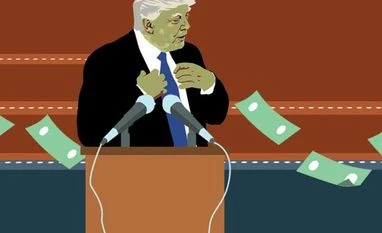 "Trump tax and spending bills are a replay of Ronald Reagan fiscal stance")











