Twinkle Khanna talks about how she acquired the 'libtard' moniker

Khanna is just out with her first novel, 'Pyajamas are Forgiving', after 'Mrs Funnybones', which was a compilation of her columns, and 'The Legend of Lakshmi Prasad', an anthology of short stories

Twinkle Khanna
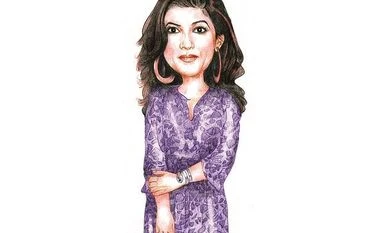
Twinkle Khanna. Illustration: Binay Sinha
Veenu Sandhu
Last Updated : Sep 14 2018 | 9:52 PM IST
Built in 1931, The Imperial was Delhi’s first luxury hotel. While a lot has changed in the years since it came into being, it has held its own. It seems fitting that I should be meeting Twinkle Khanna here. Like the grand, old hotel, she too has stayed true to herself, even when life wanted her to be otherwise.

Khanna is just out with her first novel, Pyajamas are Forgiving, after Mrs Funnybones, which was a compilation of her columns, and The Legend of Lakshmi Prasad, an anthology of short stories. Both of those sold over 100,000 copies, with Mrs Funnybones making her India’s highest-selling woman writer of 2015.

I meet Khanna in a private section on the ground floor of the hotel, not far from its bar that is famously named Patiala Peg — a tribute to the oversized measure as against the usual 60ml. It is too early for a Patiala peg, or in fact, for a peg of any measure. And, it is too late for 0plunch. So we settle for lemonade, a mix of sweet, salty and sour — a concoction one can get philosophical about. She gets up to ask for the drink, addressing the staff by their names.

Until five years ago, before she started her column in The Times of India, Khanna was almost a forgotten personality. If at all, she was identified as Rajesh Khanna and Dimple Kapadia’s daughter, the wife of Akshay Kumar, and an actor who had starred in some unremarkable films.

That was then. What you see today is a woman who has a gift of words, who has established herself as a widely read author and who is not afraid to stick her neck out to speak her mind. And she usually does it with humour, which is seldom caustic but often pointed.

Politicians and godmen, including Uttar Pradesh Chief Minister Yogi Adityanath, yoga guru Ramdev and spiritual leader Sri Sri Ravi Shankar, have often been at the receiving end of this humour. There have also been times when she has had to retract her tweets and apologise following protests, as it happened when she once tweeted about Sri Sri.

“I get trolled mercilessly,” she admits. “It is not possible to be completely unaffected by it [trolling] but with time, I have learnt to ignore it.” However, if the criticism comes from people she respects, she says she considers it and examines it carefully. “As a columnist when you write things, there are pressures from various agencies that tell you to restrain yourself on certain avenues,” she says, pensively stirring her drink. “You have to turn thick-skinned, defiant and rebellious, and continue. I have to do what I have to do, otherwise I have to leave what I am doing. There are only two choices.”

So she tweets on, despite the trolls. One of her recent tweets that put them — the trolls — into overdrive was about the arrest of several activists: “Freedom is not lost all at once, it is lost in units of one, one at a time, one activist, one lawyer, one writer till finally it’s each one of us”. In response, one posted a picture of Rajesh Khanna with Sonia and Rajiv Gandhi at a polling booth. (Her father had contested the Lok Sabha election in Delhi on a Congress ticket against Bharatiya Janata Party leader Lal Krishna Advani in 1991 and lost by a thin margin.) She is, however, no Congress sympathiser given the nature of her tweets about Rahul Gandhi.

At a time when being identified as a “liberal” has become problematic, Khanna says she has also been called “libtard” (a portmanteau of “liberal” and “retard”). “I am not very good at toeing the line; I have never been,” she says.

In contrast to her Twitter timeline, her husband’s is cautiously politically correct and his recent choice of films and endorsements has given many the impression that he is trying hard to be on the right side of the political establishment.

When she had first opened her Twitter account in her name, her family had told her she wasn’t cut out for the medium and should exit it, which she did. A politician had been slapped and she had tweeted: “What a slap, Sirji.”

Later, when her column, Mrs Funnybones, started, she tried to revive that account only to realise it was gone. So she now tweets as @mrsfunnybones. The name, she says, was a result of an irksome problem. “I have broken every bone in my body. I was in a cast practically every year till I turned 40. With Mrs Funnybones, I tried to make light of the matter.” Her mother, she says, thinks the problem is not with her bones. “She says I keep twisting my foot because I keep putting it in my mouth.”

When students at marketing and management colleges, where she sometimes gets invited to speak, ask how she created this brand name, she tells them, “I was just being myself.”

The lemonade is by now warm. Khanna pauses to take a sip. And then she talks about her childhood and her short film career. She is honest and open. “I went to boarding school in Panchgani (a hill town in Maharashtra). Before that, I lived with my parents in Bombay. It was a very privileged life and then things changed and my circumstances changed as my parents split.”

She says the person she is today was defined by that phase in her life. “That’s when I first started writing. I went from somebody who was very complacent and probably came 33rd in a class of 40 to someone who decided she was going to top her class. And I did, all through school.”

She says she wanted to become a chartered accountant. “I applied for my CA entrance exam, but again, you know…” The lemonade sits forgotten. “I remember my mum saying that this is the only time you can do this [films] and if you want to do something else, you can always do that later, but you can’t do this later.”

So she got into films, a profession which she says did not play to any of her strengths. “I found the things that were required of me very difficult. I was a tomboy who wouldn’t wear lipstick till I was on the set.” So, even though she was a child of the film industry, “it was a bit of a shock for me”. Acting, she says, requires you to open up too much about yourself. “I would rather hide behind words.”

So, while still in the movies, she started doing other things — like working in design and getting involved in her mother’s business. (Dimple Kapadia would make candles at home and had turned it into a business.) “I knew very clearly that the moment I could, I would stop — and I did stop,” she says. While in school, Khanna had started writing a book that she never got down to completing. Away from the spotlight, the mother of two says she was doing decently and was satisfied. At best she thought she would finish the book in her 60s. “But I never thought I would spend my 40s writing.”

When an editor friend invited her to write a column, she was tentative but decided to give it a shot. “Having failed as an actor  once, it did not make me scared of failure; it made me immune to it,” she says. “So I took a leap and I could have landed right on my a** but luckily my a** is well padded, so I would have been fine. But I landed on my feet.”

Though she has had a column to her name for five years and has written three books, Khanna does not identify herself as a writer. “I am still a reader,” she says. “Books and words are my world — they’ve always been.”

One subscription. Two world-class reads.

Already subscribed? Log in

Subscribe to read the full story →
*Subscribe to Business Standard digital and get complimentary access to The New York Times

Smart Quarterly

₹900

3 Months

₹300/Month

SAVE 25%

Smart Essential

₹2,700

1 Year

₹225/Month

SAVE 46%
*Complimentary New York Times access for the 2nd year will be given after 12 months

Super Saver

₹3,900

2 Years

₹162/Month

Subscribe

Renews automatically, cancel anytime

Here’s what’s included in our digital subscription plans

Exclusive premium stories online

  • Over 30 premium stories daily, handpicked by our editors

Complimentary Access to The New York Times

  • News, Games, Cooking, Audio, Wirecutter & The Athletic

Business Standard Epaper

  • Digital replica of our daily newspaper — with options to read, save, and share

Curated Newsletters

  • Insights on markets, finance, politics, tech, and more delivered to your inbox

Market Analysis & Investment Insights

  • In-depth market analysis & insights with access to The Smart Investor

Archives

  • Repository of articles and publications dating back to 1997

Ad-free Reading

  • Uninterrupted reading experience with no advertisements

Seamless Access Across All Devices

  • Access Business Standard across devices — mobile, tablet, or PC, via web or app

Next Story




