No country is better placed than India to take advantage of the China+1 strategy. But first industry must believe in itself, then trade can drive the future
7 min read Last Updated : Sep 21 2022 | 10:30 PM IST
The world is full of regional trade agreements. India is no exception. Through 2012, India signed trade agreements with Sri Lanka, Bangladesh, Asean, Japan and South Korea. Across industry and government, a view emerged that free trade agreements (FTAs) had not served India well, and had even actively damaged Indian industry. This view was flawed, but it led to our withdrawal from a key agreement with much of Asia — the Regional Comprehensive Economic Partnership or RCEP — in 2019. After a long hiatus, we have returned to the FTA negotiating table. Agreements have been signed with the UAE and Australia, and negotiations are at various stages of conclusion with the UK, Canada and the EU.
Overall, our FTAs have had little effect on our trade, accounting for 16 per cent of our trade in 2000 and 18.5 per cent of it now. They have not been a disaster for Indian industry, but we have not seen the benefits from the FTAs that we expected. Our major trading partners remain non-FTA countries: The US, China and the EU. The US has retained its importance for us in both imports and exports, while the EU has declined. The big winner is China: From 2.6 per cent of our imports and 1.5 per cent of our exports in 2000, it accounted for 16.5 per cent of our imports and 7.3 per cent of our exports in 2021 , making it our largest trading partner after the US.
So how can we benefit from FTAs? What should our FTA agenda be?
Sign FTAs that matter: We need FTAs with countries and areas that either matter to us today or will matter in the future. We should be locking-in access to our top current export markets — the US, EU and Bangladesh. And top future export markets — namely, Africa and Latin America. By dropping out of RCEP we have limited our access to Asia, the most dynamic part of the world economy. We have a second chance now, with the newly-minted Indo-Pacific Economic Framework. India has so far, mistakenly, stayed out of the trade pillar within the IPEF. We need to immediately join and systematically push a wide trade agenda there. The IPEF has the double advantage of including many countries of greatest interest to us — the US, Indonesia, Japan, South Korea, Singapore, Vietnam — and excluding China. By joining now we can help determine the course of negotiations and frame them with our national interest in mind. We must not miss this bus.
Expand ambition: Most of the world’s trade takes place within global value-chains (GVCs), where value is added stage by stage in multiple countries. One reason our old crop of FTAs had little effect is that they were inherently limited, leaving out many of the highest consumption items or imposing extended tariffs with long adjustment periods. Other countries have been much more ambitious. Asean, South Korea and Japan have FTAs with many more countries than we do, including China. Some of these are much wider and deeper than ours— the so-called zero-for-zero agreements, where zero items are excluded from the FTA and a zero tariff often apply in both directions. This enables close supply chains to develop and prosper — for example, in electronics, where components and sub-assemblies wander around Asia with tiny bits of value-addition at each step in each country. Adam Smith said 250 years ago that the “degree of specialisation is limited by the extent of the market”. By excluding many items from the agreements, we limit the extent of the market and our ability to participate in these supply chains. The key is productivity that flows from specialisation and not making everything.
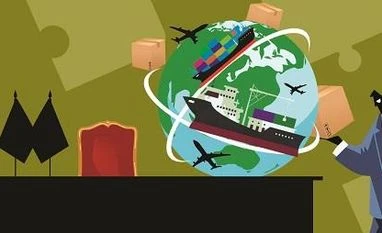
Illustration: Binay Sinha
Too often, our trade policy is dominated by simplistic thinking. We like exports, we dislike imports. But as any trade economist will tell you, a tax on imports is a tax on exports. High and growing exports of manufactured items demand high and growing imports of inputs. Consider some of our most exciting opportunities: The key input for garments is fabric, but tiny components such as buttons, zips and linings make a crucial difference. The auto industry has suppliers that cascade down six tiers, where inefficiencies at any stage make higher tiers less competitive. Our auto industry claims to be the most competitive location in the world for making small cars. Why, then, does it simultaneously argue vigorously against inclusion in FTAs with the UK and EU? We should have greater confidence in our own capabilities, and include both automobiles (everything from commercial vehicles, to cars, to two-wheelers, to construction equipment) and auto-components in all the FTAs we are signing. The UK has offered to include 99 per cent of tariff lines. India wants 100 per cent, and should get it. And we should give 100 per cent, too. Widen and deepen, in other words.
Trade patterns reflect underlying competitiveness: It is no accident that in the last two decades we have seen the greatest growth in our imports from China, South Korea and Vietnam. These are among the world’s most competitive countries, and almost any country’s trade balance has moved substantially in favour of these three. We might complain about non-tariff barriers and higher costs of doing business, but improving our competitiveness is the surest way of improving our trade balance. We should use FTAs to force competitiveness on firms. And firms, in turn, must force change in all those areas — infrastructure, regulation, ease of doing business — that reduce competitiveness.
Integrate trade and industrial policy: Our key industrial policy is the production-linked incentive scheme, which gives industry a subsidy of 1 per cent of gross domestic product over five years to increase production in 14 sectors. Combine these sectors with our trade policy. Require that all subsidies carry an export obligation (today only two or three of the 14 sectors do). Ensure that all items covered by PLI are explicitly included in every FTA we are signing. (All white goods were included in the FTA with the UAE except the one where there is a PLI scheme — air-conditioners.)
Capitalise on China+1 strategy: FTAs must lock in access to exports and imports. Together with items that matter now — automobiles and components, white goods, textiles and garments, chemicals and pharmaceuticals, and engineering — we must include items that will matter in the future. Including e-commerce, electric vehicles, and data privacy in the trade negotiations would be a fine way of forcing ourselves to quickly make up our minds where we stand on them. The world is looking for China+1 supply resilience. No country is better placed than India to take advantage of this. But to do so, Indian industry must believe in our own ability to compete with the best within India and the rest of the world. Trade can then drive the future of Indian industry.
ndforbes@forbesmarshall.com. The writer is co-chairman of Forbes Marshall, past president of CII, and chairman of Centre for Technology Innovation and Economic Research and Ananta Aspen Centre. His book, The Struggle and the Promise, was recently published by HarperCollins
Disclaimer: These are personal views of the writer. They do not necessarily reflect the opinion of www.business-standard.com or the Business Standard newspaper




