Beware of fake income tax e-mails

Log into your e-filing account to check if you have any outstanding demand or refund
graph
Tinesh Bhasin
Last Updated : Jul 26 2017 | 11:50 PM IST
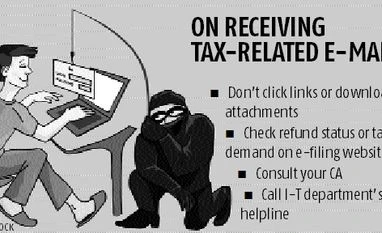
If you receive an email claiming to be from the income tax (I-T) department that there’s an outstanding tax demand that you need to pay immediately, don’t get alarmed. Get cautious. In all probability, that email is from cyber criminals, trying to trick you into revealing your bank account details.

Experts say there has been an exponential rise in such emails in the past month. “Cyber criminals are sending these emails in July as it’s the time when most people file returns and tax is on their minds,” says Amarpal Chadha, tax partner and India mobility leader, EY. He says his clients have also received emails stating there is a refund pending with the I-T department and the recipient can claim it instantly.

These emails provide a link the receiver needs to click to pay the outstanding tax demand or get the refund. Once an individual clicks on it, he is redirected to a web page that looks similar to the I-T department’s website. The individual is asked to select his bank and is redirected to another fake bank website. At this stage, as the victim tries to log into his bank account, cyber criminals capture sensitive details.

At times, the hackers are already aware of the bank account the taxpayer uses. When the individual clicks on the link provided in the email, he is taken directly to a fake website of the bank.

Recognising such fraudulent emails is not difficult. The first thing to look at is the email address. The email might seem to be originating from incometaxindia.gov.in but many service providers, such as Gmail, inform the user if it actually originated from that website. You will see such emails will have ‘via’ right after the email address, and then the name of the server. This means the email was sent via another mail service.

The I-T department sends emails from the following IDs: donotreply@incometaxindiaefiling.gov.in, intimations@cpc. gov.in, and campaign@cpc.gov.in. The fraudulent emails in circulation at present are from donotreply@incometaxindiafiling.gov.in. But some technologies can help scammers to send emails that seem to be from the official addresses. 

If you happen to click on the link provided in the email, which takes you to the fake website of the bank or I-T department, check the address. It will not be the same as your bank’s or the I-T department’s. Whenever you are transacting online, check if the address starts with HTTPS, rather than HTTP. It should also have a closed lock sign. This means the website is secure and verified. The best way to cut risk is to use a licensed antivirus software. There is also a possibility that the email has an attachment instead of a link. Do not download attachments, as these could be spyware that could get installed on your computer.

Tax experts say the I-T department does not send out tax demands or refunds in July or August. “If you receive an email this month or the next, that itself should be alarming. The authorities also don’t ask you to provide bank details separately. Taxpayers have to give those details when filing returns,” says Suresh Surana, founder of RSM Astute Consulting Group.

Fraudulent emails usually ask you to pay the outstanding demand immediately or state that you need to claim a refund within the next seven days. “Any communication from the I-T department provides at least 30 days to the taxpayer,” says Chadha. He suggests that a tax payer always consult his chartered accountant on receiving a communication from the department, before acting on it. The receiver can also contact the I-T department at its contact numbers to check if the email he has received is authentic. Thebest option is to log into your e-filing account, where you can quickly check your refund or tax demand status. 


One subscription. Two world-class reads.

Already subscribed? Log in

Subscribe to read the full story →
*Subscribe to Business Standard digital and get complimentary access to The New York Times

Smart Quarterly

₹900

3 Months

₹300/Month

SAVE 25%

Smart Essential

₹2,700

1 Year

₹225/Month

SAVE 46%
*Complimentary New York Times access for the 2nd year will be given after 12 months

Super Saver

₹3,900

2 Years

₹162/Month

Subscribe

Renews automatically, cancel anytime

Here’s what’s included in our digital subscription plans

Exclusive premium stories online

  • Over 30 premium stories daily, handpicked by our editors

Complimentary Access to The New York Times

  • News, Games, Cooking, Audio, Wirecutter & The Athletic

Business Standard Epaper

  • Digital replica of our daily newspaper — with options to read, save, and share

Curated Newsletters

  • Insights on markets, finance, politics, tech, and more delivered to your inbox

Market Analysis & Investment Insights

  • In-depth market analysis & insights with access to The Smart Investor

Archives

  • Repository of articles and publications dating back to 1997

Ad-free Reading

  • Uninterrupted reading experience with no advertisements

Seamless Access Across All Devices

  • Access Business Standard across devices — mobile, tablet, or PC, via web or app

Next Story



