Invest in your health by setting up your very own organic kitchen garden

Growing fruits and veggies on your terrace or other available space is neither expensive nor difficult. And since the produce is chemical-free, there are huge health benefits

Kitchen garden
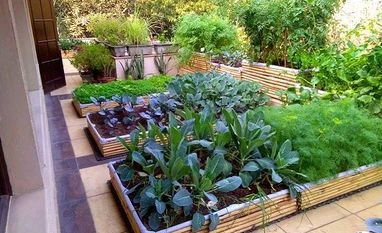
You can build food gardens in your own backyard or terrace with special planter boxes made of wood, metal or brick. These come with adequate drainage at the bottom. Picture courtesy: Edible Routes
Namrata Kohli New Delhi
9 min read Last Updated : May 25 2020 | 1:17 AM IST
You would have heard the adage: You are what you eat. Arizona-based software engineer Umesh Rohilla has taken that wisdom to heart, investing all his non-working hours to creating a kitchen garden, which today is blossoming with a wide range of vegetables, fruits and herbs. 

Back home in Delhi, his parents are delighted at the evolution of their lad, who earlier “had nothing to do with kitchen or garden, both of which were alien concepts”. Perhaps the turning point was his shifting to his countryside home in the US, where his twins were born. 

Today his all-organic garden covers an area of 100 sq feet, and is nurtured with homemade manure drawn from kitchen waste such as tea leaves, banana peels, onions, fruit waste and dry leaves. He also uses an organic neem oil pesticide. In his daily skype calls with his family, he plucks a ripe eggplant or some blushing red tomatoes, and sometimes even almonds. 

Rohilla's passion has rubbed off his Delhi-based sister, Nidhi, who at 40 years has started growing herbs and micro greens such as giloy (tinospora Cordifolia, a popular Ayurvedic herb), mint, fenugreek, coriander, carom, lemon grass, basil , curry leaves and aloe vera. 

Says Nidhi: “Herbs are easiest to grow. In fact, they are the best things to start with and can be easily grown in empty containers, plastic bottle cut-outs and recyclable tins. All are available for less than Rs 100 and most of the seeds are available in Indian kitchens while curry patta and giloy stems can be taken from the neighbourhood.”

Kitchen garden: Your food roots

The sky’s the limit to what anyone can grow. A lot depends on the space you have, the sunlight it receives, the time you have and of course, your zeal and enthusiasm. You could start with fresh greens such as spinach, fenugreek (methi), coriander (dhaniya), lettuce, cauliflower, broccoli, radish, carrot, mustard, chilli, eggplants and tomatoes. 


Says Kapil Mandawewala, founder of Edible Routes, a kitchen garden consultancy that continually nudges people into growing their food: “We believe every space is capable of growing food whether you have a terrace, a yard, a balcony or a few pots. You can grow veggies whether you have a few square feet or a few hundred square yards. Space is never a restriction because no matter how small your growing area is, you will always be able to grow something or the other. Even in 50 sq ft, you can grow five vegetables for a family of two.” 

But the ideal is about 120-150 sq ft if you want an abundance of fresh and seasonal leafy greens, salads, herbs, he adds. Only some citruses, drumstick or pomegranate are tough -- or vines and trees as they require lot of space at home.

What do plants want?

There are three things a plant essentially needs - soil, water and sunlight. But plants can have varying requirements. Says Bella Gupta, Secretary, AIKGA (All India  Kitchen Garden Association): “While some plants cannot live without sunlight, others are shade-loving. While some may need water once a week, others may need once a day. Neither under-watering nor over-watering is good.” AIKGA conducts flower shows and annual kitchen garden competitions and imparts training on best practices in organic farming and gardening. 

Gupta says while terracotta containers are the best, the ones to avoid are cement pots or ceramic. However, drainage is all important. Go for pots that retain adequate heat and water. Hanging baskets make a good option especially for herbs.

Covid spurs the gardening movement

The Covid-19 pandemic has spurred an interest in gardening. For Seema Jindal Jajodia, her kitchen garden is a labour of love that stands as the pride of South Delhi’s Westend area. She shares how she had a few extra seeds of herbs and vegetables which were literally lapped up by friends and neighbours - a visible spike in interest in growing one’s own food, owing to Covid. 

Says Jajodia: “I have been into organic food and kitchen garden for years now, but the interest from others is quite recent.” She proudly narrates how one of the kids in the community, 13-year-old Vihaan Aggarwal, put up an entire kitchen garden with her guidance. Founder of Nourish Organics, a clean-label packaged foods company, Jajodia shifted the choice of consumption to organic when two of her closest family members were struck by cancer. She says that was the time, we questioned the origin of food. “The making of a kitchen garden is only a beginning of a change. You end up saving carbon miles, you start teaching your children importance of chemical-free food, you don’t put added salt or sugar and start relishing natural taste. It has a spiralling effect on your health, your family's health and overall lifestyle.”

The foundation of a kitchen garden is all important. Says Jajodia: “It’s a little technical to make it but once you get it right, it’s easy thereafter. You need to create planter boxes with a good drainage layer. The drainage has to be correct and it can be cumbersome to move it as it is made in-situ.” The next step is getting the soil mix right. One needs special soil to grow in balconies or terraces, It is different than garden soil, as the earth is so little. In the garden, the plant roots have the freedom to explore far and wide in search of nutrients. But in a closed container there is only so much exploration the roots can do. That’s why one has to use special nutrient rich potting soils.

She says the pleasure of plucking a few cherry tomatoes, pickling them in vinegar, spreading them out on salad greens and placing a fresh basil leaf is unmatchable – the natural taste has no comparison. And the deeper you delve in the world of plants, the more you want to know. Recently she also put up some peppermint, lemon balm, lemon grass, mint, rosemary to keep the mosquitoes away.

The cost of putting up a kitchen garden

It can cost anywhere between a few thousand rupees to even a lakh. It totally depends on how much you want to grow, build and spend. One could use recycled fruit crates or bamboo baskets which don't cost much, or classy bamboo containers, terracotta or brass pots. You can even start with a small section and slowly expand it once you are confident enough to take on more. The cost of maintenance can vary between Rs 300 and Rs 10,000 a month depending on the size of the kitchen garden. There is nothing like taking personal interest. A 15-minute trip to your kitchen garden every day is all it takes to do all your de-weeding, watering, pest management and harvesting.

If you decide on planter boxes with good drainage or brick beds, it can be slightly expensive but this will be a one-time investment. Says Mandawewala: “If you are serious about creating a kitchen garden, then including containers, soil, labour, saplings and seeds for a decent sized garden would cost you Rs 20,000-30,000.” This cost is offset by what you save on antibiotics, medicines and trips to the doctor after having food laden with pesticide and chemicals.

Usually, the yield is about 20 per cent higher if chemical fertilisers are used instead of organic manure. The money spent for organic farming will be more or less the same as chemical farming. "What you save on buying of chemical fertilisers, you spend on labour costs as its more manual and requires preparation of agri inputs at farm itself," says Deepak Sabharwal, Co-Founder and CEO, Earthy Tales, a company that promotes and supports organic farming and uses only natural and chemical-free manure and methods.  

Some of these companies also offer the option of renting out farmlands called farmlets so you can grow your own food on an actual farmland. Many people prefer a combination of kitchen garden at home, and take on rent a farmlet for additional needs. Here you can own a farm over an area ranging from 1200 sq ft to 2400 sq ft and pay Rs 3,500- 6,000 for cultivating your vegetables, and have them home delivered.

A small kitchen garden is a great way to supplement your diet with fresh, organic vegetables. Greens like spinach, bathua (a leafy green), mustard, methi and dhaniya often have the highest concentration of pesticides when you buy from the market. So, even if you have only these easy-to-grow veggies in your kitchen garden, there will be a great improvement in your health and the way you feel. It is the beginning of a journey to discover the origins of the food you eat. Many who get started on the organic food journey, don’t stop here. The next stage is to complete the food basket and make organic mango pickles and jams, and mustard oil.

Seed/sapling prices
Vegetables  Fruits
Plant 
Price (Rs)
Plant
Price (Rs)
Bhindi (Lady's finger)  10-30 Mango 50/Sapling 50/Sapling
Lauki/Tinda/Tori (gourd varieties) 5-10
Papaya 
20/Sapling
Carrots  10-30 Oranges/Kinnow  30-50/Sapling
Capscicum  10-30 Banana  50/Sapling
Tomato  10-30 Lemons 50/Sapling
French Bean  10-30 Chiku  50/Sapling
Brinjal (Eggplant)  5-10 Guava 50/Sapling
Palak/Methi/Chaulayee  5-10 Source: Earthy Tales
Pots or beds for planting the above: One-time cost
  • You can use a discarded pot to plant these or a farming bed for rooptop. One-time costs can range from zero (discarded pots) or Rs 500 to Rs 3,000 for farming beds
  • Land preparation for sapling plantation:  Rs 1,000 for 15 to 20 trees
  • Labour for maintenance (if hired from outside)
    • Rs 3,500 monthly for entire patch of these vegetables
    • Rs 2,500 monthly for around 15-20 trees
    • Manure, vermi compost, disease nanagement, water
  • Rs 2,000 for entire patch of these vegetables - every quarter
  • Rs 10,000 annually for around 20-30 trees
Source: Earthy Tales
 

One subscription. Two world-class reads.

Already subscribed? Log in

Subscribe to read the full story →
*Subscribe to Business Standard digital and get complimentary access to The New York Times

Smart Quarterly

₹900

3 Months

₹300/Month

SAVE 25%

Smart Essential

₹2,700

1 Year

₹225/Month

SAVE 46%
*Complimentary New York Times access for the 2nd year will be given after 12 months

Super Saver

₹3,900

2 Years

₹162/Month

Subscribe

Renews automatically, cancel anytime

Here’s what’s included in our digital subscription plans

Exclusive premium stories online

  • Over 30 premium stories daily, handpicked by our editors

Complimentary Access to The New York Times

  • News, Games, Cooking, Audio, Wirecutter & The Athletic

Business Standard Epaper

  • Digital replica of our daily newspaper — with options to read, save, and share

Curated Newsletters

  • Insights on markets, finance, politics, tech, and more delivered to your inbox

Market Analysis & Investment Insights

  • In-depth market analysis & insights with access to The Smart Investor

Archives

  • Repository of articles and publications dating back to 1997

Ad-free Reading

  • Uninterrupted reading experience with no advertisements

Seamless Access Across All Devices

  • Access Business Standard across devices — mobile, tablet, or PC, via web or app

Topics :CoronavirusOrganic foodOrganic HarvestVegetablesfruit

Next Story