Sonia Gandhi, former Congress president, recently visited her parliamentary constituency, Rae Bareli, after one and a half years. Congress President Rahul Gandhi also visited his Amethi pocket borough. Bharatiya Janata Party (BJP) President Amit Shah and Defence Minister Nirmala Sitharaman are also among prominent national-level politicos who have touched base in Uttar Pradesh this month.
With the crucial 2019 Lok Sabha poll just about 12 months away, UP, which has been a virtual fulcrum of successive general elections, is buzzing with political activity. In the months to come, high-profile footfalls would only increase in intensity and frequency.
Rattled by the pre-poll alliance of the Samajwadi Party (SP) and Bahujan Samaj Party (BSP), Chief Minister Yogi Adityanath is determined to turn the tables on them. On the one hand, he is raking up the past antipathy between the two parties while balancing the narrative with his flagship schemes and projects of the crop loan waiver, Purvanchal Expressway, Bundelkhand Defence Corridor, etc, on the other hand his government is working on the basics of bijli, sadak and paani.
The state government has realised that during electioneering and canvassing, the local issues of power, road and water at times can weigh heavy on the party’s manifesto and disturb the poll maths of its candidates.
Bijli: The Adityanath government has made a budgetary allocation of almost Rs 300 billion during the current fiscal year for energy sector schemes. The state is working on providing electricity connection to about 15 million additional households by March 2019, which would roughly coincide with the Lok Sabha election dates.
The government is using the power sector to further its Dalit outreach agenda. A 15-day free electricity connection distribution drive is currently underway in about 3,500 Dalit-dominated villages. The campaign started on April 14, the birth anniversary of Bhimrao Ambedkar. Under this special drive, the state government is targeting electrifying nearly 400,000 Dalit households under the Central government’s flagship Saubhagya scheme. Of the 3.4 million new power connections given last year in UP, almost a third, or 1.1 million, were provided to Dalits and households in the below poverty line (BPL) category.
Sadak: The government has allocated nearly Rs 286 billion in the 2018-19 Budget for roads and bridges. These will include both new roads and bridges, apart from the existing infrastructure, which needs upgrade and maintenance. More than Rs 113 billion will be spent on constructing roads in the state, especially to link far-flung areas with district headquarters. Besides, Rs 18 billion will be incurred on building bridges, and Rs 16 billion has been allocated for linking district headquarters with four-lane roads.
At the same time, the Adityanath government is pursuing its flagship project Purvanchal Expressway, which is estimated to cost more than Rs 180 billion, and for this additional funds are being sourced from banks and external funding agencies. This project is likely to be launched next month.
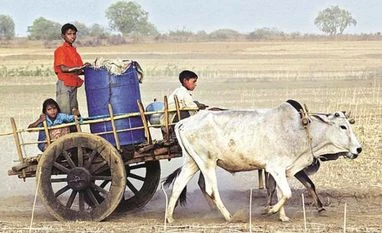
Paani: In the arid zone of Bundelkhand, potable and irrigation water is a priced commodity, given the scanty rain the region receives. In a recent review meeting, the chief minister directed officials to ensure that people in Bundelkhand got easy access to drinking water during the summer. Bundelkhand has assumed more significance after it was announced that a defence corridor would be set up there with direct investment potential of Rs 200 billion. Recently, Sitharaman held a high-level meeting, attended by Adityanath, in Jhansi.
Villagers in the Bundelkhand zone have to go long distances, even a few kilometres, to fetch water. A year before the 2017 UP poll, water had become a major flashpoint between the Narendra Modi government and the UP government under Akhilesh Yadav. In May 2016, the Centre had dispatched a water train for drought-hit Bundelkhand. However, the UP government of the day said the water wagons were all empty.
Besides, a centrally-funded Rs 210 billion drinking water reorganisation and sewerage project is underway in 61 cities of UP, and it is projected to be completed by 2020.
UP minister and government spokesperson Sidharth Nath Singh told Business Standard the government was committed to the basic needs of power, road and water, and had been working on the agenda.

 "Uttar Pradesh chief minister Yogi Adityanath sets his sights on core issues")












 Connect with us on WhatsApp