When Rahul had a tea party with porters
Congress V-P listens to the way they work; their aspirations for their children and their hunger for dignity
BS Reporter New Delhi He had spent a night in the hut of a Dalit. On Tuesday, ahead of the interim Railway Budget, continuing his exploration of the world of the very poor, Rahul Gandhi went to New Delhi Railway Station to a semi-impromptu meeting with porters.
The Congress Vice President spent nearly an hour with porters, listening to them, how they work, their aspirations for their children and their hunger for dignity. “After work we go home to call our parents maji and babuji. While at work, we use the same words 10 times a day for our clients. That is the relationship a coolie has with the traveller. Yet, we are treated like scum,” said a porter to a visibly-moved Gandhi. He asked about the loads porters had to carry on their heads and listened intently as porters said they were paid Rs 40 per headload in Delhi but half that amount in smaller cities. Porters asked for better working conditions – trollies to carry heavy luggage which had vanished from railway stations in 1996; two sets of uniforms a year, one for the summer and another for the winter; health facilities; and a chance to become something in life.
ALSO READ: Come and join politics to change the society: Rahul Gandhi to students (“We want our children to get a chance to wear a black uniform – worn by the ticket collector – not a red one – worn by coolies all over India”).
Television networks arrived almost miraculously to record Gandhi’s interaction with the symbol of the most oppressed in the Indian social system.
Gandhi provoked the coolies: “Shouldn’t you have rights?” he asked. He reminded them of the NREGA, the Right to Food and the Right to Education. “Yes,” chanted the coolies, nodding in unison. The gangmen – those who work to maintain train tracks – had their own complaints. “We work 11 hours. In theory, we get a three hour lunch break. But we have to eat our lunch where we are inspecting the track. We cannot leave our site no matter how hot or cold the weather is,” said a gangman. “We are engineers but have had to do this job because of our economic circumstances. We must be given a chance to improve ourselves…”
ALSO READ: Baba Ramdev considers Rahul Gandhi immature Gandhi provoked the coolies: “Shouldn’t you have rights?” he asked. He reminded them of the NREGA, the Right to Food and the Right to Education. “Yes,” chanted the coolies, nodding in unison. The gangmen – those who work to maintain train tracks – had their own complaints. “We work 11 hours. In theory, we get a three hour lunch break. But we have to eat our lunch where we are inspecting the track. We cannot leave our site no matter how hot or cold the weather is,” said a gangman. “We are engineers but have had to do this job because of our economic circumstances. We must be given a chance to improve ourselves…”
Gandhi saw a world of some theatrics – he seemed amused by the practised way and flowery language coolies used to address the meeting – but most of all he appeared to see a group of marginalised people, hungering for upward mobility.

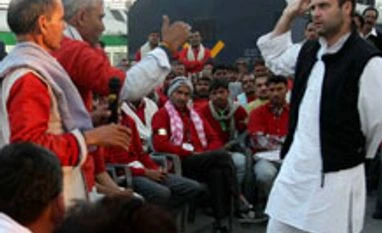 "When Rahul had a tea party with porters")


 Connect with us on WhatsApp