China launches 1st X-ray space telescope
Scientists will also study how to use pulsars for spacecraft navigation, using the telescope
Press Trust of India Beijing China today successfully launched its first X-ray space telescope to help scientists study the evolution of black holes, strong magnetic fields and gamma-ray bursts.
The 2.5-tonne Hard X-ray Modulation Telescope (HXMT), dubbed 'Insight', via a long March-4B rocket from Jiuquan Satellite Launch Center in northwest China's Gobi Desert, was launched into an orbit of 550 kilometres above the earth.
Through the telescope, scientists will also study how to use pulsars for spacecraft navigation, and search for gamma- ray bursts corresponding to gravitational waves, state-run news agency Xinhua reported.
The result of the wisdom and efforts of several generations of Chinese scientists, 'Insight' is expected to push forward the development of space astronomy and improve space X-ray detection technology in China.
'Insight' can be regarded as a small observatory in space, as it carries a trio of detectors -- the high energy X-ray telescope (HE), the medium energy X-ray telescope (ME) and the low energy X-ray telescope (LE) -- that cover a broad energy band from 1 keV to 250 keV, said Lu Fangjun, chief designer of the payload, the report said.
Based on the demodulation technique first proposed by Li Tipei, an academician of the Chinese Academy of Sciences (CAS), in 1993, the HE has a total detection area of more than 5,000 square centimetres, the world's largest in its energy band.
"Given it has a larger detection area than other X-ray probes, HXMT can identify more features of known sources," said Xiong Shaolin, a scientist at the Institute of High Energy Physics of the CAS.
Chen Yong, chief designer of the LE, said X-rays of lower energy usually have more photons, so a telescope based on a focusing technique is not suitable for observing very bright objects emitting soft X-rays, as too many photons at a time will result in over-exposure.
But HXMT will not have that problem, as its collimators diffuse photons instead of focusing them.
"No matter how bright the sources are, our telescope won't be blinded," said Chen.
According to Zhang Shuangnan, HXMT lead scientist, the satellite's developers found that a set of HXMT high-energy detectors, originally designed to shield background noises caused by unwanted particles, could be adjusted to observe gamma-ray bursts.
The creative new function pushes the satellite's observation band up to 3 MeV and a very good energy spectrum, Zhang said.
In April, China's first cargo spacecraft successfully docked with an orbiting space lab -- a key development toward China's goal of having its own crewed space station by 2022.
Last month, China opened a "Lunar Palace" laboratory on Earth to simulate a moon-like environment and house students for up to 200 days as the country prepares for its long-term goal of sending humans to the natural satellite.

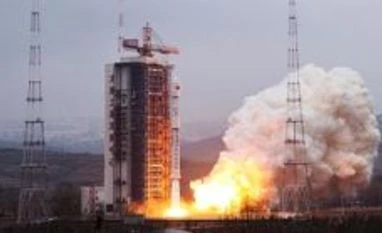 "China launches 1st X-ray space telescope")


 Connect with us on WhatsApp