China continued to flex its muscles in the South China Sea (SCS), with its first aircraft carrier conducting exercises in the disputed area with a flotilla of naval ships amid tensions with the US following President-elect Donald Trump's telephone call to the Taiwanese President.
A naval formation consisting of aircraft carrier Liaoning has conducted take-off and landing drills in the SCS on Monday, state-run Xinhua news agency quoted an official as saying.
The formation, which is on a "cross-sea area" training exercise, involved J-15 fighter jets, as well as several ship-borne helicopters, the official said without mentioning specific numbers.
Complex hydrological and meteorological conditions in the SCS, as well as a cold front in the area, have posed some challenges, but the drill provided important experience in the build-up of combat capability of the aircraft carrier formation, he said.
Chinese officials also say that the carrier is conducting a series of exercises to test its systems and to work out an appropriate formation of ships and submarines to move along with it.
Liaoning, a refit of a Soviet-era warship, has been pressed into exercises in the middle of last month during which it conducted maiden live fire drills on a massive scale along with a host of naval ships, aircraft and submarines, four years after it was commissioned.
China is currently building its second aircraft carrier.
The Chinese navy said the drills conducted in the Bohai Sea involved dozens of ships and aircraft as well as several air-to-air, air-to-ship and ship-to-air missiles.
Liaoning has been conducting exercises since then and even travelled close to Taiwan in a show of strength.
The exercises followed as China struck a more aggressive posture over the disputed SCS issue amid Trump's rhetoric over One China policy.
Trump made an unprecedented phone call to Taiwanese President Tsai Ing-wen, drawing strong diplomatic protests from Beijing.
Subsequently, the Chinese navy also seized an unmanned underwater vehicle of the US in the SCS and returned it about a week later, saying that it picked the unidentified drone to ensure safety of navigation.
China has become more assertive over the SCS after an international tribunal struck down its claim over almost all of the area.
The Philippines, Vietnam, Malaysia, Brunei and Taiwan also have counter claims over the SCS.

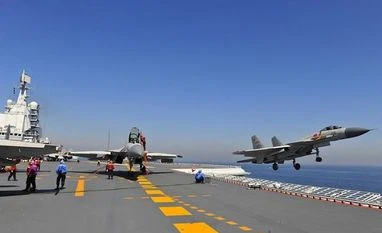 "After Trump's Taiwan call, China flexes muscles with its aircraft carrier")


 Connect with us on WhatsApp