A solar-powered aircraft on a round-the-world flight was high above the Pacific Ocean today, over a quarter of the way to Hawaii after leaving Japan, the mission website showed.
Solar Impulse 2 had travelled 26 per cent of the way to the tropical US state by 0500 GMT, having flown 2,204 kilometres (1,377 miles) with 6,136 kilometres more to go, according to the project.
That put the plane and its veteran pilot more than 36 hours into the toughest leg of the bid to circumnavigate the planet using only the power of the sun.
"Enjoying every moment of this flight. Getting to this point has been challenging," veteran Swiss pilot Andre Borschberg tweeted.
"This flight will only be a success if we really partner, the airplane and myself," he said.
The experimental solar-powered aircraft left Japan around 1800 GMT Sunday -- the small hours of Monday local time -- after spending a month in the central city of Nagoya.
The propeller-driven plane was originally scheduled to fly directly from Nanjing in China to Hawaii. But bad weather along the way forced a diversion to Japan that extended for almost the whole of June as forecasters waited for better conditions.
A live video feed showed the pilot wearing a thick flight jacket and breathing apparatus.
The temperature in the unpressurised cockpit at one point fell to minus 6 degrees Celsius, or 21.2 degree Fahrenheit, as Borschberg ascended to 28,000 feet (8,500 metres) above the water.
The journey to Hawaii was expected to take at least five days.
Solar Impulse 2 set off from Abu Dhabi earlier this year in a multi-leg attempt to fly around the world without a single drop of fuel.
It has 17,000 solar cells and on-board rechargeable batteries with a top speed of 140 kilometres an hour.
Its wingspan is longer than that of a jumbo jet but it weighs only 2.3 tonnes -- about the same as a car.
The plane is the successor to Solar Impulse, which managed a 26-hour flight in 2010, proving its ability to store enough power in lithium batteries during the day to keep flying at night.
Ridiculed by the aviation industry when it was first unveiled, the venture has since been hailed around the world, including by UN chief Ban Ki-moon.

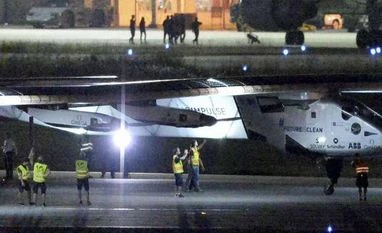 "Solar Impulse reaches quarter way point in Japan-US flight")


 Connect with us on WhatsApp