
China hunts for "manipulators" as stocks tumble
For the week, the CSI300 lost 10.4 percent and the SSEC fell 12.1 percent
 "China hunts for \"manipulators\" as stocks tumble")
WebinarsNew
Deep DiveNew
Explore Business Standard
For the week, the CSI300 lost 10.4 percent and the SSEC fell 12.1 percent
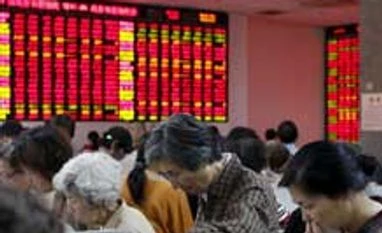
Chinese stocks tumbled again on Friday, taking the week's losses to more than 10 percent, as the securities regulator said it was investigating suspected market manipulation amid increasingly desperate attempts by Beijing to head off a full-blown crash.
After a slump of nearly 30 percent in Chinese stocks since mid-June, the China Securities Regulatory Commission (CSRC) has set up a team to look at "clues of illegal manipulation across markets".
A flurry of policy moves over the past week, including an interest rate cut and a relaxation of margin lending rules, have failed to arrest the sell-off.
"The government must rescue the market, not with empty words, but with real silver and gold," said Fu Xuejun, strategist at Huarong Securities Co, adding that a market crash would hurt banks, consumption, companies and even trigger social instability. "It's a disaster. If it's not, what is it?"
The CSI300 index of the largest listed companies in Shanghai and Shenzhen dropped 5.4 percent to close at 3,885.92, while the Shanghai Composite Index shed 5.8 percent to 3,686.92 points.
For the week, the CSI300 lost 10.4 percent and the SSEC fell 12.1 percent.
The Shanghai benchmark fell below 4,000 points on Thursday for the first time since April - a key support level that analysts had expected Beijing to defend.
The rout in China's highly leveraged stock market has become a major worry for global investors, who fear a meltdown could destabilise the world's second-largest economy at a time when growth is already slowing.
Chinese stocks had more than doubled between November and mid-June, fuelled in large part by retail investors using borrowed money to bet on shares.
"This is happening against an (economic) growth backdrop that continues to look soft, as illustrated by the flat manufacturing survey this week," noted analysts at Barclays.
"With growth data still soft, China remains a key uncertainty for the global outlook."
SHORT SELLERS TARGETED
The China Daily newspaper said on Friday that the CSRC was probing investors who used stock index futures to "short" the market - or bet on prices falling.
Sources with direct knowledge later told Reuters that the China Financial Futures Exchange (CFFEX) had suspended 19 accounts from short-selling for a month.
Much of the selling of Chinese stocks has been driven by "margin calls", when a brokerage that has extended credit to an investor to buy stocks demands more cash or collateral because prices have fallen.
If those margin calls continue, it also could affect other markets as investors need to raise cash.
"Some funds have closed their copper positions to send funds back to China, in order to meet their margin payments on stock indexes," said one metals broker in Hong Kong.
Herald van der Linde, Asia equity strategist at HSBC, said there were signs that some of the money being pulled out of stocks was going into other assets, with a pick-up in physical property transactions.
"It could go to Hong Kong, it could go to property, it could go to cash," he said. "But if they have to repay debt, it's basically deleveraging, as well."
Beijing has been struggling since the weekend to find a policy formula that would restore confidence in its stock markets.
So far, rapid-fire steps including easing monetary policy, encouraging more pension funds to invest in stocks and cutting transaction costs have failed to stem the slump.
The CSRC has relaxed rules on using borrowed money to speculate on stock markets, letting brokerages set their own tolerance level on margin calls and allowing the rollover of margin lending contracts.
On Friday, the regulator also said it would step up its monitoring of markets to protect investors against the mis-selling of investment products.
China is due to release second-quarter gross domestic product data on July 15, and many economists expect growth to dip below 7 percent, which would be the weakest performance since the global financial crisis.
(Additional reporting by Chen Yixin, John Ruwitch, David Lin, Zhang Xiaochong and Kazunori Takada in Shanghai and Michelle Price in Hong Kong; Writing by Wayne Cole and Alex Richardson; Editing by Rachel Armstrong and Will Waterman)
First Published: Jul 03 2015 | 1:16 PM IST


 Connect with us on WhatsApp