Agua is the Portuguese word for water. Earlier this week, however, it morphed into a byword for eschewing Coca-Cola. Encouraging people to drink water, it is what Portugal captain Cristiano Ronaldo uttered after putting aside two bottles of the popular beverage before the start of his press conference at the European Championship on Monday.
What was seemingly a flippant reflex has now acquired the face of a minor controversy. Several outlets reported that Ronaldo’s actions were responsible for a $4 billion tumble in Coca-Cola shares on the New York Stock Exchange. A few subsequent reports, however, suggested that the company’s shares were already down 0.9 per cent in trading — a loss of $2.1 billion in market cap — even before Ronaldo’s presser got under way.
He may not have exactly moved the markets, but Ronaldo’s snub was significant partly because it’s rare to see footballers shun sugary drinks — such offerings are a routine affair at press conferences — in such a public manner. For a global brand like Coke, the fallout may be all the more damaging considering Ronaldo’s standing as a social media behemoth: he enjoys the following of almost 400 million people across Instagram and Twitter.
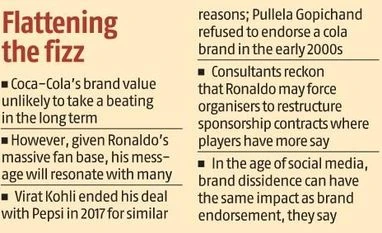
“This may not have a direct impact on Coca-Cola’s brand value, but given Ronaldo’s iconic status, his actions will resonate with a lot of people who look up to him,” says Bengaluru-based communications strategy consultant Karthik Srinivasan.
Some, however, have called out the Juventus forward for hypocrisy. He once featured in a Coke advert — back in 2006 — and has also appeared in commercials for KFC, underscoring how, despite his stature as a fitness obsessive, he hasn’t always made the right choices.
Even so, Sandeep Goyal, managing director of advertising firm Rediffusion, believes that this incident challenges the very existence of the aerated beverages category. “If a guy of his eminence can kick the brand and the shudders can be felt on the stock market, the whole segment is under threat,” he says.
Ronaldo isn’t alone in his crusade against fizzy drinks. Closer home, Virat Kohli, India’s cricket captain, ended his six-year association with Pepsi in 2017, stating that he will not ask people to consume something he himself doesn’t. Former badminton star Pullela Gopichand famously spurned a cola brand in the early 2000s for similar reasons — a rare principled stance in those days.
But Ronaldo’s antics have been perceived as more alarming due to their setting. Coca-Cola is one of the six main sponsors of Euro 2020, and Ronaldo is in no way personally affiliated with the company. Competing teams and players have to abide by a contract their associations sign with Uefa, the tournament organisers. A key part of that is attending press conferences that are plastered with sponsors’ branding.
“If there is a contract that is legally enforceable, then Uefa or Coke will really have to dare to take on Ronaldo in court,” feels Srinivasan, adding that the player’s “super-influencer” reputation will mean a lot of unintended consequences for the brand. Coca-Cola, for now, has said that “everyone is entitled to their drink preferences” with different “tastes and needs”.
Goyal, on the other hand, says this may lead to realignment in how sponsorship contracts for big tourneys are drawn up. Players cannot be taken for granted, he reckons. “They may say yes to playing in a tournament but would refuse to be bound by the rules of engagement.”
That’s the worry for brands: In taking on Coke, Ronaldo may have unintentionally set a precedent for other players. On Wednesday, French midfielder Paul Pogba removed a bottle of Heineken — albeit a non-alcoholic version — placed in front of him during his media briefing. His reasons were vastly different, though: Pogba is a devout Muslim and Islam prohibits the consumption of alcohol.
“In the world of social media, brand dissidence can create the same effect as brand endorsement. Companies must be wary of that,” adds Goyal.
Pogba’s situation, for instance, is similar to Hashim Amla’s. The former South African cricketer refused to sport official sponsor Castle Lager’s — a beer brand — logo on his jersey during his playing days.
And while Ronaldo’s was an impulsive rebuke, image consultants say that brands must be conscious of who they choose as their face, particularly if they’re in the business of selling something as ostensibly unhealthy as carbonated drinks. Srinivasan points to Pepsi signing someone like Tiger Shroff, the Bollywood actor especially popular for his high levels of fitness. “It seemed so incongruent because he is the epitome of health,” he says.
Globally, Pepsi has a partnership with Lionel Messi, Ronaldo’s long-running individual rival.
“At the end of the day, even athletes compromise on their ethics for the big bucks. It’s always been like that,” a brand manager, who does not wish to be named, tells Business Standard. Moreover, celebrities have become smarter while signing contracts. “They are clever to understand they have to endorse a product, not show loyalty to it,” explains Goyal. Ronaldo, though, seems an aberration for now: He is willing to do neither. And that is quite an example to follow.