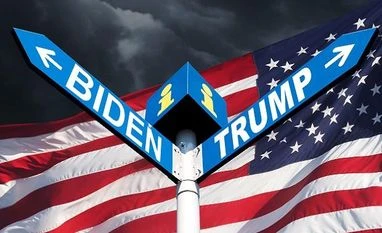
US at inflexion point: Trump or Biden, who's better for South Asia?

While both Indian and US experts say India will continue to be an influential strategic partner of the US, no matter what the colour of the new regime, there are concerns around three areas

Donald trump, joe biden
All analysts say that US-India relations will see no dramatic reset even though the emphasis in the relationship might be on different issues.
Aditi Phadnis New Delhi
4 min read Last Updated : Nov 06 2020 | 1:28 AM IST
As Democrat Presidential candidate Joe Biden advances steadily to the 270-vote mark that will enable him to take up office in the White House, analysts are beginning to discuss what the new US Administration’s policies could mean for South Asia and India.

While both Indian and US experts say India will continue to be an influential strategic partner of the US, no matter what the colour of the new regime, there are concerns around three areas:  the Democrat commitment to preventing the rise of ‘illiberalism’, a view on the rise of China and the balance of power in the subcontinent, and further trade and military relations.

While speaking to Democrat supporters as counting was underway, Biden said: “America’s greatest strength is not the example of our power but the power of our example.” He had made the same observation in 2016. He noted: “It is our adherence to our values and our commitment to tolerance that sets us apart from other great powers.”

It was this commitment to tolerance and democracy that most recently prompted Congresswoman Pramila Jayapal (who has won the election) to raise the issue of civil rights in Kashmir, following which she was excluded from attending a meeting with Foreign Minister S Jaishankar last year.

In a signed article, two of the most influential supporters of Biden, Nicholas Burns and Anja Manuel, both of whom have been part of previous Democrat administrations, said: “The US must confront racial injustice at home and repair a divisive, dysfunctional relationship between its two major political parties. India would be well advised to temper those who practice an often ugly Hindu nationalist agenda to the detriment of the country’s large Muslim majority.”


Talking to Business Standard, Paul Staniland, an academic who has studied political violence and international security in South Asia, said: “Biden has highlighted the importance of democracy and liberalism as counterweights to the influence of China, Russia, and other illiberal regimes. It obviously remains to be seen what implications this will have for actual policymaking, but a greater symbolic and rhetorical emphasis on liberal democracy seems likely.”

Former Ambassador and Director of the Mumbai-based think tank Gateway House, Neelam Deo, says this commitment to liberal democracy could have unintended consequences for India. It could mean even harsher sanctions on Russia. Tougher sanctions could mean Russia-India defence ties, already labouring under the pressure of American sanctions, could be hit further.

Burns and Manuel say Biden has proposed a Coalition of Democracies, “designed specifically to stiffen resistance to the authoritarian power and self-confidence of China and Russia”. They add: “India should be a charter member of such a group. In addition, the State Department should work much more closely with India in South Asia to counter Beijing’s bid for greater influence in Sri Lanka, Bangladesh, Nepal, and Myanmar.” It is unlikely that India will take up this offer.

Democrats by and large approve of India’s role in groupings like Quad but would like to see both a bigger military component to it and also strengthen it as an economic and infrastructural partnership. China is both dismissive of Quad and also sees it as a threat.

So far, neither Biden nor his associates have spoken about Pakistan. However, academic and analyst Christine Fair believes the Trump administration, for all its criticism of Pakistan, handed it the greatest gift it could hope to get the Zalmay Khalilzad-brokered negotiations with the Taliban in Afghanistan that would enable Pakistan, via the Taliban, to continue to have sway over the affairs of Afghanistan and prevent India from getting a foothold.

However, all analysts say that US-India relations will see no dramatic reset even though the emphasis in the relationship might be on different issues.

One subscription. Two world-class reads.

Already subscribed? Log in

Subscribe to read the full story →
*Subscribe to Business Standard digital and get complimentary access to The New York Times

Smart Quarterly

₹900

3 Months

₹300/Month

SAVE 25%

Smart Essential

₹2,700

1 Year

₹225/Month

SAVE 46%
*Complimentary New York Times access for the 2nd year will be given after 12 months

Super Saver

₹3,900

2 Years

₹162/Month

Subscribe

Renews automatically, cancel anytime

Here’s what’s included in our digital subscription plans

Exclusive premium stories online

  • Over 30 premium stories daily, handpicked by our editors

Complimentary Access to The New York Times

  • News, Games, Cooking, Audio, Wirecutter & The Athletic

Business Standard Epaper

  • Digital replica of our daily newspaper — with options to read, save, and share

Curated Newsletters

  • Insights on markets, finance, politics, tech, and more delivered to your inbox

Market Analysis & Investment Insights

  • In-depth market analysis & insights with access to The Smart Investor

Archives

  • Repository of articles and publications dating back to 1997

Ad-free Reading

  • Uninterrupted reading experience with no advertisements

Seamless Access Across All Devices

  • Access Business Standard across devices — mobile, tablet, or PC, via web or app

Topics :Joe BidenUS Presidential elections 2020Donald Trump

Next Story





