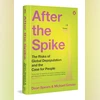
After the Spike: A bold argument for rethinking the demographic doom theory

Why a larger population is better than a smaller population with a higher quality of life

After the Spike
After the Spike
Sanjeev Ahluwalia
5 min read Last Updated : Oct 28 2025 | 10:27 PM IST
After the Spike
By Dean Spears & Michael Geruso
Published by Penguin Random House
307 pages  ₹620
  There are five reasons this book on population theory, practice and philosophy should be widely read. First, it is suffused with an uncommon sentiment these days —“goodness” — worn on its sleeve by its commitment to the “general good.” Consider this gem. In population policy, a false choice is between “quality” — providing the best to a few (think high per capita income or high-quality graduate education) versus “quantity” — providing a good enough life (think medium-income levels or basic education with some tertiary education) to all citizens. 
Dubbed the Repugnant Conclusion in population ethics, this conundrum presents a moral dilemma. Taken to the extreme, it could deny the right to life to the next child to be born, unless it would be an excellent life, for fear of reducing the average quality of life for all. For the authors quantity scores over quality because it enables the widest possible citizen cooperation, collaboration and innovation. Great research — such as this book — is never the product of one brilliant mind. It develops via extensive collaboration across colleagues and is inter-temporal, building on the achievements of the past and providing research ballast for the future. 
Second, it debunks the notion that India is middle-income because it is overcrowded or that low human density is why some areas become high-income whilst densely populated ones remain under-developed. Consider that cities everywhere have high population density versus villages, but cities are the engines of growth, not villages. So why should countries be different? 
Third, depopulation is the extant reality across economies with varying national incomes level, regions and cultures. Both France and South Korea face a common trend of depopulation, though fertility in France remains double of South Korea. In India, fertility levels were at 5.62 in 1970 and 4.04 in the 1990s. By 2024 it reduced to 2.0 (with cities at 1.6 and rural areas at 2.1) implying a depopulation trend in the former, which has a share in population of about 37 per cent. Depopulation is  accompanied by convergence. The fertility rate is reducing and converging across countries and even across states in India. The problem is that there is no automatic stabiliser for either population growth or depopulation. Both have an exponential profile and unless managed, could continue till extinction — like climate change. “Over the past one hundred years, the world quadrupled. But over the past two hundred years it grew by a factor of eight,” Dean Spears and Michael Geruso write. We are now over the population spike, which peaked in 2012. So, what can be done to manage depopulation? Prescriptive remedies fixing birth limits — such as China’s one-child norm or India’s infamous forced sterilisations in the 1980s or a minimum family size as Mohan Bhagwat, “Sarsangchalak” or chief executive of the RSS, recently advised — are all doomed to fail. The authors recommend that the size of one’s family is a personal choice based on willingness to bear the “opportunity cost” of being a parent — lack of sleep, work compromises and higher stress. The state can only assess such willingness or unwillingness on the part of citizens and provide support, not drive the trend either way. The authors do not go further than that — which keeps readers wanting more. 
Fourth, it is antediluvian to subscribe to the flawed 1978 Malthusian zero-sum construct of a fixed volume of natural assets and hence the phobia that an increasing population could degrade resources quicker. Continuous advancement in technology and innovation demonstrate that higher efficiency in the use of resources can do more with less, just as options for delaying pregnancy or preventing it can stall or reduce human needs. Recognising free will, as in gender equity, has reduced fertility across economies, income strata, regional traits and cultural biases. Global fertility declined from 6 in 1900 to 2.4 in 2025, with Europe and East Asia depopulating to 1.6 and Africa still populating at 4, but down from 6.52 in 1950 and projected to reach 2.1 by 2100.
 
The fifth reason this treatise is fascinating for Indian readers is that it grounds population management practices in present-day reality. Reducing the number of infant deaths is the most efficient and humane option to boost fertility levels. Enter Seema — a nurse in Sitapur district of Uttar Pradesh, skilled in Kangaroo Mother Care — a practice, first developed in Bogota, Columbia to keep underweight babies alive without the use of expensive incubators. Seema represents the new Indian woman — skilfully substituting available human resources for unavailable capital investment. She wants just one child, her sister two.
 
Finally, budding economists would note that for Messrs Spears and Geruso, associate professors at the University of Texas, Austin, bringing economic efficiency to general welfare is more than an occupation, it is a lifestyle, like riding the bus to work and back and a considered choice — like becoming a parent should be.
 
The reviewer is distinguished fellow, Chintan Research Foundation, and was previously in the IAS and the World Bank

One subscription. Two world-class reads.

Already subscribed? Log in

Subscribe to read the full story →
*Subscribe to Business Standard digital and get complimentary access to The New York Times

Smart Quarterly

₹900

3 Months

₹300/Month

SAVE 25%

Smart Essential

₹2,700

1 Year

₹225/Month

SAVE 46%
*Complimentary New York Times access for the 2nd year will be given after 12 months

Super Saver

₹3,900

2 Years

₹162/Month

Subscribe

Renews automatically, cancel anytime

Here’s what’s included in our digital subscription plans

Exclusive premium stories online

  • Over 30 premium stories daily, handpicked by our editors

Complimentary Access to The New York Times

  • News, Games, Cooking, Audio, Wirecutter & The Athletic

Business Standard Epaper

  • Digital replica of our daily newspaper — with options to read, save, and share

Curated Newsletters

  • Insights on markets, finance, politics, tech, and more delivered to your inbox

Market Analysis & Investment Insights

  • In-depth market analysis & insights with access to The Smart Investor

Archives

  • Repository of articles and publications dating back to 1997

Ad-free Reading

  • Uninterrupted reading experience with no advertisements

Seamless Access Across All Devices

  • Access Business Standard across devices — mobile, tablet, or PC, via web or app

Topics :populationIndian PopulationBOOK REVIEWBook readingBS Reads

Next Story