The Shortest History of AI
These days, unless you are a digital recluse or have been on a digital detox for a few years now, it is impossible to avoid Generative AI chatbots, image and video creators, and AI Agents in most parts of your life. From children in school to CEOs in the corner suites of multinational giants, and from policymakers to healthcare professionals, everyone is exposed to artificial intelligence (AI) in multiple ways.
The world has become firmly divided into two camps. One side believes that AI will solve almost all our problems pretty soon. The other worries about the emerging dangers. Corporations and IT professionals worry about AI hallucination. Psychiatrists worry about rising incidents of AI psychosis. Some content creators worry about AI slop while others watch as AI trains on their creations to produce faster and better images and videos and stories.
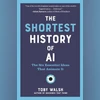
But how did we reach this stage? You could ask ChatGPT or Claude or Perplexity or Gemini or any of the other AI tools you are using for your work or entertainment for the answer. Or you could read Toby Walsh’s The Shortest History of AI .
Mr Walsh, a professor of artificial intelligence in the University of New South Wales and chief scientist at its new AI institute, UNSW.ai, is one of the leading researchers in the subject. And he has put together a thoroughly entertaining volume.
As Professor Walsh writes, you could pin the genesis of where we find ourselves currently to an eight-week long workshop held at Dartmouth College in 1956. It was organised by a young assistant professor in the college by the name of John McCarthy and the first day of the workshop was June 18. The goal of the workshop was to get together some of the brightest brains in multiple areas and to brainstorm ways of building intelligent machines. Of course, the group that gathered were all men, and Professor Walsh points out that unfortunately women are still under-represented in the field of AI. He also points out that June 18 is International Panic Day — an interesting fact, though it probably has no relationship with the anxiety that AI induces in many today.
(Actually, the Dartmouth group was all white men — mostly from the United States and Western Europe. The rise of Asian researchers and those from other parts of the globe would happen much later but that is another story and not perhaps pertinent to his book).
It is difficult to capture the full sweep of all the areas that Professor Walsh darts in and out of while explaining concepts and context in this book in any review. But he dips into examples from the philosophy of ancient Greeks to Indian mythology, and from the first mechanical computing machine to the works of mathematicians and code breakers, all of which long preceded the Dartmouth College workshop.
The Greeks come in to explain the field of logic that probably started with Socrates. Indian mythology comes in with the story of the inventor of the chess game who, when asked by the ruler about the reward he wanted, said he would ask for rice — one grain for the first square, two for the second and four for the third — and so on to demonstrate exponential growth. The amount of rice grains that would be required for the 65th square would be far higher than the rice produced in the world then.
Professor Walsh points out that Ada Lovelace was the first in recorded history to ask whether computers would ever be creative. And how Alan Turing, code breaker extraordinaire during World War II, created not only the first algorithm to play chess but also the Turing Test. (Unfortunately, there were no computers around for Turing to use his chess playing program on).
The book looks at the two ideologies — neural networks, which could learn by themselves, and Expert AI or Symbolic AI, which depended on precise instructions to perform wonders. Neural networks and learning systems fell out of favour initially because the computers were not sufficiently powerful and enough training data was not easily available. Deep learning and machine learning would again come to the forefront by the beginning of the second decade of the 2000s.
Professor Walsh talks about robots — both the basic ones (like robotic arms in automotive paint workshops) as well as intelligent ones, powered by AI. He discusses the dangers of AI and the current state of research as well.
Despite being a thoroughly entertaining read and capturing the entire history in this short book, it is not for the absolute layperson. That is because a certain knowledge of mathematics, concepts of physics and general science is required to fully appreciate the examples that dot the book.
But for anyone interested in the subject, this is an absolute gem. Though some of the events and people that Professor Walsh writes about are well known to most people interested in the field, his narration brings life and context like no other book. Highly recommended for those interested in AI and its origins and development.

 "The Shortest History of AI: How the world came to love and fear it")











