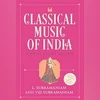
Classical Music of India: A Practical Guide
Authors: L Subramaniam and Viji Subramaniam
Publisher: Westland
Pages: 215 Price: ₹599
Among the 64 arts in ancient India, music was traditionally accorded the first position. Few probably know that Indian classical music is the oldest, most sophisticated and scientifically complete musical system in the world. In this comprehensive book, India’s violin icon L Subramaniam and his late wife, award-winning vocalist Viji Subramaniam, put together the history, structure and evolution of the country’s classical music system.
L Subramaniam’s musical journey started at a young age, acquiring a solid foundation of Carnatic music from his father. After completing his Bachelor’s degree in medicine, he decided to switch to music at the California Institute of the Arts. During this time, he also taught students from different musical backgrounds. In the 1990s, Subramaniam and his wife Viji put together Euphony, a handy guide to music theory. This book is an updated version, and aims to reach musicians, composers, musicologists and music enthusiasts.
In music, theory generally follows practice. “It is difficult to imagine a theoretical concept being developed before the practical application in any art form,” Subramaniam writes. In Hindu philosophy, music is considered a way to attain salvation. For centuries, classical Indian music was traditionally passed down from generation to generation in the oral tradition. It is a generally accepted fact that the Vedas are the source of Indian music. The oldest record of Indian drama, dance and music theory can be found in Natyashastra, an authoritative source for musicology. Brihaddesi, written by Matanga in Sanskrit, is another important work on music. Gita Govinda, a monumental work of the medieval period by Jayadeva, was the first work to set melody and rhythm together in a uniform pattern.
In the book, Subramaniam delves into technicalities, such as the elements of music, the melodic systems, rhythmic concepts and the notation system, using tables and charts in order to make them easy to understand. He also describes the gharana system in Hindustani classical music, including Agra, Gwalior, Jaipur, Benaras, and Patiala, most of which became popular in the nineteenth century.
Subramaniam also briefly compares Indian classical music concepts with those in the West. While the fundamental unit of a melody is called a “note” in the West, it is referred to as a “swara” in Indian classical music. The basic melodic idea in Indian classical music is called a “raga”, which is the equivalent of the “scale” in western classical music. Further, the basic rhythmic idea in Indian classical music is called “tala”. In western classical music, rhythm is indicated by means of a time signature, which is denoted by a fraction.
The two major streams of Indian classical music — south Indian (Carnatic) and north Indian (Hindustani) — were part of a single tradition until the twelfth century. Music in the north, however, began to gradually change due to Arabic and Persian influences that Islamic invaders brought with them. The south, on the other hand, remained relatively uninfluenced. This was how two distinct systems eventually developed.
The eighteenth century is considered the golden age of Carnatic music, with the contributions of three great musicians — Shyama Shastri, Tyagaraja and Muthuswami Dikshitar. Similarly, Subramaniam talks about the contributions of prominent north Indian musicians, such as Khusrau, Tansen and Vishnu Narayan Bhatkhande.
Comparing the two traditions, Subramaniam writes, “Relatively speaking, Carnatic music may be said to be more systematised than Hindustani music.” Learning methods in the two systems differ too. While the process is highly systematised in Carnatic music, there is no standardised system of learning in the Hindustani system. Melodic and percussion instruments used in the two systems differ as well. While a typical Carnatic vocal concert has more compositions, one hears more improvisation in a Hindustani concert.
Subramaniam also dedicates a chapter to the diverse variety of Indian musical instruments, such as the tanpura, veena, sitar, sarod, sarangi, santoor, flute, harmonium, shehnai, mridangam, and tabla, discussing their origins, various characteristics and playing positions. Another chapter is devoted to explaining various kinds of musical forms, such as dhrupad, khyal, thumri, ghazal and bhajan. The appendix has brief profiles of some other important composers, including Mirabai and Tulsidas, among others.
Subramaniam goes on to explore the many innovations by different masters in various styles of music in the post-Independence period. “Some instruments like the violin, which were earlier used more as accompanying instruments, have gained prominence and developed into solo instruments,” he writes. In recent years, many western instruments, such as the guitar, mandolin, clarinet and saxophone have been successfully introduced and adapted to Indian music. Another recent development has been the evolution of the Hindustani-Carnatic jugalbandi. “Music has become much more accessible and some of the Indian classical music festivals now attract larger audiences, not only in India but around the world,” he writes.
The book is a great resource for music connoisseurs and music lovers as well as anyone who appreciates music and is interested to learn more about it. In the Epilogue, Subramaniam explains the multiple benefits of music. Music naturally teaches us to be more creative, something that helps us in our everyday lives as well. “The presence of mind that a musician learns helps in dealing with various situations outside of music as well,” he concludes.
The reviewer is a New Delhi-based freelance writer