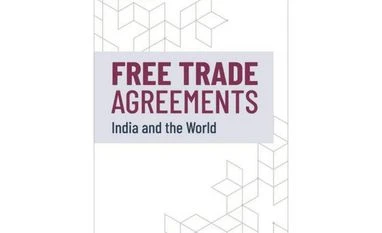
Free Trade Agreements - India and the World
Author: V S Seshadri
Publisher: Oxford University Press
Pages: 394
Price: Rs. 1,495
The world of Free Trade Agreements (FTA) is complex and, among the few experts on trade in the country, Ambassador V S Seshadri stands out. His deep knowledge on FTAs, attributable to his long stint in the commerce department and postings in missions abroad where he dealt with trade and economic issues, has found expression in his book Free Trade Agreements – India and the World. The book is a timely rendition given that India is ambitiously negotiating FTAs with several countries.
The author analyses the impact of FTAs on global trade and on India, in particular, drawing our attention to the fact that FTAs concluded elsewhere have consequential ramifications on global trade. The rationale establishes that of the 240 FTAs concluded worldwide so far and, 300 more being negotiated, trade diversion is a natural corollary for even non-FTA countries. The creation of exclusive trade partnerships under FTAs, the author observes, is a derogation of the principle of “Most Favoured Nation” (MFN) under Article I of the General Agreement on Tariffs and Trade (GATT) even as they draw legitimacy under GATT Article XXIV. This contradiction in the World Trade Organization (WTO) rule book lamentably puts two-thirds of the developing and least developed countries at a permanent disadvantage vis-à-vis the developed world.
India has been a tail-ender in the game of FTAs and its dilemma, the author perceives, stems from wanting to preserve its policy space and maintaining balance of payments. This approach also explains the reason for India concluding fewer FTAs/PTAs (preferential trade agreements) with low ambition and defensive rules of origin. Dr Seshadri’s in-depth analysis of India’s comprehensive FTAs with Asean, Japan and Korea holds significant value for both policy and industry. His assertive conclusion that partner countries disproportionately benefited from FTAs than India misses the basic truth about FTAs, i.e. that they essentially create mutually beneficial partnerships in the long run that are beyond the binary structures.
Our understanding that trade is a zero-sum game is far from reality since balancing trade with partner countries is like chasing a mirage. A better way to assess the impact of FTAs is to measure trade volume generated over time and, going by that yardstick, India’s bilateral trade with all three countries was enhanced by three to four times since FTAs were concluded a decade ago, notwithstanding the incremental widening of the trade deficit. The author draws a pertinent link between FTA and foreign direct investment flows and boosting service exports and this link is also relevant to manufacturing, technology transfers, improvement in standards, regulation, skill upgrades and so on on both sides.
Negotiating new-generation FTAs, Dr Seshadri points out, may be challenging for India as seemingly non-trade issues such as environment, labour, data, gender, e-commerce are creeping into FTAs. A case in point is the Comprehensive and Progressive Agreement for Trans-Pacific Partnership (CPTPP), considered a gold standard FTA, which has all those contentious chapters even as it seeks to eliminate tariffs and put in place common standards and regulatory framework with strong provisions for dispute settlement mechanism.
Similarly, the Regional Comprehensive Economic Partnership (RCEP) is another high-ambition FTA from which India walked out after negotiating for seven long years stating that it did not address India’s core concerns. India’s withdrawal from RCEP, the author reasons, is a missed opportunity of being able to be part of the resilient supply chains in a dynamically evolving Indo-Pacific market. Even though India suffers significant trade deficits of up to 50 per cent with RCEP countries, the long staging period of up to 20-25 years was a manageable time frame for the industry to catch up with the rest. The importance of RCEP should have been strategically analysed in the possibility of CPTPP + RCEP forming an impregnable block of trading countries in the near future, almost like an APEC FTA.
FTA negotiations are all about balancing diverging interests of big industry, MSME and consumers. It’s not that our FTA negotiation strategy could have been more effective, as the author would like us to believe, but industry’s unwillingness to face competition on domestic turf certainly put the spanner in the wheel. FTAs create competition in like products and eventually help to achieve competitiveness in the long run. A comprehensive understanding as to how trade actually takes place under FTAs, the author suggests, requires a national strategy. Building a competent and knowledgeable negotiating team well-versed in trade technicalities with visionary understanding is imperative. The process of engagement and coordination with line ministries/departments and stakeholders should be continuous. Instead of early harvest PTAs, the author recommends a holistic approach to FTAs to include chapters such as investment, services, and Mutual Recognition Agreements to be negotiated integrally to reap their full benefit.
Our collective thinking on FTAs needs to evolve so as to take advantage of their intrinsic value both in economic and strategic dimensions. FTAs could be used as tools for seeking deeper economic integration with the immediate region and extended neighbourhood and enduring partnerships with dynamic economies through resilient supply chains. This is equally relevant to the success of Atmanirbhar Bharat, and getting this act right strengthens the prime minister’s visionary approach of going “Local for Global”.
------------------------------------------------------------------------------------------------------------------------------------------------------------------------
The reviewer is a serving Indian Foreign Service officer