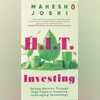
H.I.T. Investing: A new book the balance between purpose and profit

It is hard to fathom how any organisation could build a sustainable business by offering high-quality products at affordable prices, but many have done just that. H.I.T. Investing tells their stories

H.I.T. Investing
H.I.T. Investing: Strong returns through high-impact investing leveraging technology
Sanjay Kumar Singh Mumbai
5 min read Last Updated : Jul 23 2025 | 11:30 PM IST

Don't want to miss the best from Business Standard?

H.I.T. Investing: Strong returns through high-impact investing leveraging technology
By Mahesh Joshi
Published by Penguin Business
214 pages ₹799
 
Can investment firms achieve social or environmental impact while generating sound financial returns? Author Mahesh Joshi answers in the affirmative in his book H.I.T. Investing, which explores the principles and practice of impact investing. This approach seeks to improve the world while earning competitive returns. The global impact investing industry is currently valued at $2.3 trillion.

Also Read

 
Impact investors begin by identifying causes that matter to them, then back early-stage companies aligned with those goals, typically in sectors such as microfinance, health, education and so on.
 
After a decade in private equity, Mr Joshi joined an impact investment firm in 2017, which was focused on making healthcare more affordable and accessible across South and Southeast Asia. Earlier in his career, he had been an analyst covering the fast-moving consumer goods (FMCG) sector — an experience that shaped his views on how companies can earn sustainable profits. He had observed that many FMCG companies consistently generate high return on equity with little or no debt. They produce products like soaps and shampoos that can easily be manufactured by rivals. But so strong is the brand perception they build in their customers’ minds that the latter are willing to pay a premium for them. They also ensure easy availability — within an arm’s reach of desire, as the Coca-Cola marketing campaign famously said — through a distribution network that reaches every nook and cranny of the country. These attributes create high entry barriers and ensure profitability.
 
As an impact investor, the author had to find companies offering quality products and services at affordable prices. He found it hard to fathom how any organisation could build a sustainable business using this model. But many have done it. 
 
One famous example is the Grameen Bank, founded by Muhammad Yunus, currently chief advisor of Bangladesh. In the 1970s, Dr Yunus, then head of the economics department at Chittagong University, lent money to a woman who made bamboo stools but was trapped in a cycle of debt to loan sharks. That small experiment culminated in the founding of Grameen Bank in October 1983. In 2023, it disbursed $1 billion in loans. The uniqueness of the bank’s approach lay in getting customers to form associations. The group was held responsible for the credit received by its members. This created social pressure on members not to default. The bank’s enviable 99 per cent repayment rate allows it to charge low interest rates. 
 
In India, Ela Bhatt founded the Self-Employed Women’s Association (SEWA) in 1972, a co-operative with around 2 million members that works to empower small-scale women entrepreneurs.
 
Some corporations, too, have succeeded in serving low-income consumers. In The Fortune at the Bottom of the Pyramid (2004), management guru C K Prahalad argued that companies should view the low-income population as value-conscious customers and resilient entrepreneurs. His insights galvanised many multinational corporations to target this segment by keeping prices low and volumes high. Hindustan Unilever’s success with the Wheel detergent brand is a notable example.
 
Gradually, Mr Joshi came to realise that a low-price, high-volume approach, which he had initially regarded as an impediment, can be a competitive advantage. Rivals find it difficult to disrupt a business delivering great value to customers at minimal pricing.  Moreover, since fewer companies target this segment, competition remains limited.
 
Mr Joshi initially assumed impact investors relied on concessionary capital from philanthropists who are not chasing commercial returns. Over time, he found that most raise money from third-party investors and must deliver market returns. If they fail to do so, they find it difficult to raise capital in the future.
 
Impact investors, who are under pressure to deliver an exit within three to five years, sometimes make the mistake of focusing on sectors and companies that are the flavour of the season — those they believe will be easier to sell to other investors in a few years. This mirrors the “greater fool theory” in stock markets, where during bull runs investors ignore valuation in the belief there will be a buyer willing to buy from them at a higher price. This approach works until the bubble bursts. Investors are then left holding overvalued stocks no one wants. Having witnessed the debacle in India’s construction sector in the 2000s, the author says he has since focused on companies creating real value for customers, instead of chasing popular investments.
 
In the second part, Mr Joshi profiles successful impact investors across sectors and geographies. Indian readers will relate to the example of Lok Capital, an early investor in several microfinance companies that have since received small finance bank licences from the Reserve Bank of India. 
 
Anyone keen to learn about the opportunities and challenges in impact investing, and the firms in this area that have successfully struck a balance between purpose and profit, will find Mr Joshi’s book an insightful and rewarding read.

One subscription. Two world-class reads.

Already subscribed? Log in

Subscribe to read the full story →
*Subscribe to Business Standard digital and get complimentary access to The New York Times

Smart Quarterly

₹900

3 Months

₹300/Month

SAVE 25%

Smart Essential

₹2,700

1 Year

₹225/Month

SAVE 46%
*Complimentary New York Times access for the 2nd year will be given after 12 months

Super Saver

₹3,900

2 Years

₹162/Month

Subscribe

Renews automatically, cancel anytime

Here’s what’s included in our digital subscription plans

Exclusive premium stories online

  • Over 30 premium stories daily, handpicked by our editors

Complimentary Access to The New York Times

  • News, Games, Cooking, Audio, Wirecutter & The Athletic

Business Standard Epaper

  • Digital replica of our daily newspaper — with options to read, save, and share

Curated Newsletters

  • Insights on markets, finance, politics, tech, and more delivered to your inbox

Market Analysis & Investment Insights

  • In-depth market analysis & insights with access to The Smart Investor

Archives

  • Repository of articles and publications dating back to 1997

Ad-free Reading

  • Uninterrupted reading experience with no advertisements

Seamless Access Across All Devices

  • Access Business Standard across devices — mobile, tablet, or PC, via web or app

Topics :Markets and InvestingBOOK REVIEWBS ReadsBookBook readinginvesting

Next Story