THE GREAT MATH WAR: How Three Brilliant Minds Fought for the Foundation of Mathematics
by Jason Socrates Bardi
Published by Basic
394 pages $32
By Jordan Ellenberg
It may surprise most readers to learn that, just a century or so ago, some of the era’s greatest mathematical minds were enlisted in a debate about whether numbers exist. You’d think, after millenniums, we’d have gotten that straight. But it’s not that simple, as Jason Socrates Bardi explains in his new book, The Great Math War.
In the late 19th century, Georg Cantor had proved, startlingly, that there wasn’t just one kind of infinity, but infinitely many kinds. And the infinity of the set of real numbers, while relatively modest, was not the very smallest. Numbers are complicated!
A real number is traditionally described by an infinite sequence of decimal digits; that sequence might
terminate, like 0.12, or it might obey some simple repetitive rule. It might be an irrational number, like pi, whose decimal expansion doesn’t repeat but which you can compute with a simple computer program.
Or it might be something worse. Cantor’s theorem shows that the infinity of describable numbers — such as 3/25, or ⅙ — is much, much smaller than the infinity of all real numbers.
In other words? There are numbers we simply cannot describe. Can you give an example? By definition, no.
If that makes you uneasy, great. It made everybody uneasy. One of the generals in Bardi’s war, L E J Brouwer, advocated a radical solution: According to him, and to the “intuitionists” who shared his views, the only things that are real in mathematics are things human beings with a finite life span can describe, and the only things that are true are those that admit a proof of finite length.
His opponents, chiefly represented here by the German mathematician David Hilbert, thought such a restrictive view gave away too much — throwing out most of the points on the number line, for instance.
But a completely liberal attitude, admitting into the tent of mathematics anything we can conceive, however infinitely infinite, had led to unacceptable contradictions, which required bolting on ever more complicated hacks. This was the core of the argument: What should mathematics be allowed to be about?
Bardi’s title might seem hilariously overwrought; nobody gets shot or shelled here. But, as Bardi, a science writer, shows, the mathematicians themselves used the language of combat to describe their struggle.
Hermann Weyl, in a 1921 paper, termed the difficulties Grenzstreitigkeiten (“border disputes”) and warned that despite their apparent distance from the centre of mathematics, these concerns threatened the stability of the whole system.
The Great Math War does something most popular math books don’t; it situates mathematics in the context of the people doing the mathematics — and the lives they were living outside the profession.
Bardi is very good at showing how the exclusion of German mathematicians from international conferences, long after the war’s end, created resentment that bled into the way scholars treated one another’s theories.
Bertrand Russell, who came up with some of the first paradoxes that threatened math’s basic structure, is especially well drawn. Russell was torn between his respected academic research and his mostly hated work as an antiwar activist. He was also constantly involved in one love triangle or another. Most were sexual, but the one most movingly rendered here is composed of Russell, his lover Ottoline Morrell and the young Ludwig Wittgenstein — whose stormy relations with Russell were about math only. For anyone who has admired Russell’s cool, heady philosophical writing, it’s bracing to see that his personal life was a hot mess.
Unfortunately, much about The Great Math War is pretty messy, too. This is not the book to read if you want a precise understanding of the mathematics at stake. Bardi writes mostly in the present tense; this gives his historical accounts a nice immediacy, but gets him into verbal tangles. Writing of Wittgenstein in 1920, Bardi declares, “The problems he once concerned
himself with ‘were solved now and forever’ in his view, the Dutch mathematician Dennis Edwin Hesseling will write in 2003.”
Is it necessary to revisit a century-old controversy that, as Bardi concedes, has little impact on the day-to-day practice of contemporary mathematicians? I say yes; current developments in the application of machine learning have once again demanded that we think carefully about what mathematics should be about.
Can mathematics, as Hilbert insisted, be reduced to a sequence of formal manipulations of symbols, with no inherent meaning save what we impose? Or is it, in a more intuitionist vein, inextricably bound by what real people can perceive?
This dispute was not settled a hundred years ago, and it probably won’t be now. But in uncertain times, there’s value in remembering that we have been in a place like this before.
The reviewer, a professor of mathematics at the University of Wisconsin, is the author of How Not to Be Wrong: The Power of Mathematical Thinking
©2025 The New York Times News Service

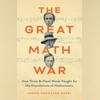 "Jason Bardi's book retraces conceptual conflicts between mathematicians")


 Connect with us on WhatsApp