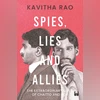
'Spies, Lies and Allies' recalls two forgotten pre-Independence stories

Spies, Lies and Allies is more than a biography-it reminds us of two extraordinary lives from the pre-Independence era and why their stories, their mistakes, and their erasure matter

book
Amritesh Mukherjee
5 min read Last Updated : Apr 03 2025 | 11:45 PM IST
Spies, Lies and Allies: The Extraordinary Lives of Chatto and Roy
Author: Kavitha Rao
Publisher: Westland Non-fiction
Pages: 272
Price: Rs 499
  Somerset Maugham writes in his story, Guila Lazzari, on Chatto, “He is the most dangerous conspirator in or out of India. He’s done more harm than all the rest of them put together. You know that there’s a gang of these Indians in Berlin; well, he’s the brains of it. If he could be got out of the way, I could afford to ignore these others.”

Also Read

 
What are the true markings of an extraordinary life? Must it reshape the world like Gandhi, endure like Curie, or provoke like Marx? Must it mirror the ideals of a nation, or is its extraordinariness defined in spite of that? History tends to reward lives that fit the stories a nation wants to tell. Kavitha Rao’s  Spies, Lies and Allies  is less interested in celebrating greatness than in excavating complexity.
 
It chronicles the twin lives of Virendranath Chattopadhyaya (Chatto) and Manabendra Nath Roy — restless, ambitious, politically brilliant — who were ultimately discarded by the nation they imagined in more expansive terms than it was ready for. From Berlin salons to Soviet safe houses, from Mexico’s leftist circles to Zurich’s radical presses, Chatto and Roy moved with the velocity of revolution. The two men negotiated with anarchists and communists, joined international conspiracies, founded revolutionary cells, edited journals, shipped arms, debated global leaders, and birthed philosophies.
 
Ms Rao reconstructs two complicated lives — animated by ideas, fractured by ego, distance, and ideological drift. Far more than revolutionaries, Roy and Chatto were cosmopolitans, shaped by the intellectual currents of their time, their political thought drawing as much from European modernity and Marxist theory as it did from anti-colonial sentiment. In that sense, they belonged to the global 20th century more than to the Indian nationalist canon.
 
That alone might explain why they were written out of it.
 
Roy’s early life reads like a spy novel, marked by exile, subterfuge, and reinvention. Leaving India in 1915, he spent years moving through Java, Japan, the US, and ultimately Mexico, where his encounter with Borodin, a Soviet emissary, drew him into the international communist movement.
 
Chatto’s trajectory was relatively more conventional: He had originally travelled to London to take the Indian Civil Services exam. He failed, switched to law, failed again, and eventually, under the influence of Shyamji Krishna Verma and Savarkar, veered into radical politics. But that similarity ends quickly. Where Roy aligned himself with the emerging institutions of communism, the Comintern, Lenin, Moscow, Chatto’s radicalism was more diffuse, more desperate, and eventually more doomed.
 
They met only once, in 1920. Despite their shared ambitions, they were never friends. The book’s interested in this dissonance: Not just between the men, but within them. Ms Rao writes sharply about how little their ideological radicalism translated into personal progressivism, like Chatto’s volatile relationship with the American writer Agnes Smedley, which soon turned abusive. They lived together for eight years, years defined less by partnership and more by inequality. “To her great dismay and disappointment, Chatto’s liberalism and modernity did not extend to women. He was jealous of her many past lovers and felt that he had ‘got the leavings’ of other men,” Ms Rao writes.
 
She also points to “Roy’s puritan disapproval of Smedley’s sexual mores”, a man who could speak before global audiences about liberation and class struggle, yet privately bristling at female autonomy. Roy would also discard his long-time partner Evelyn Trent for his secretary. Throughout his life, “revolutionary women continued to buzz around him like moths to a flame.”  In many ways, their personal hypocrisies mirrored the failure of the political movements they aligned themselves with, each starting with utopian promise and ending in disappointment, exclusion, or, in Chatto’s case, execution.
 
Alternating between each protagonist of this historical thriller, Ms Rao also takes the reader through the shifting political landscapes of the early 20th century, from Bolshevik Russia and post-war Europe to pre-Independence India. The prose is gripping, confident but never didactic, the kind that interacts with you, telling you a thrilling story. For instance, when describing Willi Münzenberg, the “communist media mogul, agitator and propaganda ‘tsar’ for the Soviet Union”, Ms Rao quips: “In modern times, he might have been called an influencer.”
 
Most importantly, the book neither valorises nor condemns. It is alert to failure but not obsessed with it, sympathetic to its subjects without being indulgent. The India that emerged post-1947 had no room for Chatto and Roy.
 
Their internationalism, secularism, sharp-edged critiques of power — including Indian power — sat uncomfortably alongside the sanitised story the country chose to tell itself. They were ideologically erratic, often arrogant. But they were also rigorous thinkers, capable of changing their minds, of throwing themselves into complex political experiments most would not even dare to understand.
 
All of this makes Spies, Lies and Allies  more than a biography. Not because it lectures, but because it insists that these men mattered. Their mistakes mattered. Their erasure matters. And reading them now, in a moment of renewed global authoritarianism, of intellectual shallowness parading as certainty, we’re reminded how rare it is to find people who thought across borders, challenged every orthodoxy, and paid for it.
 
The extraordinary book reminds us of two extraordinary lives. 
 
The reviewer is a journalist, writer, and editor fascinated by the stories that shape our world. Instagram/X: aroomofwords

One subscription. Two world-class reads.

Already subscribed? Log in

Subscribe to read the full story →
*Subscribe to Business Standard digital and get complimentary access to The New York Times

Smart Quarterly

₹900

3 Months

₹300/Month

SAVE 25%

Smart Essential

₹2,700

1 Year

₹225/Month

SAVE 46%
*Complimentary New York Times access for the 2nd year will be given after 12 months

Super Saver

₹3,900

2 Years

₹162/Month

Subscribe

Renews automatically, cancel anytime

Here’s what’s included in our digital subscription plans

Exclusive premium stories online

  • Over 30 premium stories daily, handpicked by our editors

Complimentary Access to The New York Times

  • News, Games, Cooking, Audio, Wirecutter & The Athletic

Business Standard Epaper

  • Digital replica of our daily newspaper — with options to read, save, and share

Curated Newsletters

  • Insights on markets, finance, politics, tech, and more delivered to your inbox

Market Analysis & Investment Insights

  • In-depth market analysis & insights with access to The Smart Investor

Archives

  • Repository of articles and publications dating back to 1997

Ad-free Reading

  • Uninterrupted reading experience with no advertisements

Seamless Access Across All Devices

  • Access Business Standard across devices — mobile, tablet, or PC, via web or app

Topics :BookBOOK REVIEW

Next Story