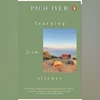
Home / Book / Learning from Silence: Pico Iyer's book explores meaning of suffering, joy
Learning from Silence: Pico Iyer's book explores meaning of suffering, joy
Delicately written, with a rhythm and lyricism that resembles many of Mr Cohen's songs, Learning from Silence is about living a full, robust life with eyes wide open and all senses ablaze
The beauty of words lies not in the meaning that they convey to things around and emotions within, but in their capacity to lift human consciousness into moments of such luminous clarity that the ordinary appears sublime. Songs by Leonard Cohen bear that dexterity and so does this book by Pico Iyer.
Delicately written, with a rhythm and lyricism that resembles many of Mr Cohen’s songs, Learning from Silence is about living a full, robust life with eyes wide open and all senses ablaze. It is about the companionships that give us strength and resolve; it is about love that glues up the cracks and mends the broken, and about the kindness of human beings that often goes unnoticed.
The world that Mr Iyer draws his readers into, is both personal and universal. His friendships reveal as much about him as do the cataclysmic events that circle his life. Everything leads him to question the meaning of existence, of power and sacrifice. The book helps understand the meaning of suffering and joy and how the two are not as different as we may think them to be. He writes, “Fire illuminates a life quite brilliantly, but in that very blaze it threatens to bring down everything in its path.”
The book takes readers into the selfless work of caregivers, of the body and the soul— all those who are moved to help another in need including monks, nuns and priests—and the inexhaustible happiness that this brings. The joy comes from the tiny acts of love and change that they can bring. In one instance, Mr Iyer writes about a conversation with the Dalai Lama. What is his biggest achievement? Not the Nobel Prize, says the Tibetan who has lived his entire life in exile, but the difference he thought he made when he could impart hope to a “dispossessed soul” he met in Soweto, Johannesburg.
Born out of more than a hundred retreats: To a small Benedictine hermitage (as the blurb tells us), the book steps into the numerous lives that encircle the author’s existence — the wildfires of California that give the lie to permanence in the world, the home in Japan where his daily life draws upon his time at the hermitage, and his work that takes him to the most exotic destinations and puts him in a room with extremely interesting people.
All of this, the different parts of his life, come together in the silences that he craves and cherishes. It is, as he writes, “I am thrilled, in the wide-awake silence, to sense that all the scattered filaments inside of me come together in a singing whole.” The book is a record, not only of such moments of epiphany but also the doubts that dog his journeys.
What is he, a man who has never been religious, doing with monks and nuns? Or as a friend wonders: What makes him, he who has seemed so happy with his life, retreat from it? The questions that run like a parallel trail through the book help readers draw deeper into the meaning of silence, and its absence.
Learning from Silence reads like a book that has been in the making for a very long time. It carries the confidence of a writer who has revisited the words innumerable times to see if they measure up to the feelings and emotions that he seeks to convey. He is careful to not let his experiences overshadow the meaning he has found in them and vice versa. There are no glib answers here, he seems to be telling the reader. When a friend asks if he believes in God (given the time spent in monasteries), he says that it doesn’t matter. Belief and faith can be peeled differently by different people—it does not bear the prescriptive burden of religion. Composed in five short chapters, the book is somewhat like a rolled-up scroll. It unwinds in slow, circuitous whorls and it is bursting with colours, symbols and fragrances. It revolves around silence, not as an escape from the world but more like an elixir that helps us draw infinite pleasure from the act of living.
Silence, in Mr Iyer’s way of life, is a way to tune oneself to all the noise around us and still hear ourselves with sanity and clarity and it could, at times, be noisier than a family of woodpeckers marking their territories on the hollows of the trees.
The reviewer is a journalist and co-founder of The Mythology Project, a centre for the study of mythology, legends, and folklore