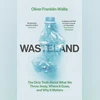
WASTELAND: The Dirty Truth about What We Throw Away, Where it Goes, and Why it Matters
Author: Oliver Franklin-Wallis
Publisher: Simon & Schuster
Pages: 392
Price: Rs 799
The apocalyptic title of Oliver Franklin-Wallis’ book is a clever play on T S Eliot’s epic poem “The Waste Land”, a dystopian view of humanity after World War I. The big message here is no less unsettling, and the author underlines the issue with the subtitle ,“The Dirty Truth about What We Throw Away, Where it Goes, and Why it Matters”.
Most of us try not to think about garbage, though it’s in your face in any Indian city. But the first chapter of this book suggests we should be: The prospect of being inundated by garbage or contracting some ghastly disease from the indirect consumption of toxic chemicals leaching into the ground is real. From the disposal of household waste to treating industrial waste and the disposal of nuclear waste (the supposed “clean fuel”), Mr Franklin-Wallis’s book traces waste in all its grim infinite varieties.
This fluently written narrative is not just a wake-up call about garbage; it points to the deleterious consequences of the throwaway consumerism of modern society predicated on the planned obsolescence of consumer goods industries. No country has a handle on how to deal with the consequences of business models that are predicated on growing consumption. Worse, waste is becoming a global crisis.
“Human beings have always produced waste but never before on such a scale,” he writes in his introduction titled “The Tipping Point”. “Worldwide, we produced 2.01 billion tonnes of solid waste in 2016, the last year for which reliable data is available. In the UK, the average person generates 1.1 kg of waste every day; in the US, the world’s most wasteful nation, the number is an astonishing 2 kg a day.”
Waste being a corollary of wealth, the developing world is catching up. “The richer you are, the more wasteful you are, and so as the developing world grows richer, the problem is accelerating. It is forecast that by 2050, we will be producing a further 1.3 billion tonnes a year, much of that in the Global South,” Mr Franklin-Wallis writes.
The big paradox here is that almost 30 per cent of the world’s population currently live without access to solid waste collection, so waste is simply dumped or burnt (never mind the dangerous chemicals this process releases) or ends up in our rivers and seas (and, in India at least, in our jungles, waterfalls and mountainsides) where it joins toxic outflows from sewers, factories and power stations. As a result, the author points out, “many of the world’s great rivers, from the Mekong to the Ganges, are increasingly hostile to living things.” The second is the rapidly expanding waste recycling industry, “a global industry determined to extract the last penny of value from what remains.”
That’s created the societal problems of “waste mafias”, who flourish in this unregulated industry in Asia, Africa and South America, and its adjunct, “toxic colonialism”, which encourages the West to send its garbage to poorer countries for disposal, India being one among several major ports of call. China was once the destination for 85 per cent of Europe and America’s plastic waste until Beijing passed Operation National Sword in 2018 banning “illegal foreign garbage”. The immediate fallout of this was a surge of plastic waste to southeast Asia.
The author, who has written for most of the marque names of global journalism, gets plenty of dirt under his fingernails to tell his story — visiting stinky landfills, factories, recycling plants, nuclear waste recovery facilities and composting units to dig out the environmental and socio-economic consequences of how waste creation is overwhelming solutions for its management.
He climbs halfway up the waste mountain of the Ghazipur landfill to interview those who make a living from it and learns the lingo for different kinds of waste (“natural”, “BP”, “milk” for various grades of plastic, for instance). He records how a nearby energy-from-waste plant has been defunct for some years. He walks along the Yamuna, foaming with factory waste upstream, to discover why it’s called a “dead river”, and talks to a Muslim diver whom Hindus pay to swim out mid-river to dispose of their dead relative’s ashes (no surprise, he’s drunk most of the time). Every year, the river’s excessive toxicity causes fish to die. The divers then sell the dead fish (catfish and tilapia) to local markets at discounted rates. You would only know when you have eaten it, his informant tells him, because the polluted water dulls the taste. “A person who knows the taste would know there is something wrong.” (Urgent note to self: Do not order fish at a restaurant in the national capital region.)
He visits landfills in the UK and recycling plants to demonstrate that, in fact, this is far from being a zero-sum game. For one, there are grades of commonly used plastics that can’t be recycled. For another, the prospect of recycling actually acts as a spur for consumption. Third, most conglomerates recycle far less than they claim — he records in detail how Coke has never met recycling targets. He strolls through a second-hand garments market in Ghana, where the cast-offs from the rapidly growing “fast-fashion” industry found a market once vibrant but now facing a serious glut.
One of the key points the writer makes is that the waste produced from manufacturing dwarfs the waste that end-consumers create. He suggests that countries should be measured on Gross National Trash, a term coined by the writer Joel Makower to measure the waste built into everything we buy. But increasing outsourcing of “dirty industries” such as chemicals, refining and metals, to job-hungry developing countries, could make GNT a misleading metric. Much better we relearn the virtues of moderation and reuse, just like our forefathers.