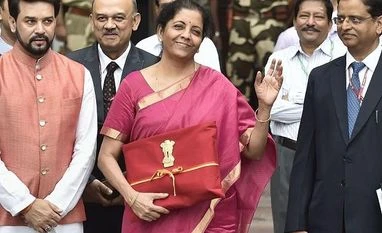
Finance Minister Nirmala Sitharaman, presenting her first Budget, found novel ways of raising resources while also seeking to restore confidence in the financial sector and deepening the equity and bond markets. A major thrust of the Budget was simplifying the payment of both direct and indirect taxes, as well as support for small and medium enterprises and start-ups. Capital expenditure was crunched to help meet fiscal consolidation targets.
The fiscal deficit target for the ongoing fiscal year has been lowered to 3.3 per cent of gross domestic product (GDP), lower than the Interim Budget’s 3.4 per cent. In spite of disappointing indirect tax revenue, this was achieved through raising the targeted nominal GDP growth from 11.5 per cent to 12 per cent, as well as higher excise on fuel, which would raise an additional Rs 40,000 crore. More money would also come in from disinvestment, dividends from the Reserve Bank of India, and spectrum auctions.
The financial sector was a reform focus. Troubled non-banking financial companies were thrown a lifeline: The FM said that tax benefits provided to banks with respect to NPAs would be extended to NBFCs, and that a partial credit guarantee would be provided to public sector banks for their purchases of securitised NBFC assets. The RBI’s regulatory authority over NBFCs would be strengthened — and it would also once again become the regulator of the housing finance sector. Bank recapitalisation was higher than expected, at Rs 70,000 crore.
There was, however, bad news for the highest bracket of taxpayers: Sitharaman said that the effective tax rates for those with a taxable income above Rs 2 crore would increase by 3 per cent and, above Rs 5 crore, by 7 per cent.
MSMEs were not forgotten — GST registered MSMEs were promised a two percentage point interest Subvention on fresh or incremental borrowing, although only Rs 350 crore was set aside for this scheme. Start-ups burdened by the “angel tax” were promised minimised scrutiny, and additional measures to allow them to raise money more simply were proposed.
In what will increase petrol and diesel prices in the country, the Budget has proposed an additional excise duty and road and infrastructure cess of Rs 2 on every litre of petrol and diesel sold in the country.
On the external front and the openness of the Indian economy, there was good and bad news. The FM promised that onerous local sourcing conditions for single-brand retail would be relaxed. Meanwhile foreign direct investment in insurance and aviation sectors might be opened up. Some constraints on foreign portfolio investment in individual companies were also eased.

 "Budget 2019: Fiscally correct, but familiar tax targets")












 Connect with us on WhatsApp