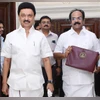
The DMK-led Tamil Nadu government on Friday tabled the state Budget for 2025-26 (FY26), targeting a narrower fiscal deficit of 3 per cent of state GDP in the upcoming financial year despite increased allocations for welfare schemes, a 22 per cent jump in capex and outlays for industrial parks for semiconductors and non-leather footwear.
The last Budget of the ruling DMK before it faces state polls next year comes amid language row and the state’s decision to replace the rupee symbol from the budget logo with the Tamil letter of ‘Ru’.
While tabling it, Finance Minister (FM) Thangam Thennarasu said that his government sticks to its two-language policy despite the challenging situation. He also announced a language museum in Madurai to educate people on Tamil’s rich linguistic heritage.
While sticking to the fiscal glide path, the Budget pegged the fiscal deficit for 2025-26 at ₹1.069 trillion, equivalent to 3 per cent of the Gross State Domestic Product (GSDP).
This is against an expected ₹1.016 trillion or 3.26 per cent in the revised Budget Estimates for 2024-25. This is a dip of ₹6,992 crore against the Budget Estimate of ₹1.086 trillion or 3.44 per cent of GSDP.
FM Thennarasu said that the state’s revenue for 2025-26 is estimated at ₹3.31 trillion, while expenditure is estimated at ₹3.73 trillion, keeping the revenue deficit down to ₹41,635 crore next year.
The state is estimating the revenue deficit at ₹46,467 crore based on the Revised Estimate for 2024-25, compared to ₹49,729 crore in the Budget Estimate, a feat which FM attributed to prudent fiscal management.
The government’s revenue from its own taxes is estimated to increase by 14.6 per cent in 2025-26. In an effort to provide impetus to economic growth through spending on capital works, the capital expenditure in 2025-26 is projected at ₹57,231 crore, which is an increase of 22.4 per cent over 2024-25 (RE).
The state’s outstanding debt for the next financial year is estimated to be 26.07 per cent of the GSDP or ₹9.29 trillion.
The budget includes increased allocations for flagship welfare schemes, incentives for gig workers, a plan for a new airport in Rameswaram, and plans to develop industrial parks for semiconductors and non-leather footwear. Additionally, the government has floated the idea of transforming Hosur into a new hub for Global Capability Centres (GCCs).
The finance minister said that a 2,000-acre global city will be developed near Chennai, which will include schools, colleges, private enterprises, and other infrastructure.
He also announced a new airport in Rameswaram to improve connectivity to South Tamil Nadu. Land acquisition has been completed for the expansion of Chennai, Coimbatore, Madurai, Tiruchirappalli, and Thoothukudi airports with an investment of ₹2,938 crore, he said.
The government will soon launch a program to extend ₹20,000 to gig workers to buy e-scooters and will introduce an insurance scheme for 150,000 gig workers to cover accidental death and disability. The state plans to set up lounges for workers in large cities like Chennai.
As part of the Semiconductor Mission 2030, the state will establish semiconductor parks in Coimbatore (Sulur and Palladam, 100 acres each). Plans were also unveiled to develop Hosur into a new hub for GCCs, research and development, and information technology.
“Over the past four years, leading global non-leather footwear manufacturers have set up factories in Villupuram, Ranipet, Vellore, Kallakurichi, Karur, Perambalur, and Ariyalur. These factories have provided employment to over 100,000 people, with 80 per cent of the workforce being women from rural areas,” the finance minister said.
To further boost this industry, two footwear industrial parks will be established in Cuddalore and Melur with an investment of ₹250 crore, creating 10,000 jobs. Additionally, a Footwear Skill Training Centre will be set up by SIPCOT in Kallakurichi district, he said.
The FM also claimed that the Central government has withheld the Samagra Shiksha Abhiyan funds of over ₹2,000 crore, citing the three-language policy in the National Education Policy (NEP). The state government has allocated its own funds to the scheme.


 "TN Budget: Fiscal deficit at 3% of GSDP in FY26; Hosur to be new GCC hub")

