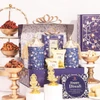
With Diwali around the corner, India Inc is going all out with gifts for employees, clients, and partners. From sweet offerings such as biscoff Mathura peda or medjoul dates to utilitarian choices like handcrafted brass articles or multipurpose travel kits, this year’s hampers are unconventional, bespoke and sustainable.
“Companies are now approaching gifting with the same rigour, scale and strategic thinking as any other critical procurement decision,” says Mitranjan Bhaduri, director at Amazon Business, adding that the platform has seen a 60 per cent year-on-year rise in corporate gifting demand after expanding into customised and assembled gift sets.
Delhi-based premium sweets brand Khoya Mithai is projecting a 30-35 per cent rise in its business-to-business sales. “There is a noticeable uptick in demand for unique offerings like white chocolate aam papad barfi and rose-and-chocolate katli. In hampers, these are usually paired with aesthetically pleasing items such as artisanal platters or décor pieces like hourglasses,” says Sid Mathur, founder of Khoya Mithai.
Highlighting customisation and premiumisation as the key trends this season, Avi Kumar, chief marketing officer at FNP, says: “Companies are opting for tailored hampers featuring gourmet delights, elegant floral arrangements, sustainable plant-based gifts, wellness kits, tech accessories, and digital vouchers.” Hampers with five unique flavours of the same traditional sweet, and wellness kits paired with plants, are among the many orders the gifting platform has received this year so far.
Echoing the wellness trend, Nitika Seth, founder of Embrace Gifting Solutions, says there is a clear shift towards responsible gifting. “Healthier options like millet mathis and date sweets are seeing a major uptick.”
At online gifting platform IGP, the average hamper this year is priced around ₹1,500, with premium ones exceeding ₹10,000. “For long-standing clients, we recently executed an order for 8,000 hampers with 150 grams each of six varieties of dry fruits packed in customised suitcases. Another order had boxes made of fur and suede,” says Tarun Joshi, founder and CEO of IGP. Premium tea maker Vahdam, too, expects a double digit growth in its corporate gifting business."We have also launched matcha gifting sets this year," said Bala Sarda, founder and CEO, Vahdam.
Focusing on thoughtful gifting, 3D printing company WOL3D is offering an exclusive range of 3D-printed idols, including the ones of Lord Shiva. These intricately designed idols not only celebrate India’s cultural heritage but also reflect amodern and sustainable approach to gifting,” says Rahul Chandalia, Director, WOL3D.
Breaking away from the trend of classic sweets and hampers, crypto exchange firm CoinDCX has planned travel kits including a trolley bag, neck pillow, tech organiser, and travel tag for its employees. “All of this is designed with a fun, crypto-inspired twist and symbolises exploration and new beginnings,” says Mridul Gupta, founder-partner at CoinDCX. The firm also plans to evoke nostalgia with a Diwali mela featuring magic and puppet shows.
Gurugram-headquartered premium handbag brand Miraggio has scheduled a leave period in addition to thoughtfully curated hampers. “From October 19 to 26, employees will be given time to spend with their family and loved ones,” says Mohit Jain, founder and CEO of Miraggio.
At fashion-accessory major Titan Company, gifting is not just an exchange of items. “We aim to blend sustainability with wellness, ensuring that our gifts are meaningful, responsible and resonate with everyone who partners with us,” says Swadesh Behra, chief people officer of Titan Company.
Thinking out of the ‘box’
India Inc’s gifting choices increasingly go beyond the hamper, making a statement about company ethics, strategy -- and sometimes even finances. “Poorly chosen gifts can give off the message that the company does not care about its employees,” says Surat-based image consultant Anita Singh.
IGP’s Joshi says companies often collaborate with curators months in advance. “The average order value by corporates is witnessing an annual increase of 10-15 per cent,” he adds.
Sameer Seth, founder and CEO of Hunger Inc Hospitality, which operates The Bombay Sweet Shop, says that while gifting budgets have risen this year, the real shift lies in how companies are allocating them. “There is a clear movement towards quality, curation, and experience over volume,” he says.
According to Embrace Gifting’s Nitika Seth, companies are also moving towards subtle design. “Earlier, there used to be big logos and names, which reduced the utility of the items. Now, they’re opting for smaller patterns, colour-coding, and more refined aesthetics.”
Vendors say gifting budgets are determined by multiple factors. “For clients and associates in sectors like real estate, IT, and logistics, the budget can go up to ₹10,000,” says Mathur of Khoya Mithai. FNP’s Kumar adds that, on average, companies are spending between ₹1,000 and ₹2,000 per gift, with that trajectory rising each year. “For large-scale companies with a huge client base, the gifting budget may go into crores.”
While companies pick more customised options for clients and partners, the employee gifting category tends to feature relatively uniform selections. “Packs for employees are more inclusive, aiming to turn gifting into a shared experience rather than an individual gesture,” says Seth from The Bombay Sweet Shop.
“For employees, there’s usually something that makes them feel appreciated and valued on a daily basis. The clients’ gifts are the ones with stronger visual memory,” says Singh.


 "Sweet, sleek, sustainable: India Inc's Diwali gifts get thoughtful")

