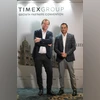
From aggressively doubling down on their development in India to diversifying the brand with launches like Guess Jewellery, Timex is charting a clear and ambitious path forward. Tobias Reiss-Schmidt, president and CEO of Timex Group, and Deepak Chhabra, managing director of Timex Group India Limited (TGIL), told Aneeka Chatterjee in a face-to-face interview that the company’s aspiration is to become one of the leading global watch players in India. Edited excerpts:
How do you envision the company's growth and strategy evolving in the India market?
Tobias: We are committed to doubling down on our development in India and significantly increasing our focus and investment in this market, given the incredible growth opportunities we are seeing. GUESS and Versace have shown impressive performance, and newer brands like Philipp Plein have doubled in growth over the past year. Across the board, our brand portfolio is developing very well.
What is your strategy to expand your market share in India further?
Tobias: Our overall business is growing by over 50 per cent, and our flagship brand, Timex, is growing even faster, significantly outpacing the market, which is growing at around 10 to 15 per cent. We are seeing strong momentum across our brand portfolio, but our top priority is always our largest and most important brand-Timex. We are expanding our assortment and broadening architecture, introducing more styles priced above ₹10,000. What also sets Timex apart is its wide distribution network, especially in Tier-II, III and IV cities. We are also committed to serving the growing middle class, offering strong value with styles in the ₹3,000 - ₹4,000 range. Growth is visible across all price segments.
What revenue goals have you set for FY26, and what factors will drive that growth?
Deepak: In the last financial year, our revenue grew by 28 per cent, and earnings before interest, taxes, depreciation, and amortisation (Ebitda) increased way higher by 55 per cent. I see no reason why we cannot sustain similar growth in both our top line and bottom line over the next three to five years.
Our aspiration is to first become the second-largest international watch company operating in India. Titan, for example, is already considered a global company and has achieved a great deal, backed by the credibility and strength of the Tata Group.
How do you plan to allocate investments in India during the upcoming quarters in FY26?
Tobias: As our business continues to grow at a strong pace, we are committed to increasing our marketing investments in India to support that momentum. Since we manufacture in India, we are also expanding our production capacity. Beyond that, we are developing India as a key sourcing hub for our global product lines.
Can we expect any strategic acquisitions or partnerships as part of your growth roadmap?
Tobias: We are actively expanding our brand portfolio and are excited to be launching Aston Martin in India. In addition to new launches, we are also exploring acquisition opportunities to further strengthen and diversify our portfolio.
What strategies do you have in place to recover the operating cash flow, which saw a record decline in Q1FY26, over the coming quarters?
Deepak: The primary reason was a shortage of capital. Coming out of COVID, and even over the last 8 to 10 years, our business was gradually improving, but our cost structure remained high. As a result, the cash flow did not translate into Ebitda, and those gaps had to be funded. To cover those losses, we had to rely on our available credit limits. Inventory was not a major concern but the real issue was that business growth was not keeping pace with our cost structure, which was quite heavy.
What is your strategy to scale up the GUESS jewellery business in India?
Tobias: The type of jewellery Guess is offering falls under costume jewellery, which is increasingly resonating with the younger generation. Traditionally in India, the focus has been on precious metal jewelry, especially gold. However, with Guess watches having a strong distribution here, we see an opportunity to collaborate with our watch dealers and merchandise jewellery. This approach can elevate the overall brand experience and create a compelling in-store presentation that captures attention followed by expanding into online sales.
Do you see a shift in how younger consumers are engaging with analogue and smartwatches, especially in the premium and luxury categories?
Tobias: I would not say we are seeing a major shift, but what is clear is that interest in traditional watches among younger consumers is growing. The common perception that younger people only want smartwatches is not accurate. With Timex, we are leaning into the vintage trend by reissuing classic models, which resonates with today’s youth.