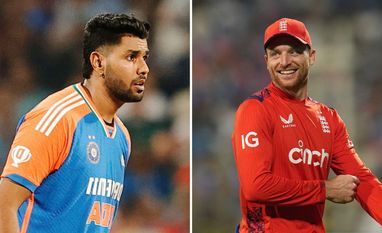
India's decision to use a concussion substitute during the fourth T20 International against England at MCA Stadium in Pune has ignited a fierce debate, with England captain Jos Buttler and former cricketer Kevin Pietersen criticising the move. The controversial choice saw India submit
Harshit Rana's name as the concussion replacement to match referee Javagal Srinath after Shivam Dube suffered a blow to the helmet on the penultimate delivery of India's innings.
While
Buttler didn't mince his words while speaking about India's concussion substitute, Pieterson was also categorically said Rana coming in for Dube was not at all a like-to-like replacement.
As the controversy spills into the cricketing world, lets take a look on when and why International cricket council (ICC) introduced the rule in cricket.
Raising Eyebrows Over Substitution
Both Buttler and Pietersen were unequivocal in their criticism, asserting that the inclusion of Rana as a replacement for Dube did not represent a like-for-like substitution. Their comments have added fuel to the ongoing controversy that continues to reverberate within the cricketing community.
Tracing the Concussion Substitute Rule
To understand the context behind the debate, it is essential to revisit when and why the International Cricket Council (ICC) introduced the concussion substitute rule. The rule was established to safeguard players suffering from head or neck injuries, ensuring that a match can proceed with a like-for-like replacement without providing an undue advantage.
When concussion substitute rule was introduced in cricket?
The ICC implemented this regulation across all international formats – including Twenty20 and first-class cricket – on 1 August 2019.
What is a concussion?
A concussion is a form of mild traumatic brain injury that occurs when a sudden impact causes the brain to move inside the skull. Though many recover without long-term effects, proper rest and medical clearance are vital, as returning prematurely may lead to further injury. Notably, a concussion does not always result in loss of consciousness, making immediate evaluation essential.
What is the concussion substitution in cricket rule?
Under the concussion substitute rule in cricket, if a player is suspected of having sustained a concussion during active play, a replacement may be authorised under strict conditions. The injury must occur on the field, and the decision to request a substitute is based on a formal diagnosis by the team’s medical representative. The team’s medical staff or manager must then submit a Concussion Replacement Request to the ICC Match Referee, detailing the incident, the medical assessment, and the proposed like-for-like replacement.
The request must be made as soon as possible after the incident, with the ICC Match Referee responsible for approving the replacement. This process is designed to ensure that no unfair advantage is created for the team benefiting from the substitution.
Check Champions Trophy 2025 full schedule here Why ICC came up with the concussion substitute rule?
The introduction of concussion substitutes was part of the ICC’s broader efforts to balance the game between bat and ball. With regulations allowing bowlers to use two bouncers in an over, the ICC sought to protect players’ welfare by introducing a rule that has its roots in the tragic demise of Australian cricketer Phillip Hughes, who was fatally injured when struck on the neck by a bouncer during a Sheriff Shield match. ICC rule on concussion substitute in cricket? Clause 1.2.7.4 of the ICC's T20I Playing Conditions stipulates that when determining if a nominated concussion replacement qualifies as a like-for-like player, the ICC Match Referee must evaluate the role the concussed player would have fulfilled for the remainder of the match, alongside the typical role performed by the nominated replacement. So how India used a loophole for their own advantage? WIth Shivam Dube being a designated all-rounder for India, he was expected to bowl in the second innings of India vs England 4th T20 International. However, after getting concussed, India was eligible to ask for a concussion substitute and it submitted the name of Harshit Rana who can bowl but certainly not a like-for-like replacement. But the match referee Javagal Srinath has followed the rule as it said in assessing whether the nominated Concussion Replacement should be considered a like-for-like player, the ICC Match Referee should consider the likely role the concussed player would have played during the remainder of the match. So a caveat in the ICC rule came for advantage to India. Previously India used a Yuzvendra Chahal as concussion substitute for Ravindra Jadeja, who was concussed while batting during a T20 International against Australia.
What is Like-for-like concussion substitute in cricket?
A key element of the rule is that the substitute must be comparable to the injured player in terms of role and skillset. The match referee assesses the likely contribution of the concussed player had they continued playing against the normal role of the proposed replacement. If the referee determines that the replacement might offer an unfair advantage, restrictions may be imposed. For example, if the original player was restricted from bowling at the time of injury, the substitute would also be barred from bowling.
Once the substitute is approved, the original player and the replacement are both recorded as having participated in the match for statistical purposes. The match referee's decision regarding concussion replacements is final and not subject to appeal.
List of players debuted in International Cricket as concussion sub player
- Brian Mudzinganyama (Test, Zimbabwe, 2020)
- Neil Rock (ODI, Ireland, 2022)
- Matt Parkinson (Test, England, 2022)
- Kamran Ghulam (ODI, Pakistan, 2023)
- Bahir Shah (Test, Afghanistan, 2023)
- Harshit Rana (T20I, India, 2025)

 "What is ICC concussion substitute rule? A loophole in the rule explained")


