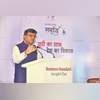
Uttar Pradesh’s (UP’s) revenue from excise has risen to nearly 4x what it was eight and a half years ago under the Yogi Adityanath government — from a little over ₹14,000 crore in 2016–17 to ₹52,573 crore in 2024-25 — and is on track to reach almost ₹63,000 crore by the end of the current financial year (2025-26), Minister of State (Independent Charge) for Excise and Prohibition Nitin Agrawal said on Wednesday.
Delivering the inaugural address at the Business Standard Samriddhi event in Lucknow, Agrawal credited the department’s revenue surge to improvements in UP’s law and order. He said the excise department has plugged loopholes, ensured transparency and accountability, and lined up its functioning with the chief minister’s (CM’s) target of making UP a $1 trillion economy.
Agrawal said UP is now the country’s leading producer of molasses and ethanol. The state government, he said, has cracked down hard on illicit liquor. “Not one life has been lost in UP — a state of over 240 million — since 2017 because of illicit liquor,” he said, adding that bootlegging from neighbouring states has also been curbed and the liquor industry has grown 13–14 per cent annually due to industry-friendly policies.
He credited CM Adityanath’s approach with transforming UP from “the country’s crime capital” into a growth engine. “I believe it is a massive transformation. It was not easy. When this government assumed power in 2017, we faced serious challenges. Gross state domestic product (GSDP) growth was sluggish, and crime was rampant. The picture has changed hugely since then,” he said.
According to Agrawal, the government has strengthened policing and created basic infrastructure since 2017. UP now has the country’s largest expressway network, along with better inland water and air connectivity. The state has eight airports, including two international airports, and Prime Minister (PM) Narendra Modi will soon inaugurate the third, he said. Once law and order and basic infrastructure are in place, he added, industry gains the confidence to invest.
In 2017, the state’s GSDP was ₹13.3 trillion. It has since increased to ₹30 trillion, with a target of ₹35 trillion by the end of this financial year, Agrawal, 44, said. The manufacturing sector has contributed ₹2.81 trillion to gross value addition — more than 2.5x the 2017 level.
He said the challenge for UP’s exports is its landlocked geography, but exports have nonetheless risen from ₹84,000 crore in 2017 to ₹1.86 trillion. Unemployment, he said, has fallen from 6.4 per cent to 2.4 per cent over the same period. “We have created 800,000 jobs in the government sector and 9 million in the private sector,” Agrawal said. As a result, per capita income has doubled from ₹54,500 in 2017 to ₹1.08 lakh in 2025.
The number of industries, including small and medium enterprises, has increased from 13,000 in 2015-17 to 27,295, he said. Investor summits have generated proposals worth ₹45 trillion, of which projects worth ₹15 trillion have reached the groundbreaking stage.
“We are now No. 2 in the country in the ease of doing business rankings and the second-fastest growing economy in GSDP after Maharashtra,” the minister said, crediting governance reforms, stricter accountability, and leadership vision. He said agriculture and services have also recorded growth alongside industry.
Agrawal said the target of making UP a developed state by 2047 will require accelerating manufacturing, attracting high-value industries — such as electronics, semiconductor, and automotive — and creating infrastructure for industrial clusters in these sectors.
A mega textile hub planned between Hardoi and Lucknow, for which the PM will soon lay the foundation stone, is one such initiative. The government also aims to develop leather and footwear hubs. Labour-intensive industries will be crucial for job creation, he said, as will supporting traditional crafts such as handloom, brassware, and pottery.