The work to overhaul India’s rural employment scheme was taken up over a year ago to fix a host of issues including “mismanagement and leakages” and states will be given six months to transition from MGNREGA to VB-G RAM G, Union rural minister Shivraj Singh Chouhan said on Tuesday.
“We had taken several measures to remove irregularities in MGNREGA but despite that several things were coming to our notice. Also when we wanted to increase the number of guaranteed workdays from 100 to 125 we worried about what role such a large expenditure could play in building developed villages,” Chauhan told a group of reporters, adding that the Centre plans to roll out the new scheme from April 1, 2026 across India.
He tabled the Viksit Bharat-Guarantee for Rozgar and Aajeevika Mission (GRAMIN) Bill, 2025 (VB- G RaM G) in Lok Sabha on Tuesday.
While addressing the concerns surrounding the states’ increased expenditure under the new regimen, Chouhan said that it won’t be a burden on the states as their revenue collections have been rising due to higher goods and services tax (GST) collections and they too will become participants in developing rural India.
The funding pattern under the proposed VB-G RaM G scheme has been tweaked to 60:40 from the current 90:10 under the Mahatma Gandhi National Rural Employment Guarantee (MGNREGA).
“Also, it must be remembered that the Centre too is sharing a higher burden from ₹86,000 crore to almost ₹96,000 crore now,” Chouhan said.
He said that the Centre was spending a considerable sum of funds for MGNREGA, which was almost ₹86,000 crore in the financial year 2025 (FY-25), but it was not helping in developing villages in tune with the idea of a developed India by 2047, which also prompted it to go for the overhaul.
The Union minister said that in the new scheme, the Centre will be sharing a higher proportion of the total budget estimate of around ₹151,000 crore, which is around ₹96,000 crore from the financial year 2026-27 as against the existing ₹86,000 crore.
“All these estimates are based on full demand from across the country for 125 days of work starting from next financial year,” Chouhan said.
Also, administrative expenditure on the scheme has been raised from 6 per cent to 9 per cent which will help in digitisation and more.
He later introduced the Bill in the Parliament amid strong objections by the opposition to the “removal” of Mahatma Gandhi’s name from it.
Replying to this, Chouhan said that the government not only believes in Mahatma Gandhi but also follows his principles.
“If changing name was akin to insulting the legacy of Mahatma Gandhi, then Congress insulted the legacy of Pandit Jawaharlal Nehru when they changed the name of Jawahar Rozgar Yojana to MGNREGA,” Chouhan said.
“The (Narendra) Modi govt has done more for rural development than previous governments,” he said.
Opposition members pressed for sending the Bill to a parliamentary panel for greater scrutiny.
Chouhan, meanwhile, told reporters that the endeavour of the government will be to get the Bill passed in the current session of Parliament so that states have adequate time for transition from the old scheme to the new.
He said the basic objective of the new scheme will be to develop poverty-free, modern, developed villages with adequate employment opportunities.
On how will the expanding of guaranteed workdays from 100 to 125 days help in generating more employment opportunities in villages when traditionally the average number of workdays has hardly crossed 50-55 days so far under MGNREGA, Chouhan said that there are around 4 million households, and roughly 20 million individuals who work for 100 days in a year at present.
“This means that these 4 million families will immediately get the benefit of an extra number of work days. Plus, when people know that more workdays are guaranteed, I’m sure the worker participation will increase,” Chouhan said.
He said that the new scheme, G RAM G, will ensure that funds from the Central government are uniformly distributed among all panchayats as they would grade A, B and C based on their performance and spending capacities.
“It was noticed that many times, panchayats which had a large tribal population got left out from MGNREGA while those closer to big cities benefited more. All this will now stop in the new scheme,” Chouhan said.
In a statement, the Rural Development Ministry said the proposed legislation will establish a modern statutory framework aligned with the goal of ‘Viksit Bharat 2047’.
It said the Bill aims to create both employment and durable rural infrastructure through four priority verticals -- water security through water-related works, core rural infrastructure, livelihood-related infrastructure, and special works to mitigate extreme weather events.
All assets created are aggregated into the Viksit Bharat National Rural Infrastructure Stack, ensuring a unified, coordinated national development strategy, the statement said.
On normative allocation to each state by the Centre, Chouhan said criteria for such funding will be determined in consultation with NITI Aayog and states.
The minister also said separate employment cards will be made for ‘divyangs’, old and infirm workers and also SC and STs to ensure that benefits of the new scheme percolates down to the poorest of the poor.

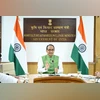 "Centre planned to modify MGNREGA over repeated complaints: Shivraj Chouhan")


